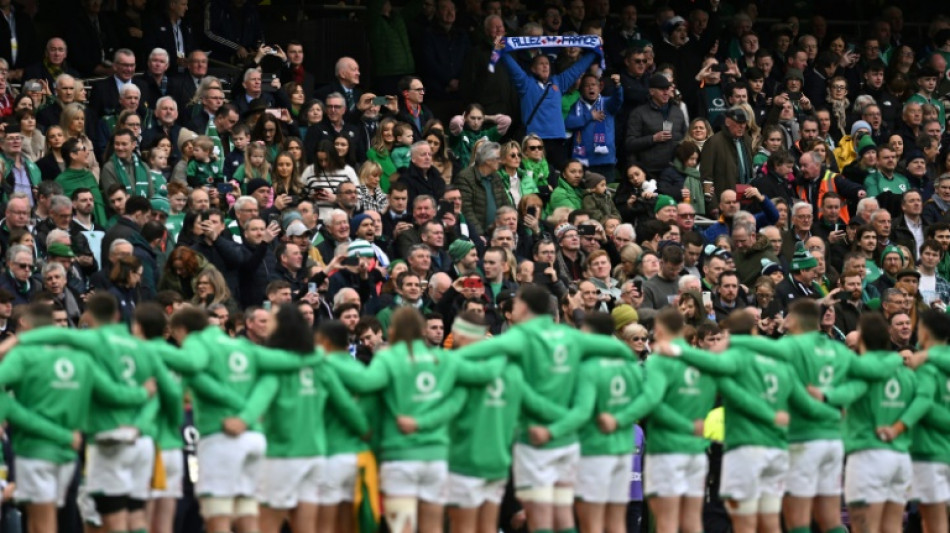
Northern Irish rugby players find their voice with 'Ireland's Call' / Photo: Paul ELLIS - AFP

The rugby anthem "Ireland's Call" has divided opinion among supporters but former international players Hugo MacNeill and Trevor Ringland say it has served a greater purpose by giving a voice to the Northern Irish players in the team.
"Ireland's Call", composed by the Grammy-nominated Northern Irish composer Phil Coulter, had its first outing at the 1995 World Cup.
Due to the sectarian divide in Ulster -- brought to a violent head by the Troubles which lasted almost three decades from the late 1960s to 1998 -- and Northern Ireland being part of the United Kingdom, it made it impossible for the Northern Irish players to sing the Irish national anthem.
They would stand tight-lipped alongside their team-mates as the players from the south sang the anthem "Amhran na bhFiann" (The Soldier's Song).
Both that and "Ireland's Call" will be sung on Saturday when Ireland, bidding for the Grand Slam, host England in Dublin. When the team plays abroad, only "Ireland's Call" is played.
Dublin-born full-back MacNeill -- like Ringland a member of the Ireland team that won the 1982 and 1985 Triple Crowns -- took an interest in the problems in the North during his playing days, discussing it with his team-mates from over the border.
He says "Ireland's Call" was a logical step forward.
"It was absolutely necessary," he told AFP.
"When I was playing for Ireland before we went onto the pitch our captain Ciaran Fitzgerald would send groups of players into the corners.
"Thus as fullback I would be with the wings Keith Crossan and Trevor Ringland in one corner.
"Then we would go out onto the pitch five minutes later knowing we depended on each other - and neither Keith nor Trevor could sing the national anthem."
MacNeill, 64, says "Ireland's Call" fulfils two of the key goals of the 1998 Good Friday Agreement -- tolerance and reconciliation.
"Some people like the tune, some do not," he said.
"It definitely gives people the option to sing an anthem if you are serious about reconciliation and tolerance.
"Without being too heavy-handed, if you give out about 'Ireland's Call', wait till you get onto the really hard stuff.
"It shows a lack of respect."
- 'Pressed the button' -
MacNeill, along with Crossan and Ringland, were involved in an incident that brought the Troubles close to home for the squad when they were on their way to training in April 1987.
They, along with team-mates David Irwin, Nigel Carr and Philip Rainey were travelling in two cars from Northern Ireland, but that trio never arrived.
They were caught in an Irish Republican Army bomb -- the target, a judge called Maurice Gibson and his wife were killed. The injuries Carr suffered were serious enough to end his career.
Ringland -- whose father was a policeman in Northern Ireland -- said there was never a question of the Northern Irish players withdrawing from the squad due to the bombing.
"How did we play for the Irish team after that? It was due to the friendships we had amongst the team and support that they gave us," Ringland told AFP.
"Along with a sense of inclusion, of Irishmen who could accommodate us as British and just as we could be comfortable with them being Irish.
"That is why we could go on to play. That friendship, the drive to include overcame the bitterness and hatred that could so easily have come out of that.
"That is what the extremes of both sides wanted is drive people apart then it is easier to hate people if you do not know them."
One consequence of the bomb was the decision to drop "The Soldier's Song" for the inaugural World Cup later that year and replace it with "The Rose of Tralee".
"There are many songs you are going to lay down your life for but not that one," said 63-year-old Ringland.
"Another anthem would have happened without the bomb but the World Cup brought the issue forward (of) how do we deal with it. The compromise was Coulter's song."
MacNeill agrees it was a good compromise.
"Phil should be terribly proud of it," he said.
"It promotes respect and tolerance as well as valuing different traditions.
"I like the sentiment and thought behind it.
"The great thing about the Irish team is it reflects all types of Irishness across the island."
(A.Lehmann--BBZ)