Berliner Boersenzeitung - France, Netherlands settle tensions over 'footrace frontier'

EUR -
AED 4.097816
AFN 72.527946
ALL 90.712998
AMD 404.811747
ANG 1.99706
AOA 1024.313507
ARS 1724.662178
AUD 1.623096
AWG 2.008458
AZN 1.91877
BAM 1.953926
BBD 2.256892
BDT 139.72599
BGN 1.950247
BHD 0.422793
BIF 3352.449481
BMD 1.11581
BND 1.432668
BOB 13.291252
BRL 6.230345
BSD 1.120725
BTN 105.323984
BWP 15.375116
BYN 3.355477
BYR 21869.872723
BZD 2.253918
CAD 1.585326
CDF 2583.100203
CHF 0.922108
CLF 0.0279
CLP 1098.064116
CNY 7.442842
CNH 7.446837
COP 3690.831133
CRC 506.911552
CUC 1.11581
CUP 26.896962
CVE 110.159347
CZK 24.353609
DJF 199.538223
DKK 7.475346
DOP 67.974501
DZD 152.322563
EGP 59.441086
ERN 16.737147
ETB 179.813105
FJD 2.521675
FKP 0.837623
GBP 0.836361
GEL 2.900602
GGP 0.837623
GHS 13.123413
GIP 0.837623
GMD 82.569707
GNF 9928.433203
GTQ 8.563787
GYD 234.834771
HKD 8.754365
HNL 30.127233
HRK 7.552928
HTG 146.895822
HUF 364.308582
IDR 20253.064275
ILS 3.538138
IMP 0.837623
INR 104.639586
IQD 1698.955315
IRR 2126817.227366
ISK 136.806464
JEP 0.837623
JMD 177.867814
JOD 0.7911
JPY 177.20958
KES 144.999439
KGS 97.577343
KHR 4570.636808
KMF 493.187739
KPW 1004.228806
KRW 1489.840304
KWD 0.347051
KYD 0.933896
KZT 500.345637
LAK 25225.015582
LBP 100356.101099
LKR 372.449448
LRD 190.51557
LSL 18.372503
LTL 3.294696
LVL 0.674942
LYD 7.18411
MAD 10.932215
MDL 20.138054
MGA 5121.567239
MKD 61.529349
MMK 2342.916727
MNT 4020.769368
MOP 9.055134
MRU 45.209437
MUR 52.587814
MVR 17.179495
MWK 1943.318757
MXN 20.739588
MYR 4.546978
MZN 71.31144
NAD 18.372914
NGN 1501.914249
NIO 41.006083
NOK 10.604989
NPR 168.517621
NZD 1.990159
OMR 0.428949
PAB 1.120725
PEN 3.819334
PGK 5.019192
PHP 70.494669
PKR 309.947231
PLN 4.396012
PYG 6917.311752
QAR 4.085282
RON 5.343504
RSD 117.623643
RUB 92.835034
RWF 1658.09487
SAR 4.192115
SBD 9.027735
SCR 15.61324
SDG 671.145774
SEK 11.024313
SGD 1.430513
SHP 0.836094
SLE 25.547314
SLL 23397.979196
SOS 640.479979
SRD 41.894194
STD 23095.010728
STN 24.476306
SVC 9.806507
SYP 14507.759094
SZL 18.378373
THB 37.519083
TJS 10.29923
TMT 3.905334
TND 3.347703
TOP 2.686602
TRY 56.050138
TTD 7.600642
TWD 36.644646
TZS 2951.791192
UAH 50.972855
UGX 4572.61443
USD 1.11581
UYU 45.346102
UZS 13419.768365
VES 1004.776153
VND 28606.016684
VUV 133.693197
WST 3.109828
XAF 655.957
XAG 0.021063
XAU 0.000275061032
XCD 3.015532
XCG 2.019745
XDR 0.788935
XOF 655.957
XPF 119.331742
YER 263.891149
ZAR 18.441943
ZMK 10043.624196
ZMW 22.830625
ZWL 359.290311
SSP 6410.771031
MXV 2.330291
  • CMSD

    -0.1200

    19.81

    -0.61%

  • JRI

    0.0000

    10.77

    0%

  • BCC

    -1.8200

    74.15

    -2.45%

  • CMSC

    -0.2228

    19.53

    -1.14%

  • BCE

    0.2000

    20.34

    +0.98%

  • RIO

    0.0100

    94.17

    +0.01%

  • AZN

    -2.7400

    161.47

    -1.7%

  • GSK

    -1.1800

    48.17

    -2.45%

  • RBGPF

    0.0000

    65

    0%

  • NGG

    0.8800

    75.82

    +1.16%

  • RYCEF

    -0.7300

    19.08

    -3.83%

  • BTI

    -0.4500

    54.4

    -0.83%

  • BP

    0.4700

    43.99

    +1.07%

  • RELX

    -0.0600

    33.18

    -0.18%

  • VOD

    -0.1800

    16.15

    -1.11%

France, Netherlands settle tensions over 'footrace frontier'
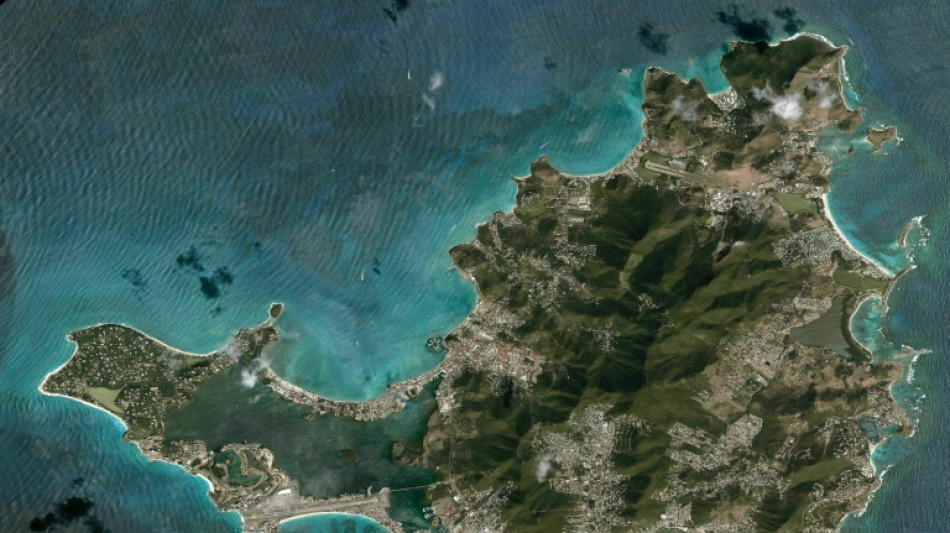
France, Netherlands settle tensions over 'footrace frontier' / Photo: - - CNES/AFP

France, Netherlands settle tensions over 'footrace frontier'

Around 400 years ago, two groups of runners -- one Dutch, one French -- are said to have set off from the same point on the Caribbean island of Saint Martin to trace the border between their nations. On Friday, this footrace frontier is set to be formally updated.

Text size:

Starting from a bay on the east coast and running in opposite directions, the runners in 1648 eventually met on the west coast of the island, with a straight line between the two points forming the international border ever since.

According to the legend, the Gallic runners were faster, handing France by far the larger share of the roughly 90-square-kilometre (35-square-mile) tropical paradise, which they called Saint Martin.

The Netherlands took the southern part, which they named Sint Maarten, with the athletic feat and the peaceful coexistence of the two colonial powers leading to the territory being dubbed the "friendly island".

The so-called Concordia Hill treaty of 1648 established the boundary and has formed the basis of relations on Saint Martin/Sint Maarten ever since, although no written record for the footrace exists.

"Although there are two territories which are governed differently by two separate nations, this is neither drastic nor obvious," notes the French tourist office on its website.

Low-level friction over administration, tax, or policing have caused problems, however, and new tensions emerged in 2017 after Hurricane Irma ripped through the local palm trees, luxury villas and plantations.

Reconstruction around Oyster Pond on the east coast -- the point of departure for the 1648 runners -- stalled because both countries disputed the exact location of the frontier.

The Dutch claimed all the waters of the bay, while the French pointed to modern international law which posits that the border should run through the mid-point of the natural harbour.

- 'Long-awaited regeneration' -

Rather than settling it with a sprint, French Interior Minister Gerald Darmanin is set to meet Sint Maarten Prime Minister Silveria Jacobs to pen a new agreement on Friday after months of sometimes difficult talks.

France, as with the running, has prevailed in the border argument.

The boundary will be "in the middle of the pond, giving equal water to both sides," Jacobs said in a statement ahead of Friday's signing ceremony.

The agreement "will help define the border in a precise and clear way," Saint Martin president Louis Mussington said, while also "preserving the free movement established in the Concordia agreement".

Resolving the conflict "will open the way for long-awaited economic and urban regeneration" of the Oyster Pond area, which suffers from higher-than-average poverty, he added.

The island is not the only territory in the Caribbean to be divided, with Haiti and the Dominican Republic sharing the same landmass.

Saint Martin/Sint Maarten, which has a history of producing salt, tobacco and sugar cane, was host to indigenous Arawak and Carib populations before the arrival of Spanish, then French and Dutch settlers in the mid-17th century.

(O.Joost--BBZ)



