Berliner Boersenzeitung - 'Negligible' impact of Fukushima water release on South Korea: Seoul

EUR -
AED 4.089192
AFN 72.375297
ALL 90.522135
AMD 403.960011
ANG 1.992858
AOA 1022.158315
ARS 1721.026204
AUD 1.622555
AWG 2.004232
AZN 1.896276
BAM 1.949815
BBD 2.252143
BDT 139.432002
BGN 1.946144
BHD 0.421903
BIF 3345.395827
BMD 1.113462
BND 1.429654
BOB 13.263287
BRL 6.211445
BSD 1.118367
BTN 105.10238
BWP 15.342766
BYN 3.348417
BYR 21823.857856
BZD 2.249176
CAD 1.584629
CDF 2577.664591
CHF 0.923589
CLF 0.027839
CLP 1095.680494
CNY 7.427182
CNH 7.425395
COP 3684.47961
CRC 505.844995
CUC 1.113462
CUP 26.84037
CVE 109.927568
CZK 24.381701
DJF 199.118389
DKK 7.475084
DOP 67.831481
DZD 152.094503
EGP 59.632022
ERN 16.701932
ETB 179.434408
FJD 2.519208
FKP 0.83586
GBP 0.836605
GEL 2.8909
GGP 0.83586
GHS 13.095801
GIP 0.83586
GMD 82.395958
GNF 9907.543483
GTQ 8.545768
GYD 234.340672
HKD 8.735945
HNL 30.063268
HRK 7.537036
HTG 146.586749
HUF 365.29322
IDR 20242.407585
ILS 3.533294
IMP 0.83586
INR 104.319432
IQD 1695.380662
IRR 2122342.339778
ISK 136.788751
JEP 0.83586
JMD 177.493575
JOD 0.789402
JPY 177.191876
KES 144.72809
KGS 97.371816
KHR 4561.020051
KMF 492.150581
KPW 1002.115879
KRW 1485.881747
KWD 0.346409
KYD 0.931931
KZT 499.292895
LAK 25171.941393
LBP 100144.948857
LKR 371.665803
LRD 190.11472
LSL 18.333846
LTL 3.287764
LVL 0.673522
LYD 7.168994
MAD 10.909213
MDL 20.095683
MGA 5110.791458
MKD 61.532684
MMK 2337.98716
MNT 4012.309549
MOP 9.036082
MRU 45.114315
MUR 52.522235
MVR 17.145125
MWK 1939.229956
MXN 20.722015
MYR 4.535686
MZN 71.160941
NAD 18.334257
NGN 1498.887566
NIO 40.91944
NOK 10.621132
NPR 168.163054
NZD 1.993353
OMR 0.428136
PAB 1.118367
PEN 3.811298
PGK 5.008631
PHP 70.414184
PKR 309.295093
PLN 4.403453
PYG 6902.757521
QAR 4.076686
RON 5.344281
RSD 117.600504
RUB 92.249092
RWF 1654.606189
SAR 4.183295
SBD 9.008741
SCR 15.35965
SDG 669.749634
SEK 11.049609
SGD 1.42779
SHP 0.834335
SLE 25.503035
SLL 23348.749147
SOS 639.13239
SRD 41.806022
STD 23046.418134
STN 24.424807
SVC 9.785874
SYP 14477.234335
SZL 18.339705
THB 37.488059
TJS 10.27756
TMT 3.897117
TND 3.340082
TOP 2.680949
TRY 55.931898
TTD 7.58465
TWD 36.590149
TZS 2948.514585
UAH 50.865607
UGX 4562.993512
USD 1.113462
UYU 45.250693
UZS 13391.53277
VES 1002.662073
VND 28565.314355
VUV 133.411902
WST 3.103285
XAF 655.957
XAG 0.021085
XAU 0.000275170461
XCD 3.009187
XCG 2.015495
XDR 0.787276
XOF 655.957
XPF 119.331742
YER 263.331712
ZAR 18.432803
ZMK 10022.446406
ZMW 22.782589
ZWL 358.534353
SSP 6397.282577
MXV 2.32832
  • CMSD

    -0.1200

    19.81

    -0.61%

  • JRI

    0.0000

    10.77

    0%

  • BCC

    -1.8200

    74.15

    -2.45%

  • CMSC

    -0.2228

    19.53

    -1.14%

  • BCE

    0.2000

    20.34

    +0.98%

  • RIO

    0.0100

    94.17

    +0.01%

  • AZN

    -2.7400

    161.47

    -1.7%

  • GSK

    -1.1800

    48.17

    -2.45%

  • RBGPF

    0.0000

    65

    0%

  • NGG

    0.8800

    75.82

    +1.16%

  • RYCEF

    -0.7300

    19.08

    -3.83%

  • BTI

    -0.4500

    54.4

    -0.83%

  • BP

    0.4700

    43.99

    +1.07%

  • RELX

    -0.0600

    33.18

    -0.18%

  • VOD

    -0.1800

    16.15

    -1.11%

'Negligible' impact of Fukushima water release on South Korea: Seoul
'Negligible' impact of Fukushima water release on South Korea: Seoul / Photo: Jung Yeon-je - AFP

'Negligible' impact of Fukushima water release on South Korea: Seoul

Japan's plan to release treated water from the Fukushima nuclear plant would have "negligible consequences" for South Korea, Seoul said Friday as it tries to assuage rising public concern.

Text size:

The International Atomic Energy Agency (IAEA) this week gave the green light for a decades-long project to discharge accumulated water from the plant, which was devastated by an earthquake and a tsunami that hit the eastern coast of Japan in 2011.

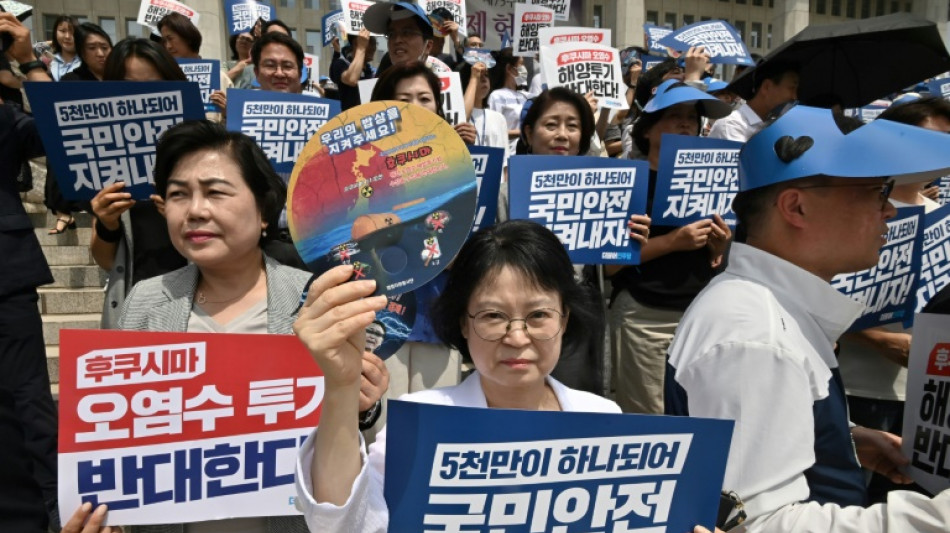
But the plan has encountered widespread public opposition and protests in South Korea, and even panic-buying of salt based on fears that the Fukushima water would pollute the ocean and the salt sourced from seawater.

South Korea conducted its own separate review of Tokyo's plan, which found Japan will meet or exceed key international standards, policy coordination minister Bang Moon-kyu told reporters at a press conference Friday.

The study, which focused on whether the discharge would affect South Korean waters, found it would have "negligible consequences", the minister said.

It would take up to 10 years for the treated water released from Fukushima into the Pacific Ocean to circulate back near the Korean peninsula, Bang said.

"It is projected to have a radiation level approximately 1/100,000 of the average level during normal times" when the treated waters come back near the Korean waters, he added.

IAEA head Rafael Grossi will visit Seoul from Friday, but the agency's review has not alleviated strong opposition in South Korea over the discharge plan, with some opposition lawmakers even going on hunger strike in protest.

"Japan wants to release the wastewater into the sea because it's the easiest and cheapest way to do so," Woo Won-shik, an MP who has been on hunger strike at the parliament in Seoul since June 26, told AFP.

- Decommissioning over decades -

Several of the reactors at the Fukushima Daiichi plant went into meltdown after cooling systems were overwhelmed by a massive 2011 tsunami.

The resulting nuclear accident was the worst since Chernobyl, and the clean-up has lasted more than a decade, with most areas declared off-limits due to radiation now reopened.

Decommissioning the plant itself will take decades more, but the facility's operator TEPCO faces the immediate problem of more than 1.33 million cubic metres of water accumulated on the site.

The water is a mixture of groundwater, rain that seeps into the area, and water used for cooling.

TEPCO and Japan's government want to release the treated liquid, diluted with seawater, via a pipe extending a kilometre from the coast where the plant sits.

But South Korean MPs and civic groups claim there are multiple alternatives that are safer but more expensive, such as burying the treated water deep underground or vaporising it.

Since taking power last year, South Korean President Yoon Suk Yeol has sought to bury the historical hatchet with Japan on issues including wartime forced labour as he seeks closer regional security cooperation in the face of rising nuclear threats from North Korea.

(O.Joost--BBZ)



