US auto workers vote to authorize strike if contract talks fail / Photo: JEFF KOWALSKY - AFP/File

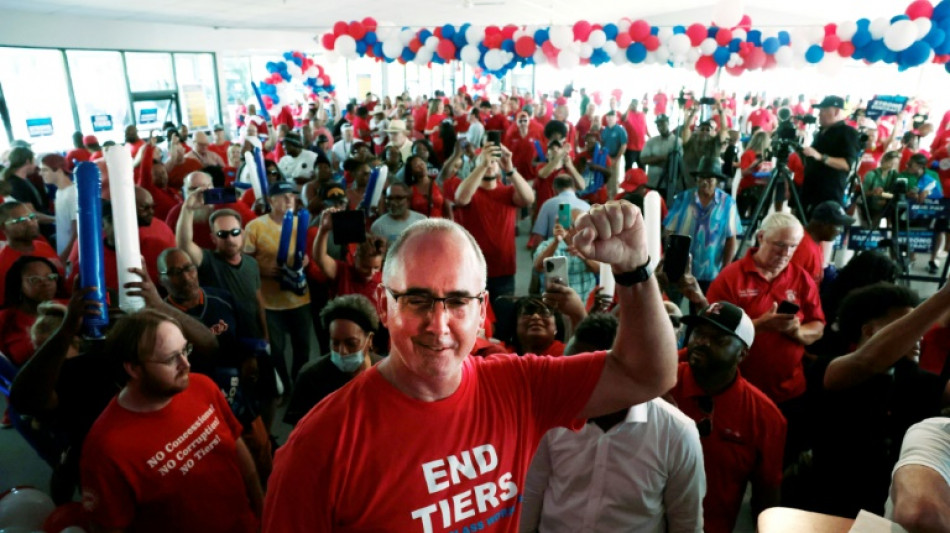
Workers at Detroit's three auto giants overwhelmingly voted to authorize union leaders to call a strike if there is no contract by next month's deadline, the union announced Friday.
The United Auto Workers announced that it won at least 95 percent support for a possible strike at General Motors, Ford and Stellantis if negotiations fail to produce a contract by the September 14 deadline, with an average of 97 percent across the three companies.
The vote, which was expected, does not mean there will be a stoppage, but it gives newly-installed UAW President Shawn Fain an additional point of leverage in talks. Fain has criticized the companies for dragging their feet during the negotiations thus far.
"Our union's membership is clearly fed up with living paycheck-to-paycheck while the corporate elite and billionaire class continue to make out like bandits," said UAW President Shawn Fain. "The Big Three have been breaking the bank while we have been breaking our backs."
The UAW's push comes in a period dubbed #HotLaborSummer as unions flex muscles in a still-tight employment market. Hollywood has been virtually shut down by writer and actor strikes, while UPS avoided a stoppage following difficult negotiations.
A strike at all three companies would involve about 150,000 workers, with a potentially wide-ranging economic impact on suppliers and industry-adjacent services.
The talks are on the radar of President Joe Biden, who recently called for a "fair" contract that ensures workers' rights are strengthened during the transition to electric vehicles (EVs).
Fain has signaled a willingness to strike at all three companies, although labor experts think if there is a strike, a stoppage at just one company is more likely.
Fain has argued workers should get the same 40 percent salary boost given to auto executives. Other demands include a restoration of cost of living adjustments (COLA), guaranteed pensions for all workers and elimination of a multitiered compensation system.
The pandemic helped "create a sense among the American workforce that they don't have to tolerate bad working conditions anymore," said Michelle Kaminski, a professor at Michigan State University who specializes in labor relations.
"These are the most favorable conditions for unions in decades," she said.
- Reform candidate -
Fain, 54, who worked as an electrician at a Stellantis factory in Indiana, narrowly won the first UAW presidential election with direct voting by rank-and-file members. The voting was overseen by a court-appointed monitor after a corruption scandal led to prison terms for two former UAW presidents.
In the campaign, Fain ran as a reformer, criticizing other UAW leaders for an overly cozy approach with management and a legacy of plant closures and lower pay for junior employees.
He has maintained an aggressive posture since taking office, shunning a ceremonial handshake with auto CEOs when the talks kicked off.
In a streamed bargaining update earlier this month Fain plunked Stellantis' proposal in the trash, a gesture the company criticized as "theatrics and personal insults."
Stellantis said it was committed to reaching an agreement "based on economic realism" that reflects the pressures of competing with nonunionized automakers.
"Agreeing to Mr. Fain's demands could endanger our ability to make decisions in the future that provide job security for our employees," Stellantis said in a letter to employees.
GM said it has "been working hard with the UAW every day to ensure we get this agreement right for all our stakeholders," while Ford said it looks "forward to working with the UAW on creative solutions ... when our dramatically changing industry needs a skilled and competitive workforce more than ever."
- Compromise? -
Fain's strategy with the Detroit Three has taken a page from that of Teamsters President Sean O'Brien, who also presented regular livestream updates and organized "practice pickets" at UPS.
UPS workers overwhelmingly approved a contract that included hefty wage increases and an elimination of a two-tier wage system.
Labor historian Nelson Lichtenstein, who noted the UAW's long history of striking, said Fain could "claim victory" with hefty wage hikes and elimination of the tiered system.
Harry Katz, a professor at Cornell's School of Industrial & Labor Relations, said a compromise could include a cost-of-living adjustment and a narrowing of pay gaps in tiers.
Fain "will definitely deliver a favorable contract," Katz said. "It's all a question of how favorable."
But Katz said there is also a decent chance of a strike if either side misreads the situation. While the UAW has some leverage over the carmakers, it has less compared with the Teamsters in the UPS case, given the heavy number of US vehicles built by nonunion automakers.
(B.Hartmann--BBZ)