
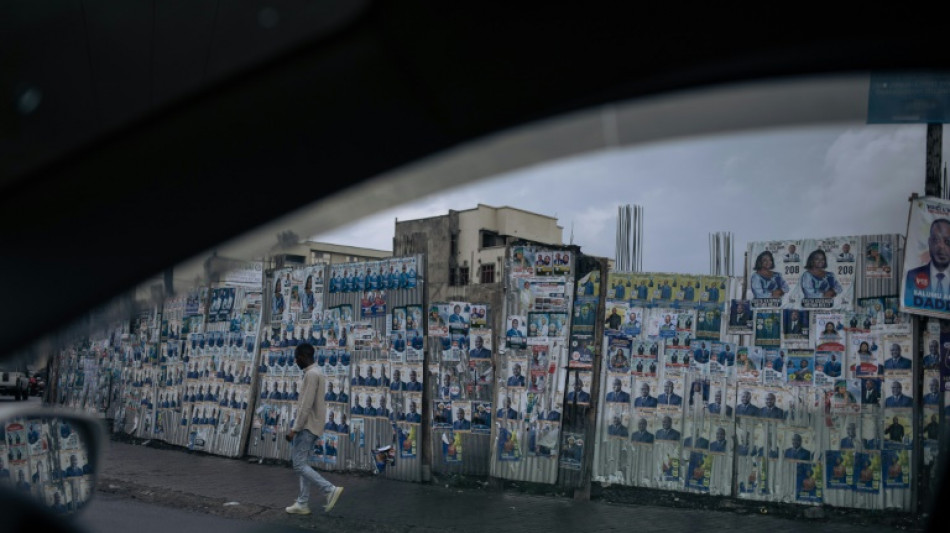
Inflation, unemployment weigh on DR Congo leader's economic gains / Photo: Alexis HUGUET - AFP

President Felix Tshisekedi, who once vowed to transform DR Congo into "the Germany of Africa", has promised to create jobs if he is re-elected, after a first term marked by economic growth but soaring inflation.
The 60-year-old has presided over years of economic upturn -- with more than six percent GDP growth projected for this year -- and ballooning national budgets.
But inflation, which is at about 20 percent this year, and stubborn joblessness are a drag on economic prosperity as the vast central African nation prepares to go to the polls on December 20.
"Everything indicates that there has been considerable progress," Congolese Finance Minister Nicolas Kazadi told reporters this week.
Foreign-currency reserves have soared from about $1 billion when the government took office in 2019, to nearly $5 billion this year, he said.
The annual budget will also swell to about $16 billion, from $5.7 billion in 2019, the minister added, driven mostly by mining-sector growth.
The Democratic Republic of Congo is Africa's top copper producer and the world's largest producer of cobalt -- a key component of batteries used in electronics and electric vehicles.
But little wealth trickles down in the DRC.
About two thirds of the 100-million population survive on under $2.15 a day, according to the World Bank.
Precise figures are scarce but most Congolese work informally.
Jobs are a hot-button electoral issue -- Tshisekedi has promised to create 6.4 million by attracting investors, and the main opposition candidates are also promising jobs.
"Put your trust in me and you will be satisfied," the president told supporters in in the east of the country this week, referring to job creation.
- Push to diversify -
The World Bank expects GDP growth to reach 6.8 percent this year, driven mainly by mining.
The economy grew 8.9 percent in 2022, and 6.2 percent the year before, the bank said.
"The Congolese government has made extraordinary progress," said World Bank country director Albert Zeufack.
Better tax collection has helped triple the national budget over five years, he said.
But he cautioned that mining-driven growth did not deliver the level of employment needed to alleviate poverty.
Tshisekedi has pushed to diversify the economy.
In 2019, he promised to make DRC the "Germany of Africa" and he has pledged to build a battery factory using domestically mined minerals.
But the scheme has been slow to get going.
Experts view it as quixotic, in a country with regular power cuts and little manufacturing expertise.
For many, the economic growth only exists on paper for now.
"There is certainly economic growth but it's not responding to needs," said economics professor Albert Malukisa from the Catholic University of Congo.
- Graft -
Malukisa said the problems facing the economy were severe, from scant infrastructure to rampant unemployment and inflation.
But he cast corruption as the core issue, deterring serious investors.
"It's the conduct and behaviour of the political class that we need to start changing upstream to make things work," he said.
The DRC ranks 166th out of 180 countries in Transparency International's Corruption Perceptions Index.
Tshisekedi initially made efforts to fight graft, Malukisa said, but it remains the norm.
He pointed to unpaid civil servants as evidence of the problem.
Dozens of ex-government officials protested loudly last month in the capital, Kinshasa, after losing their jobs in a reshuffle and complained they had not received severance pay.
"They're embezzling the money," said one deflated-looking former agriculture ministry official, holding a placard outside a government department.
A government spokesman did not respond to a request for comment about the unpaid dues.
- 'Making losses' -
Inflation reached 22 percent year-on-year in October, according to the International Monetary Fund.
It is partly due to global hikes in inflation, a fallout from the Ukraine war.
But poorly managed government spending has also led to the Congolese franc depreciating against the dollar, according to several experts.
Nana Luka, a banana seller in Kinshasa, said higher wholesale costs were driving her under.
"I'm making losses, because the dollar is rising," she grumbled.
Opposition candidates have been quick to highlight the dollar-franc exchange rate as proof of the government's failure.
Matata Ponyo, an ex-prime minister campaigning for leading opposition figure Moise Katumbi, told a rally this week that the exchange rate was stable when he was in office -- to cheers.
Tshisekedi has also been met with jeers about the exchange rate.
The government has pledged to fix the problem.
"It's a challenge that we have," Kazadi, the finance minister, said, pinning the blame mainly on macroeconomic factors.
(B.Hartmann--BBZ)



