Ukraine eyes Romanian port for key farm exports

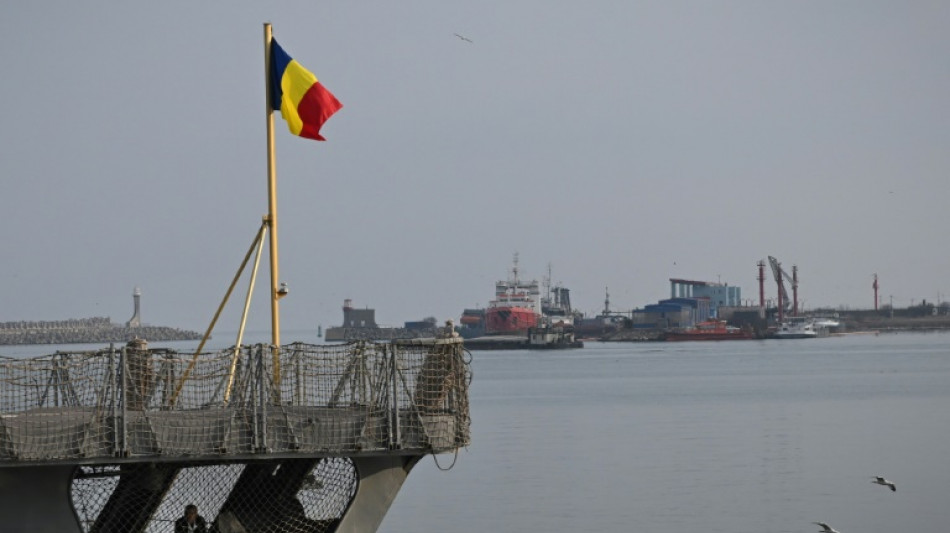
Faced with a Russian blockade of its own ports, Ukraine is seeking to export the farm goods that many countries depend on via the Romanian Black Sea port of Constanta.
The solution is crucial both to Ukraine's economy and to entire populations that rely heavily on its wheat and sunflower oil.
Bucharest has confirmed that discussions are underway with Kyiv, pointing out that Constanta already handles some imports to Ukraine and exports from it.
Before the war, Ukraine accounted for 12 percent of global wheat exports, 15 percent of maize and 50 percent of world sunflower oil.
"We and our partners are looking for alternative logistical routes to export our goods via European ports, including Constanta," Ukrainian Agricultre Minister Mykola Solsky said recently.
- Ukraine ports blockaded -
The presence of Russian battleships and mines in Ukrainian waters renders commercial shipping there nearly impossible.
Since the start of the war, Russian forces have been blocking access to the southeastern Ukrainian ports of Berdiansk and Mariupol on the Sea of Azov, which opens into the Black Sea.
In the southwest, the crucial Black Sea port of Odessa lies perilously close to the frontline at Mykolaiv.
Odessa handles 90 million tonnes of shipments a year -- 60 percent of the country's total port traffic -- and is in the Krelmin's sights.
The Marine Traffic website, which tracks the position of all seagoing vessels, clearly shows the de facto blockade of these waters.
Commercial ships have been absent from the zone since missile attacks on vessels sent their insurance premiums rocketing.
According to the agriculture ministry, Ukraine is currently losing $1.5 billion (1.4 billion euros) a month because of the stranglehold on port exports.
Meanwhile countries that depend on Ukrainian farm exports, particularly on the southern coasts of the Mediterranean, are seeing a food crisis start to develop.
Kyiv says it has sufficient stocks to meet Ukraine's own food needs for the next two years. But it is equally keen to ensure exports continue as normal.
"Ukraine wants to show it is defending its export markets as well as its territory and is conscious of its importance as a supplier of both foodstuffs and industrial goods," said Paul Tourret, head of France's Isemar Institute, which specialises in the maritime economy.
- Alternative options -
Kyiv is seeking to increase grain exports to Poland, Romanian and Slovakia by rail and, to a lesser extent, by lorry.
The Romanian and Ukrainian rail companies are discussing ways of cooperating, the Bucharest government said.
The goal is to export 600,000 tonnes per month, which nonetheless remains "marginal" compared to the export capacity of Ukraine's sea ports, said Agritel analyst Gautier Le Molgat.
Tourret said Constanta represents the best option. Romania is a member of NATO, meaning its waters are protected. And as the EU's second largest wheat exporter after France, it has the necessary infrastructure.
Constanta is the largest port on the Black Sea. It handled more than 67 million tonnes of exports in 2021, including more than 25 million tonnes of grains. It has a total capacity of 100 million tonnes.
The port is in a position to accept Ukrainian stocks because by this time of year, Romanian grain shipments have already left for their destinations.
However, if the blockade of Ukraine's own ports were to last until the forthcoming harvests, Constanta's storage capacity could be stretched to the limit.
"Romania also has something to gain from this ... a moral benefit," Romanian Defence Minister Vasile Dincu said recently.
The speaker of the Romanian parliament and the transport ministry announced earlier this week that new investments were planned for Constanta port.
- Getting to Constanta -
The crucial element is getting merchandise out of Ukraine and into Constanta.
There are several potential routes, Tourret said.
The most dangerous option is to transport goods by lorry from Odessa, along the Black Sea coast as far as the Danube river port of Galati and then by boat to the canal which links the river to Constanta. That takes one or two days.
A second possibility is to transport goods via Moldova, avoiding the border region of Transdniestr, which seceded in 1990 and hosts a Russian military base.
Avoiding this region under de facto Russian control can involve a detour of several hundred kilometres, depending on the starting point.
The third choice is the longest but currently the least hazardous. It entails crossing Ukraine's western border, the area least affected by the war, straight into northern Romania.
This route is currently used, in the other direction, to supply Ukraine with essential goods.
(Y.Berger--BBZ)