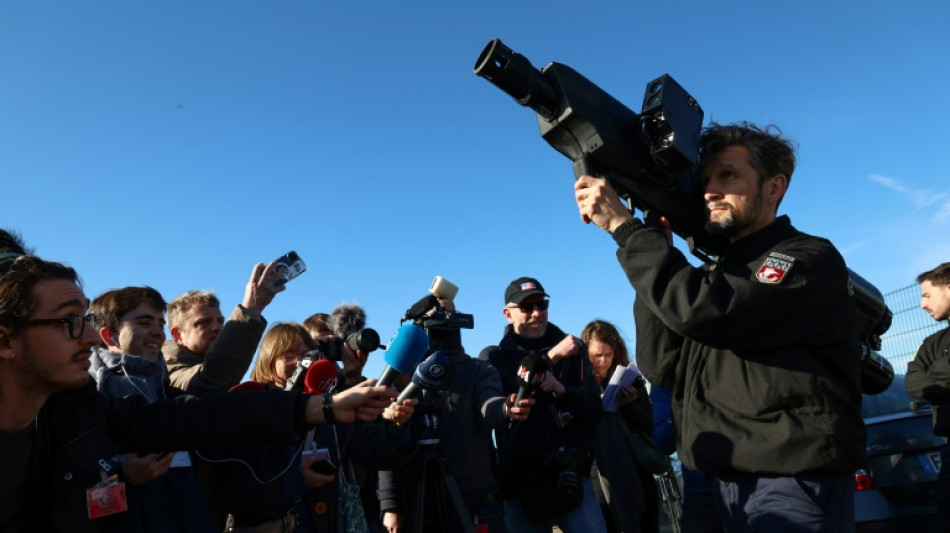
Paris Olympics anti-drone system fails to convince as clock ticks / Photo: Emmanuel DUNAND - AFP

Three and a half months before the start of the Paris Olympics, concerns are growing that the anti-drone shield being put in place for the Games is not up to the task of protecting the French capital from a potential attack.
Last year, Interior Minister Gerald Darmanin singled out drones as "without doubt the main (threat) to be dealt with" at the Olympics.
However, a parliamentary report has now been deemed too sensitive to be made public, while exercises to test the system have proved inconclusive.
"It's annoying that this is coming out publicly but unfortunately, contrary to the official line, things aren't really working as we'd like," a high-level security source told AFP on condition of anonymity.
- Spectre -
The spectre of a "terror" attack has haunted every Olympic host country since the 1972 Munich Games, when the Palestinian Black September organisation killed 11 members of the Israeli team.
The threat level rose significantly with the 9/11 attacks in New York, with the build-up to the Athens Games of 2004 dogged by constant speculation of 'dirty' bombs in the metro and a rapidly inflating security bill.
The scenario of an attack this year, with a swarm of drones swooping down on the river Seine during the opening ceremony on July 26 with 300,000 spectators on the quayside, is the authorities' nightmare.
Despite France's national security alert being raised to its maximum level following an attack on a concert venue in Moscow on March 22, for which Islamic State claimed responsibility, President Emmanuel Macron has said maintaining the opening ceremony on the Seine remained "the preferred scenario".
With an estimated three million drones in France -- most in private hands -- the armed forces and government are working hard to prevent the flight of any potentially hostile craft.
The military response for the Paris Olympics was entrusted to Thales and CS Group in April 2022.
But since then, one glitch has followed another.
Scheduled for June 2023, delivery of the six systems, known as Parade, has been delayed by several months.
This raised concerns, and convinced a Senate committee to launch a fact-finding mission at the end of 2023.
The committee's chairman, Cedric Perrin of the centre-right Les Republicains party, told defence journalists in December the fight against drones was "not up to scratch".
- 'Dangerous' -
The large-scale exercise organised by the French air force in mid-March to test the first Parade systems at Villacoublay, near Paris, clearly did not convince all the participants.
The senators announced on March 20 that their report would not be made public after all.
According to several sources, Perrin expressed his frustration to the military.
"It's a national security issue" and publishing the report "could be dangerous", explained a source close to the army.
When Armed Forces Minister Sebastien Lecornu concluded the fact-finding mission's hearings on April 2, it was behind closed doors.
"We have asked the manufacturer, Thales in this case, to improve by responding precisely to all the requests made of it by the armed forces and the French Defence Procurement Agency in order to be ready," Lecornu had previously told the press.
Contacted by AFP, Thales had no comment.
"Yes, it doesn't work perfectly. And yes, the system can be improved. The problem is that in three months there is very little room for manoeuvre," said another security source who wished to remain anonymous.
With just three months to go before the opening ceremony of the Olympics, "the time to train the staff, to make significant improvements to the system, it seems impossible", said the same source.
Alain Bauer, a professor of criminology, is phlegmatic about the possibility of a security breach
"No system is as effective as expected. This is demonstrated almost daily by what is happening in Ukraine," he says.
"Despite systems that are undoubtedly among the best in the world, several drones still manage to get through."
- Plan B -
The question remains as to whether or not the French army continue with the Parade system.
"We'll see," says a source close to the matter.
Recently, the air force acquired several Bassalt anti-drone systems, designed to detect and intercept any drone within a 10-kilometre (radius.
The army would have "enough to equip all the Olympic venues", including the opening ceremony, with Bassalt, a sort of anti-drone Plan B, the security source added.
"It's like having a car that's broken down, or not in great shape, and in your garage you have a car that works. What are you going to take on holiday? I know," said a senior civil servant.
(P.Werner--BBZ)