Bucha: A street filled with bodies
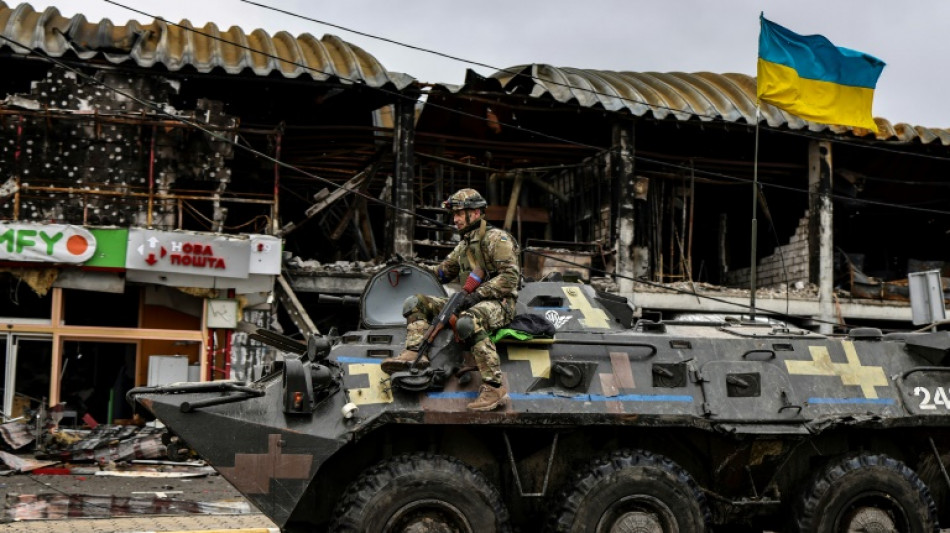
/ Photo: RONALDO SCHEMIDT - AFP

An AFP team were the first journalists to discover the horrors of Bucha, a quiet commuter town near Kyiv occupied by the Russian army for over a month.
Russian troops are accused of massacring hundreds of civilians there, shocking the world and prompting allegations of war crimes.
AFP's bureau chief in The Hague, Danny Kemp, was part of the team that uncovered the atrocities on April 2, 2022. Here is his account of what they saw that day, originally published on AFP's Correspondent blog site.
Some may find the account distressing.
We saw three of them at first, lying in the dirt like piles of rags. That alone would have been bad enough.
"Bodies," someone in the car said, because it was all that could be said. Our driver screeched to a halt and we jumped out of the vehicle.
A long grey road on the edge of Bucha stretched out under an equally grey Ukrainian sky. The three bodies lay next to a stack of construction materials and wooden pallets.
As we approached we could see that one had his hands tied behind his back.
Yet it seemed to take a while before any of us -- myself, photographer Ronaldo Schemidt, video journalist Nicolas Garcia, along with our fixer, our driver and our security consultant -- actually looked up and down the rest of the street.
When we did, we realised that these three bodies were only the beginning. Dotted here and there, for as far as we could see in either direction, were more, many more. Corpse after corpse after corpse along this single debris-strewn street.
This lonely place had become a special kind of hell for the inhabitants of Bucha.
A wave of shock and disbelief washed over me: this horrible scene could not be real. But it was. I looked at my colleagues, and that was when the professional instinct kicked in, helped by the robotic tiredness at the end of a three-week stint in Ukraine.
We began to work, because we knew that this was a huge story, one that could possibly lead to allegations of war crimes.
We knew that as journalists we had to tell the world about it, and quickly. Ronaldo and Nicolas were taking images, the evidence to prove that the reports on social media about bodies in Bucha were true. I set about counting them.
We knew, too, how fast disinformation campaigns about such incidents can spread (and later so it proved), and how important it was to get everything right.
What we did not know was that within 24 hours, the images and the text we would produce would spark international outrage against Russia, and calls for sanctions that moved the war in Ukraine into a new and more distressing phase.
We had been trying for days to get into the once sleepy commuter towns of Irpin and Bucha on the pine-forested northwestern outskirts of Kyiv. The main checkpoint out of Kyiv had been closed to journalists since the death of US filmmaker Brett Renaud on March 13.
The answer at the checkpoint remained a firm "Ni" (No), even after authorities declared the towns liberated — this was the flipside of the tightly controlled Ukrainian media operation that had beamed President Volodymyr Zelensky’s speeches into parliaments across the world.
From the checkpoint we could hear the booms of constant shelling and wondered what the situation was like for people inside the towns.
A change of route finally got us into Irpin on the foggy late afternoon of Friday April 1. We discovered a wasteland of destroyed and badly damaged buildings, crushed and bullet-ridden cars, and burned out Russian tanks, almost completely devoid of any human population.
The next day, Saturday April 2, was grey, cold and drizzly as we headed for Bucha. The evening before we had seen videos on social media purporting to show someone driving through a street full of bodies in the town, but no journalists had yet reached the scene to corroborate that the videos had been filmed there.
We were on edge as we drove through Bucha's devastated streets, fearing that Russian troops had not pulled out and that there could be more fighting. At first we found stories of survival, like the group of elderly people who had survived without food, running water or electricity for a month. Ukrainian soldiers had started to hand out aid.
Then the mood turned darker. A body lay on the ground, half covered by a blanket, near the shell-blasted railway station. A local resident, wild-eyed and drawing hard on a cigarette, showed us what he said was the shallow grave of four people killed by Russians, dug in a neighbour's back garden and topped with a green wooden cross.
By now we thought we had enough material to describe the situation in Bucha. But our driver had been talking with soldiers and local people who seemed to confirm what was on social media, that a short drive from here was a street filled with bodies. The man who had shown us the graves offered to be our guide. Often these leads go nowhere, but it was worth a try. We got back in the car.
It seems strange that a human can look so inhuman. The face of the first body, a man in a brown hooded jacket and jeans lying on his side, looked so white and waxy it seemed almost unreal. Instead it was his hands, tied behind his back with white cloth, that brought the reality of his death home: the lines of slightly wrinkled skin, the discoloured nails. He was in the largest group of bodies, a cluster of three. The trouser leg of one of the others had ridden slightly above a sock, showing purplish skin. That was all too real.
Reporters often have to suppress the instinct that tells us not to intrude on people, and that is true even of the dead. At first it felt somehow wrong to look too closely at these people who had no way of saying that they did not want to be looked at. Then you realise there is no other way to try to find out how they died, and maybe who they were. These people, it became clear, were all wearing civilian clothes.
They all appeared to be adult males, but of various ages. And they all appeared to have been dead for some time. They had sallow, sunken skin and stiff fingers. I had not seen many bodies before that day, but some of the few I had were recently killed, and they did not look like this.
A reporter's task is simple enough in circumstances like this: you try to put the enormity or the horror to one side, you count the bodies and observe and describe. I walked up and down the street at least twice trying to keep a tally but there were so many I kept losing count, and on one occasion found another body lying in a courtyard that I hadn't seen. In the end I had to take photos of each one with my phone to ensure that I had the right number. On the third pass I was sure: 20 bodies.
For my colleagues Ronaldo and Nicolas the job is tougher. The poet T.S. Eliot famously said that "human kind cannot bear very much reality", and this is one of the paradoxes of photo and video journalism. How do you convey the horror of the situation without being too graphic, so that people will not scroll past it on their mobile phones? And how do you somehow try to preserve the dignity of these victims who have been left shorn of it by the manner of their deaths?
My colleagues' skill in walking that line would be seen later on the front pages of newspapers and on screens around the world, and used later by politicians both in Ukraine and abroad to illustrate the devastation in Bucha.
Still, the reality of it would cut through sometimes while we were on that freezing, grey street. Who were these people who lay in such different poses on the tarmac? The older elderly man whose head rested on a yellow and white striped curb, eyes closed and legs crossed, almost as if taking a nap? The two younger men lying side by side in a puddle, one with his eyes open, gazing sightlessly at the sky — were they friends, or relatives? And the man with his hand in the pocket of his black jacket, was he reaching for something when he died?
And then the crucial question: how did they die, and at whose hands? We could see catastrophic head wounds on two of them but not the rest. Why did only one of them have his hands tied, while others had apparently been killed as they went about their daily lives: the three falling tangled in their bicycles, one still gripping his black holdall; the two who tumbled on or near their shopping bags? The street was covered with debris and at least one house was destroyed. Had the area been shelled? But what about the burned out, crushed and bullet-ridden cars?
These questions would have to wait. A handful of local residents strolled past, looking at a few of the bodies but not all, as if death had become routine here. But we did not speak to them. There comes a time when you have to get the news out, and we decided to go and send our pictures, video and text to our newsdesk. We noted the name of the road, Yablonska Street, and we drove away.
Our news alert -- "At least 20 bodies seen in one street in town near Kyiv: AFP" -- hit the wire at 16:33 Kyiv time on Saturday, along with photographs and video footage of the scene.
We reported what we saw and left others to attribute blame. Ukrainian authorities later said all the victims in Yablonska Street had been shot, and that hundreds of people had been killed by retreating Russian forces in Bucha, some of whom were buried in mass graves.
Satellite images would later show that several bodies had been lying in the street since mid-March, when the town was under Russian control. The Bellingcat website published drone footage of tank fire hitting one cyclist in the same road. Russia denied all the allegations.
It was far from the first horror to emerge from the Russian invasion of Ukraine more than a month earlier.
Distressing testimony and images had emerged during previous weeks from the besieged port city of Mariupol in the south, in Kharkiv in the east and Chernigiv in the north. But something about what happened in Bucha seemed to cut through with the outside world in a different way.
Was it that these corpses in the street were the first clear evidence of such deaths emerging from towns where Russia had pulled back after a month of occupation? Was it the pure shock of seeing those people's bodies littered on the ground, in Europe in 2022?
Whatever the case, the next day, a string of western countries reacted with outrage, threats of further sanctions, and calls for war crimes investigations.
UN chief Antonio Guterres said he was "deeply shocked by the images of civilians killed in Bucha" while US Secretary of State Antony Blinken said that "you can't help but see these images as a punch to the gut."
A Russian campaign to discredit the allegations began too, suggesting that the scene in Yablonska Street was staged by Ukrainian forces and that some of the bodies were filmed moving.
Journalists are used to dealing with disinformation, but it is different when you have seen something with your own eyes. I was able to tell AFP's Fact Check service that these people were clearly dead, and at no time had we seen any of them move.
Had we realised at the time we were documenting history? All journalists like to think so, But on that grey, cold street, it was the individual tragedies that were most important.
I wished we had somehow been able to tell the stories of these people -- who they were, what they did, who they loved, or even as simple as how they died.
In time, their stories -- and those of the thousands of people killed in similar circumstances according to Ukrainian authorities -- may emerge from an investigation or in a war crimes court.
Our AFP colleagues have gone on documenting and investigating what went on in Bucha during that grim month.
Since I am normally based in The Hague, home to the International Criminal Court, I may end up one day covering the cases myself. But until then, this is what we witnessed, and that is all we can offer the victims for now.
(H.Schneide--BBZ)