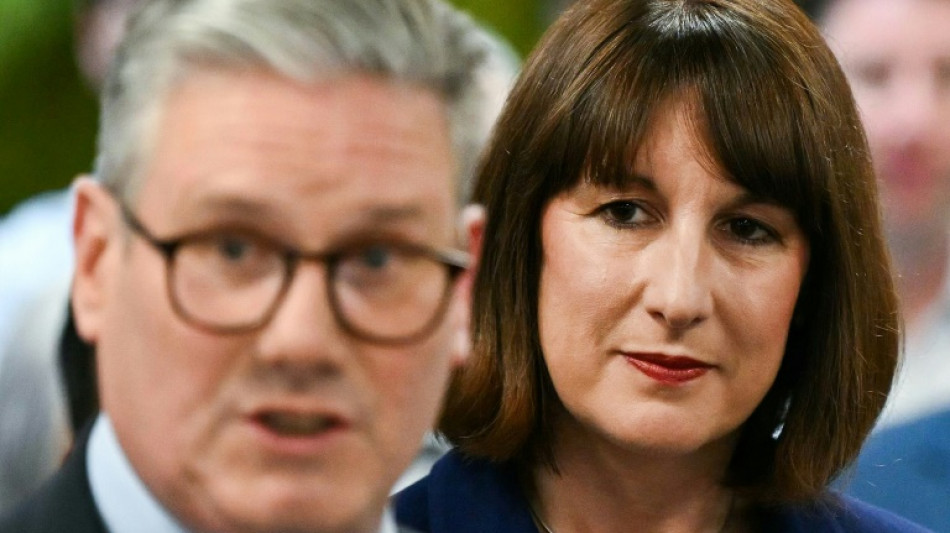
New UK government faces tough economic challenge / Photo: JUSTIN TALLIS - AFP

Britain's new Labour government on Friday pledged immediate action to grow the economy after the centre-left party won a landslide general election victory.
However, its task could be hampered by strained state finances following huge spending by the previous Conservative administration to protect millions of jobs during the Covid pandemic.
Labour, led by new Prime Minister Keir Starmer after it ended 14 years of Conservative rule, has promised investment in key areas such as health and education but also stresses the need to balance the books.
This after government coffers were further hit by subsidies for energy bills after Russia's invasion of Ukraine sent oil and gas prices rocketing.
"Economic growth was the Labour Party's mission. It is now a national mission. Let's get to work," Britain's new finance minister Rachel Reeves said Friday after Starmer made her the country's first female chancellor of the exchequer.
- Stability -
Starmer will want to avoid a repeat of October 2022, when the then-Conservative government's proposed unfunded tax cuts spooked markets and tanked the pound.
It also sank the chaotic premiership of Liz Truss, who lasted just 49 days before she was replaced by Rishi Sunak.
Truss lost her parliamentary seat in Thursday's election.
Britain's economy is currently on a more stable footing after exiting a mild recession, as inflation returns to normal and with Bank of England interest-rate cuts on the horizon.
"Labour talked a lot about wanting to boost the economy and help businesses during its election campaign," noted Dan Coatsworth, investment analyst at AJ Bell.
"Now comes the hard part and delivering on its promises. Public finances aren't in the best shape given high levels of debt and it will take a lot of hard work to accelerate economic growth."
Eight years after Britain voted for Brexit, businesses still lament economic fallout caused by the country's departure from the European Union, with little prospect of change in the near future.
Starmer has ruled out returning Britain to the European single market, customs union, or bringing back free movement of EU nationals.
- 'Safe haven' -
"I want investors to look at Britain and say it is a safe haven in a turbulent world, a place where I can invest with confidence in a world where perhaps other countries are tilting to more populist politics," Reeves said ahead of Thursday's UK vote and in her previous role as Labour's finance spokesperson.
Reeves has added that "change will be achieved only on the basis of iron discipline".
British public debt has flirted with a level totalling 100 percent of gross domestic product in recent months -- a situation not seen since the 1960s.
Heading into the election, Labour won support of company bosses and key UK publications -- including the Financial Times -- who believe the party can successfully manage the economy.
Business organisations on Friday welcomed Labour's victory.
"By working with business, the new government can deploy the capability and capacity of industry to deliver the connected transitions across net zero, the digital economy, and the future of work needed to put the economy on a pathway to sustainable growth," the Confederation of British Industry said in a statement.
The City of London Corporation -- the local authority for the capital's financial district -- said it would work with the new government to "deliver high-skilled jobs, opportunities, and economic growth right across the country".
- Spend and tax -
Included in Labour's spending plans is the creation of publicly-owned Great British Energy, with the aim of slashing bills as millions of Britons still struggle with a high cost of living.
The party has an ambition also to hike defence spending to 2.5 percent of gross domestic product from around two.
According to Daniel Sopher, senior partner at tax specialists Sopher + Co, "tax is going to go up" to fund public services.
"There's only so much to what one can increase debt to," he told AFP.
(T.Renner--BBZ)