Berliner Boersenzeitung - With bulging in-tray, Ishiba to become Japan PM

EUR -
AED 4.058238
AFN 71.827065
ALL 90.387401
AMD 398.375914
ANG 1.977772
AOA 1014.420427
ARS 1707.560467
AUD 1.623598
AWG 1.98906
AZN 1.884164
BAM 1.949007
BBD 2.2264
BDT 137.495104
BGN 1.931411
BHD 0.417058
BIF 3342.241075
BMD 1.105033
BND 1.420587
BOB 12.93925
BRL 6.241119
BSD 1.105377
BTN 103.904652
BWP 15.335962
BYN 3.330382
BYR 21658.652946
BZD 2.223211
CAD 1.575192
CDF 2558.152063
CHF 0.923609
CLF 0.02784
CLP 1095.695402
CNY 7.370959
CNH 7.375092
COP 3667.881826
CRC 499.073985
CUC 1.105033
CUP 26.530366
CVE 109.883979
CZK 24.387868
DJF 196.386709
DKK 7.476036
DOP 67.068049
DZD 151.387143
EGP 59.047681
ERN 16.5755
ETB 180.49487
FJD 2.50809
FKP 0.832125
GBP 0.835367
GEL 2.825984
GGP 0.832125
GHS 12.944233
GIP 0.832125
GMD 81.772227
GNF 9793.862669
GTQ 8.446787
GYD 231.269124
HKD 8.668561
HNL 29.724929
HRK 7.479982
HTG 144.839083
HUF 365.709653
IDR 20173.709179
ILS 3.527822
IMP 0.832125
INR 103.949434
IQD 1675.804339
IRR 2106276.372842
ISK 136.615251
JEP 0.832125
JMD 175.109641
JOD 0.783436
JPY 176.55668
KES 143.642883
KGS 96.633944
KHR 4555.245976
KMF 488.424308
KPW 994.529939
KRW 1475.954336
KWD 0.342273
KYD 0.921214
KZT 490.972005
LAK 24875.968069
LBP 98990.946199
LKR 367.608649
LRD 187.92009
LSL 18.424912
LTL 3.262876
LVL 0.668423
LYD 7.128154
MAD 10.888345
MDL 20.163267
MGA 5045.55029
MKD 61.565799
MMK 2320.265419
MNT 3983.538744
MOP 8.930813
MRU 44.706587
MUR 52.334293
MVR 17.011781
MWK 1916.870627
MXN 20.571074
MYR 4.506881
MZN 70.609884
NAD 18.424912
NGN 1488.369162
NIO 40.679313
NOK 10.565964
NPR 166.247045
NZD 1.992823
OMR 0.424904
PAB 1.105477
PEN 3.769065
PGK 5.042515
PHP 70.573506
PKR 305.678232
PLN 4.405381
PYG 6852.332655
QAR 4.029682
RON 5.348546
RSD 117.608664
RUB 91.498051
RWF 1632.952539
SAR 4.171329
SBD 8.940545
SCR 15.377943
SDG 664.677448
SEK 11.081594
SGD 1.42257
SHP 0.828019
SLE 25.309141
SLL 23172.000929
SOS 631.715254
SRD 41.443188
STD 22871.958538
STN 24.41556
SVC 9.672286
SYP 14367.642795
SZL 18.412322
THB 37.466201
TJS 10.197487
TMT 3.867617
TND 3.327302
TOP 2.660655
TRY 55.53377
TTD 7.509031
TWD 36.478922
TZS 2938.969804
UAH 50.231124
UGX 4549.266655
USD 1.105033
UYU 44.805247
UZS 13232.296828
VES 995.072
VND 28376.702976
VUV 132.541962
WST 3.080611
XAF 655.957
XAG 0.022062
XAU 0.00028479873
XCD 2.986408
XCG 1.99221
XDR 0.781316
XOF 655.957
XPF 119.331742
YER 261.341095
ZAR 18.543895
ZMK 9946.661002
ZMW 22.577916
ZWL 355.820276
SSP 6394.301253
MXV 2.310758
  • CMSD

    -0.1200

    19.81

    -0.61%

  • JRI

    0.0000

    10.77

    0%

  • BCC

    -1.8200

    74.15

    -2.45%

  • CMSC

    -0.2228

    19.53

    -1.14%

  • BCE

    0.2000

    20.34

    +0.98%

  • RIO

    0.0100

    94.17

    +0.01%

  • AZN

    -2.7400

    161.47

    -1.7%

  • GSK

    -1.1800

    48.17

    -2.45%

  • RBGPF

    0.0000

    65

    0%

  • NGG

    0.8800

    75.82

    +1.16%

  • RYCEF

    -0.7300

    19.08

    -3.83%

  • BTI

    -0.4500

    54.4

    -0.83%

  • BP

    0.4700

    43.99

    +1.07%

  • RELX

    -0.0600

    33.18

    -0.18%

  • VOD

    -0.1800

    16.15

    -1.11%

With bulging in-tray, Ishiba to become Japan PM
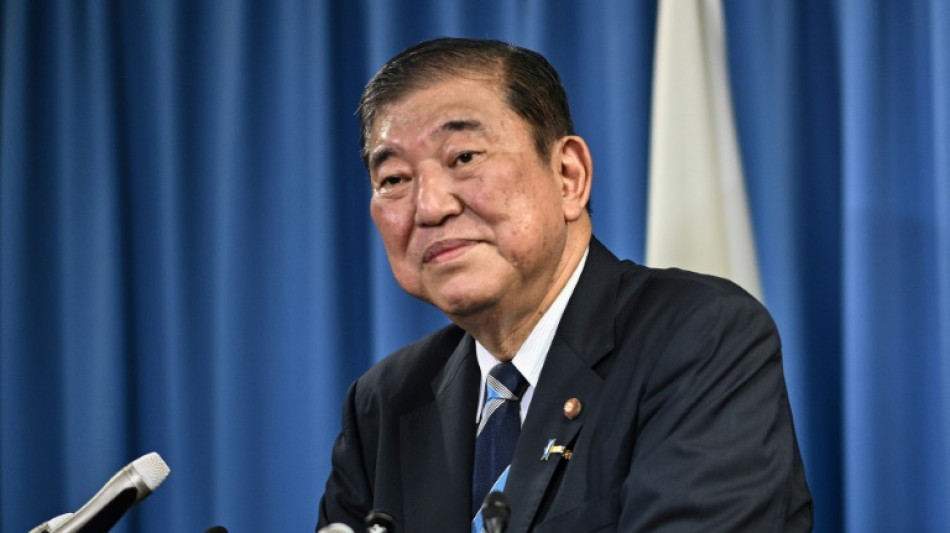
With bulging in-tray, Ishiba to become Japan PM / Photo: Philip FONG - AFP

With bulging in-tray, Ishiba to become Japan PM

Shigeru Ishiba was set Tuesday to become Japanese prime minister, seeking to restore the ruling party's popularity and tackle a demographic crisis, a lacklustre economy and fears over China's military build-up.

Text size:

Ishiba, 67, on Friday won a tight race to head the Liberal Democratic Party (LDP), which has governed almost constantly for decades. He says he intends to call an election for October 27.

Parliament, where the LDP has a majority, was expected to appoint Ishiba on Tuesday afternoon as Japan's 65th prime minister, followed by the announcement of his cabinet.

Former chief cabinet secretary Katsunobu Kato was tipped to be finance minister, while Gen Nakatani will take defence and Takeshi Iwaya foreign affairs, local media said.

Ishiba, who has held two ministerial posts, is a self-confessed defence "geek" who tried and failed four times previously to become LDP leader.

He finally succeeded this time because while a divisive figure within the party, he is -- unlike predecessor Fumio Kishida -- relatively popular among voters, analysts said.

Ishiba's win "indicates that the LDP sought an experienced leader with broad voter appeal to steer the party in the next national election," said Yuko Nakano of the Center for Strategic and International Studies.

"If the ruling coalition secures a fresh mandate (in the election), Ishiba will have the opportunity to reshape the party's internal dynamics and restore public confidence, while addressing Japan's broader challenges, including economic stagnation felt by many voters and regional security concerns," she said.

- Tumbling stocks -

Markets have however reacted negatively, with the Nikkei plunging almost five percent on Monday. On Tuesday the index recovered some ground, up 1.6 percent late morning.

Ishiba's backing of interest rate hikes by the Bank of Japan sent the yen higher, while the prospect of corporate tax hikes has worried investors.

One major area of government spending is the military.

Kishida undertook to double defence spending and boost ties with the United States and other countries rattled by China's rise and the behaviour of Russia and North Korea.

Last week a Japanese warship sailed through the Taiwan Strait for the first time. A week earlier a Chinese aircraft carrier steamed between two Japanese islands near Taiwan.

Japan has also scrambled fighter jets on multiple occasions in recent weeks to respond to activity by Russian and Chinese aircraft, including in its airspace.

Ishiba, who visited Taiwan in August, backs the creation in the region of a military alliance along the lines of NATO with its tenet of collective defence.

"Replacing Russia with China and Ukraine with Taiwan, the absence of a collective self-defence system like NATO in Asia means that wars are likely to break out because there is no obligation for mutual defence," Ishiba said in a recent policy paper.

(A.Berg--BBZ)



