
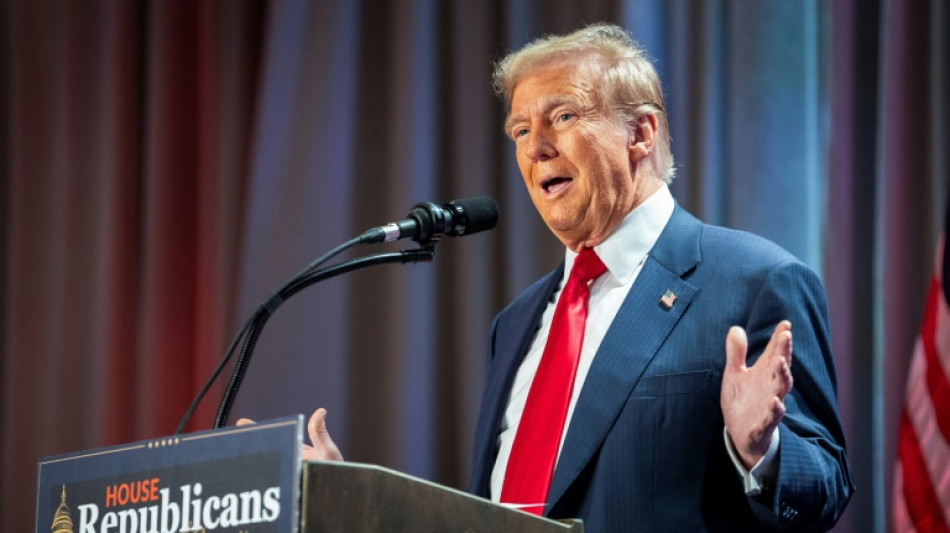
Trump vows big tariffs on Mexico, Canada and China / Photo: Allison ROBBERT - POOL/AFP

US President-elect Donald Trump said Monday he intends to impose sweeping tariffs on goods from Mexico, Canada and China in response to illegal drug trade and immigration.
In a series of posts to his Truth Social account, Trump vowed to hit some of the United States' largest trading partners with duties on all goods entering the country.
"On January 20th, as one of my many first Executive Orders, I will sign all necessary documents to charge Mexico and Canada a 25 percent tariff on ALL products coming into the United States, and its ridiculous Open Borders," he wrote.
In another post, Trump said he would also be slapping China with a 10 percent tariff, "above any additional Tariffs," on all of its products entering the US in response to what he said was its failure to tackle fentanyl smuggling.
Tariffs are a key part of Trump's economic agenda, with the Republican president-elect vowing wide-ranging duties on allies and adversaries alike while he was on the campaign trail ahead of his November 5 victory.
Trump's first term in the White House was marked by an aggressive and protectionist trade agenda that also targeted China, Mexico and Canada, as well as Europe.
While in the White House, Trump launched an all-out trade war with China, imposing significant tariffs on hundreds of billions of dollars of Chinese goods.
At the time he cited unfair trade practices, intellectual property theft, and the trade deficit as justifications.
China responded with retaliatory tariffs on American products, particularly affecting US farmers.
The US, Mexico and Canada are tied to a three-decade-old free trade agreement, now called the USMCA, that was renegotiated under Trump after he complained that the US businesses, especially automakers, were losing out.
"Mexico and Canada remain heavily dependent on the US market so their ability to walk away from President-elect Trump's threats remains limited," Wendy Cutler, vice president at the Asia Society Policy Institute, and former US trade official, told AFP.
By citing the fentanyl crisis and illegal immigration, Trump appeared to be citing national security concerns as a means to break that deal, something that is usually allowed under the rules set by the World Trade Organization or in trade deals.
But most countries and the WTO treat national security exceptions as something to be used sparingly, not as a routine tool of trade policy.
Trump in 2018 cited national security justifications to impose tariffs on steel and aluminum imports that targeted close allies like Canada, Mexico, and the European Union.
This led to retaliatory measures from the trading partners.
- 'Bet on China tariffs' -
Many economists have warned that tariffs would hurt growth and push up inflation, since they are primarily paid by importers bringing the goods into the US, who often pass those costs on to consumers.
But those in Trump's inner circle have insisted that the tariffs are a useful bargaining chip for the US to push its trading partners to agree to more favorable terms, and to bring back manufacturing jobs from overseas.
Trump has said he will put his commerce secretary designate Howard Lutnick, a China hawk, in charge of trade policy.
Lutnick has expressed support for a tariff level of 60 percent on Chinese goods alongside a 10 percent tariff on all other imports.
William Reinsch, senior adviser at the Center for Strategic and International Studies, said that that move was classic Trump: "threaten, and then negotiate."
"In terms of what might actually happen, I'd bet on some China tariffs going into effect. That's legally easier and politically more palatable,' he said.
"On Canada and Mexico there was going to be a renegotiation of their trade deal (the USMCA) anyway in 2026."
(K.Müller--BBZ)



