Berliner Boersenzeitung - Emigration and war hit once-booming Belarus tech sector

EUR -
AED 4.071603
AFN 72.063828
ALL 90.767
AMD 405.078305
ANG 1.984285
AOA 1017.760889
ARS 1712.354319
AUD 1.619254
AWG 1.995609
AZN 1.880429
BAM 1.955116
BBD 2.258609
BDT 139.811061
BGN 1.937771
BHD 0.423046
BIF 3354.625769
BMD 1.108672
BND 1.433598
BOB 13.300004
BRL 6.169981
BSD 1.121392
BTN 105.388111
BWP 15.384407
BYN 3.357625
BYR 21729.969788
BZD 2.255311
CAD 1.580118
CDF 2566.57511
CHF 0.923934
CLF 0.027708
CLP 1090.512103
CNY 7.39523
CNH 7.399271
COP 3644.603749
CRC 507.215595
CUC 1.108672
CUP 26.913579
CVE 110.231884
CZK 24.377494
DJF 199.690102
DKK 7.475667
DOP 68.015272
DZD 151.6858
EGP 59.368826
ERN 16.630079
ETB 182.516244
FJD 2.513525
FKP 0.832264
GBP 0.835378
GEL 2.90055
GGP 0.832264
GHS 13.131404
GIP 0.832264
GMD 82.042039
GNF 9934.567375
GTQ 8.569426
GYD 234.989403
HKD 8.697486
HNL 30.143041
HRK 7.504611
HTG 146.989212
HUF 364.807432
IDR 20166.686936
ILS 3.519867
IMP 0.832264
INR 103.918758
IQD 1700.096917
IRR 2113211.844764
ISK 136.566334
JEP 0.832264
JMD 177.975295
JOD 0.78606
JPY 177.260003
KES 145.712381
KGS 96.952912
KHR 4573.419777
KMF 490.032808
KPW 997.804692
KRW 1484.711016
KWD 0.345219
KYD 0.934473
KZT 500.654754
LAK 25241.164753
LBP 100420.349537
LKR 372.67955
LRD 190.633272
LSL 18.384265
LTL 3.27362
LVL 0.670625
LYD 7.188484
MAD 10.939414
MDL 20.150946
MGA 5074.155225
MKD 61.531797
MMK 2327.928943
MNT 3995.048256
MOP 9.061219
MRU 45.236554
MUR 52.295821
MVR 17.072798
MWK 1944.493054
MXN 20.633937
MYR 4.515181
MZN 70.841511
NAD 18.384265
NGN 1492.571601
NIO 41.265556
NOK 10.595949
NPR 168.618696
NZD 1.993065
OMR 0.426228
PAB 1.121463
PEN 3.821762
PGK 5.036169
PHP 70.258722
PKR 307.899459
PLN 4.412636
PYG 6922.576868
QAR 4.087972
RON 5.345681
RSD 117.601267
RUB 92.105391
RWF 1659.096814
SAR 4.167623
SBD 8.969984
SCR 15.366789
SDG 666.868756
SEK 11.06211
SGD 1.424565
SHP 0.830746
SLE 25.392647
SLL 23248.300869
SOS 640.867004
SRD 41.737049
STD 22947.270509
STN 24.491096
SVC 9.812565
SYP 14414.952058
SZL 18.389314
THB 37.445949
TJS 10.30615
TMT 3.880352
TND 3.342296
TOP 2.669416
TRY 55.69062
TTD 7.605338
TWD 36.476388
TZS 2950.601712
UAH 51.003657
UGX 4575.625371
USD 1.108672
UYU 45.376368
UZS 13428.299648
VES 998.348542
VND 28442.423975
VUV 132.837953
WST 3.089934
XAF 655.957
XAG 0.021445
XAU 0.000278325468
XCD 2.996242
XCG 2.021102
XDR 0.783889
XOF 655.957
XPF 119.331742
YER 262.199651
ZAR 18.405384
ZMK 9979.376155
ZMW 22.848002
ZWL 356.991908
SSP 6369.76093
MXV 2.318423
  • CMSD

    -0.1200

    19.81

    -0.61%

  • JRI

    0.0000

    10.77

    0%

  • BCC

    -1.8200

    74.15

    -2.45%

  • CMSC

    -0.2228

    19.53

    -1.14%

  • BCE

    0.2000

    20.34

    +0.98%

  • RIO

    0.0100

    94.17

    +0.01%

  • AZN

    -2.7400

    161.47

    -1.7%

  • GSK

    -1.1800

    48.17

    -2.45%

  • RBGPF

    0.0000

    65

    0%

  • NGG

    0.8800

    75.82

    +1.16%

  • RYCEF

    -0.7300

    19.08

    -3.83%

  • BTI

    -0.4500

    54.4

    -0.83%

  • BP

    0.4700

    43.99

    +1.07%

  • RELX

    -0.0600

    33.18

    -0.18%

  • VOD

    -0.1800

    16.15

    -1.11%

Emigration and war hit once-booming Belarus tech sector
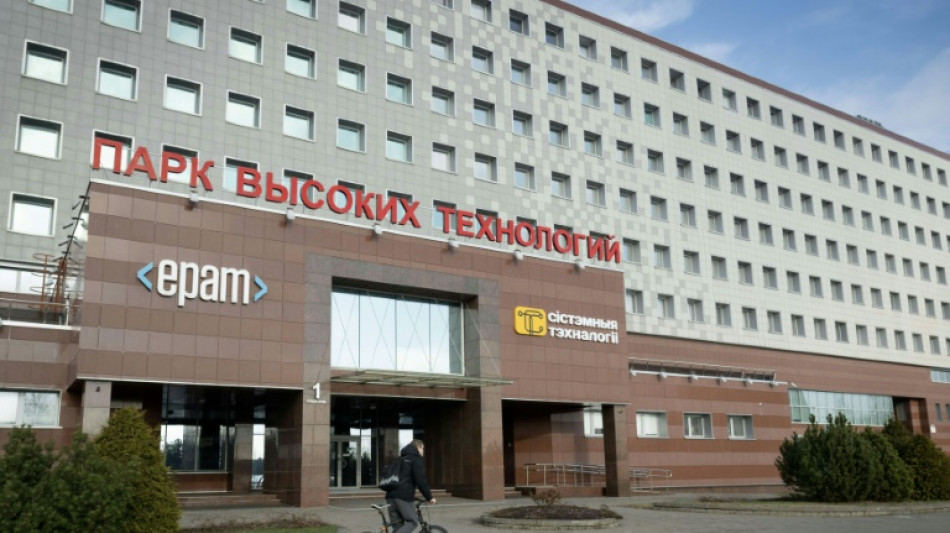
Emigration and war hit once-booming Belarus tech sector / Photo: Natalia KOLESNIKOVA - AFP

Emigration and war hit once-booming Belarus tech sector

A project manager in Belarus's once-flourishing tech industry, Andrei Dorin admits his sector is in "crisis".

Text size:

Thousands of programmers have moved abroad because of stepped-up political repression and President Alexander Lukashenko's support for Russia's invasion of Ukraine in 2022.

Dorin told AFP that out of around 400 engineers at his software development company Qulix, some 25 percent have moved abroad over the last five years.

"It's a lot," the 42-year-old said.

Tech has been one of the few relatively liberalised sectors in ex-Soviet Belarus's state-dominated economy.

It experienced a boom until 2020, particularly for app and software development and maintenance.

The "Hi-Tech Park" in Minsk -- a cluster of buildings on the outskirts of the capital -- was one of the symbols of this success and was quickly dubbed the "Silicon Valley" of Belarus.

The Viber messaging service and the video game "World of Tanks" were developed here.

But the bloody repression that followed authoritarian leader Lukashenko's re-election in 2020 pushed many tech workers to emigrate.

- Exports plunge -

The turning point came in September 2020 when police raided the software company PandaDoc and arrested several employees, after the group's boss voiced his support for anti-Lukashenko protests.

Russia's invasion of Ukraine in February 2022 accelerated the exodus after Belarus was hit by Western sanctions for allowing Russia to use its territory to launch the attack.

Kirill Zalessky, deputy director of Hi-Tech Park, said the number of employees in the cluster has fallen by nearly 30 percent since 2022 to 56,000 people.

Exports also fell by 45 percent from $3.2 billion in 2021 to $1.8 billion in 2023.

But Zalessky said he preferred to "see the glass as half full", pointing out that there are still 1,000 companies at Hi-Tech Park benefiting from tax breaks.

He said the departure of tech workers "broadly stopped more than a year ago" and "many developers want to come back".

Zalessky also said Belarusian tech companies affected by Westerns sanctions are finding new markets in Asia.

- Regional stability -

Stephan Hoffmann, the German head of the European-Belarusian Business Association, said he was hopeful about the future although his work had become more "uncomfortable" because of sanctions.

Instead of direct flights to Germany, the 39-year-old business owner takes long bus journeys to Lithuania.

Another difficulty is bank payments.

"It is more and more expensive and takes more time," he said, since sanctions have taken four Belarusian banks out of the SWIFT financial messaging network which underpins global payments.

But he said exiled Belarusians and those who stayed in the country could "still work together", albeit remotely.

"There are still connections," he said.

Zalessky said he was "cautious" about what the future might hold, citing the need for "a stable regional situation".

(A.Lehmann--BBZ)