Berliner Boersenzeitung - Germany's huge spending package passes final hurdle in upper house

EUR -
AED 4.072631
AFN 72.082457
ALL 90.411931
AMD 399.756294
ANG 1.984791
AOA 1018.021125
ARS 1717.476479
AUD 1.618641
AWG 1.996119
AZN 1.883348
BAM 1.947476
BBD 2.249784
BDT 139.264755
BGN 1.938266
BHD 0.421399
BIF 3341.517691
BMD 1.108955
BND 1.428054
BOB 13.247378
BRL 6.163461
BSD 1.117026
BTN 104.97631
BWP 15.324225
BYN 3.34464
BYR 21735.52008
BZD 2.246498
CAD 1.579346
CDF 2567.230885
CHF 0.923377
CLF 0.027728
CLP 1091.311732
CNY 7.397119
CNH 7.398683
COP 3669.022327
CRC 505.240502
CUC 1.108955
CUP 26.808416
CVE 109.795711
CZK 24.384478
DJF 198.90982
DKK 7.475616
DOP 67.753159
DZD 151.735048
EGP 59.338855
ERN 16.634327
ETB 181.805527
FJD 2.512451
FKP 0.832477
GBP 0.835326
GEL 2.886177
GGP 0.832477
GHS 13.080093
GIP 0.832477
GMD 82.062482
GNF 9895.703801
GTQ 8.535632
GYD 234.05538
HKD 8.700668
HNL 30.026878
HRK 7.506528
HTG 146.420113
HUF 364.632598
IDR 20166.348605
ILS 3.525662
IMP 0.832477
INR 103.944636
IQD 1693.430659
IRR 2113751.603665
ISK 136.745462
JEP 0.832477
JMD 177.28226
JOD 0.78621
JPY 177.096247
KES 144.164089
KGS 96.977681
KHR 4555.44696
KMF 490.158153
KPW 998.059553
KRW 1482.002352
KWD 0.345306
KYD 0.930859
KZT 498.698464
LAK 25142.53582
LBP 100027.960675
LKR 371.223318
LRD 189.896052
LSL 18.312429
LTL 3.274456
LVL 0.670796
LYD 7.160395
MAD 10.896128
MDL 20.073018
MGA 5054.396508
MKD 61.554164
MMK 2328.523545
MNT 3996.068676
MOP 9.025689
MRU 45.060403
MUR 52.309345
MVR 17.104169
MWK 1936.921215
MXN 20.649537
MYR 4.516336
MZN 70.85982
NAD 18.312429
NGN 1492.819456
NIO 41.104312
NOK 10.585825
NPR 167.95908
NZD 1.991633
OMR 0.426393
PAB 1.117026
PEN 3.806829
PGK 5.016558
PHP 70.236783
PKR 306.704632
PLN 4.411425
PYG 6895.527151
QAR 4.071796
RON 5.34727
RSD 117.605763
RUB 91.7396
RWF 1652.703084
SAR 4.161424
SBD 8.972276
SCR 15.421044
SDG 667.034305
SEK 11.076815
SGD 1.424447
SHP 0.830958
SLE 25.405147
SLL 23254.238975
SOS 638.36001
SRD 41.747754
STD 22953.131725
STN 24.395728
SVC 9.774223
SYP 14418.63394
SZL 18.317953
THB 37.431119
TJS 10.26514
TMT 3.881343
TND 3.329071
TOP 2.670097
TRY 55.705271
TTD 7.57562
TWD 36.50381
TZS 2936.984468
UAH 50.805049
UGX 4557.520255
USD 1.108955
UYU 45.19682
UZS 13375.829056
VES 998.603538
VND 28449.68877
VUV 132.871883
WST 3.090723
XAF 655.957
XAG 0.021186
XAU 0.000276064467
XCD 2.997007
XCG 2.013078
XDR 0.784089
XOF 655.957
XPF 119.331742
YER 262.273308
ZAR 18.39899
ZMK 9981.918073
ZMW 22.758725
ZWL 357.083092
SSP 6371.387902
MXV 2.320176
  • CMSD

    -0.1200

    19.81

    -0.61%

  • JRI

    0.0000

    10.77

    0%

  • BCC

    -1.8200

    74.15

    -2.45%

  • CMSC

    -0.2228

    19.53

    -1.14%

  • BCE

    0.2000

    20.34

    +0.98%

  • RIO

    0.0100

    94.17

    +0.01%

  • AZN

    -2.7400

    161.47

    -1.7%

  • GSK

    -1.1800

    48.17

    -2.45%

  • RBGPF

    0.0000

    65

    0%

  • NGG

    0.8800

    75.82

    +1.16%

  • RYCEF

    -0.7300

    19.08

    -3.83%

  • BTI

    -0.4500

    54.4

    -0.83%

  • BP

    0.4700

    43.99

    +1.07%

  • RELX

    -0.0600

    33.18

    -0.18%

  • VOD

    -0.1800

    16.15

    -1.11%

Germany's huge spending package passes final hurdle in upper house
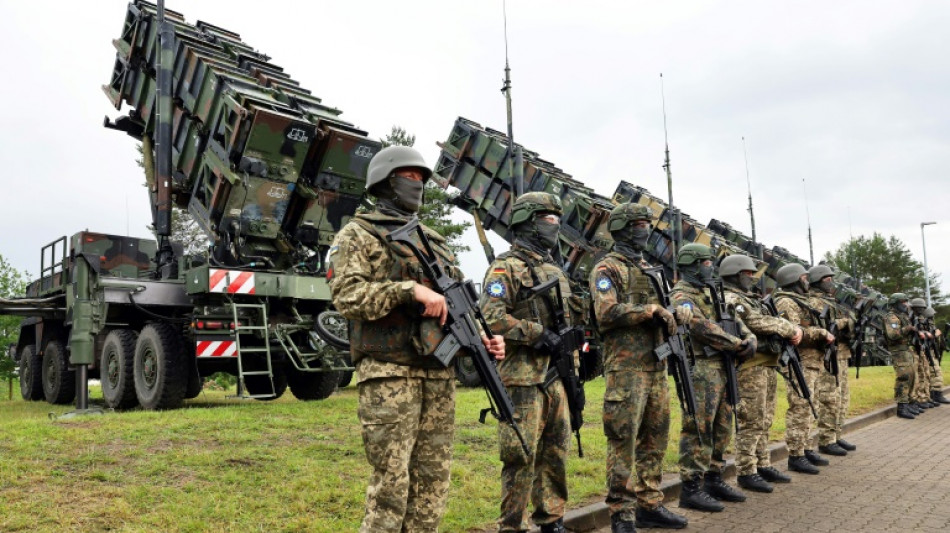
Germany's huge spending package passes final hurdle in upper house / Photo: Jens Büttner - POOL/AFP/File

Germany's huge spending package passes final hurdle in upper house

Germany's upper house of parliament on Friday gave the final seal of approval to a massive spending package to build up the military and overhaul infrastructure.

Text size:

Worth hundreds of billions of euros, the so-called spending "bazooka" has been pushed by the likely next chancellor Friedrich Merz, whose centre-right CDU/CSU won elections last month and is now in coalition talks with the centre-left Social Democrats (SPD).

The plan exempts defence spending above one percent of GDP from Germany's constitutionally enshrined debt brake and sets up a 500-billion-euro ($545-billion) fund for infrastructure over 12 years.

This paves the way for over one trillion euros (dollars) worth of outlays in Europe's top economy, which has shrunk for the past two years.

The plan marks a dramatic break from Germany's economic orthodoxy, particularly for the CDU/CSU alliance which has been wedded to the debt brake since it was brought in in 2009.

The party has shifted position in the wake of US President Donald Trump's overtures to Moscow, saying there is now an urgent need to invest in defence to become more independent from Washington.

Bavaria's state premier Markus Soeder, who heads the CSU, told the chamber that "we must do everything we can to ensure that Germany once again becomes one of the strongest armies in Europe and can protect itself".

And he labelled the massive infrastructure spending a new "German Marshall Plan", referring to the American post-World War II effort to rebuild western Europe.

Soeder said Germany would undertake long-neglected upgrades of roads, bridges and rail lines, arguing that letting them fall into disrepair was a greater disservice to the next generation than building up state debt.

- 'Brutal paradigm shift' -

Berlin's move to bolster its fiscal firepower has been keenly watched by its neighbours as Europe scrambles to adapt to Trump's pivot away from traditional alliances.

The package needed a two-thirds majority and was approved by 53 of the Bundesrat's 69 members, after it cleared the lower house on Tuesday.

The upper house is made up of representatives of Germany's 16 federal states, and several state leaders spoke in favour of the package before the vote.

Boris Rhein, CDU leader of the central state of Hessen -- home to many US army bases -- said that geopolitical turmoil spelt "a brutal paradigm shift" for Germany which had learnt that "we cannot rely on military help from the United States".

He pointed to Trump berating his Ukrainian counterpart Volodymyr Zelensky in front of the world's media in the White House last month, calling the exchange "an obscene humiliation of a president whose people are fighting for their freedom".

"Europe must react to this, Germany must react to this, quickly and decisively," he said.

Representatives from the states of Thuringia and Brandenburg, where the far-left BSW party is part of governing coalitions, refused to approve the spending plans on Friday, as did those from Saxony-Anhalt and Rhineland-Palatinate, where the debt-averse Free Democrats (FDP) are in state governments.

(U.Gruber--BBZ)