
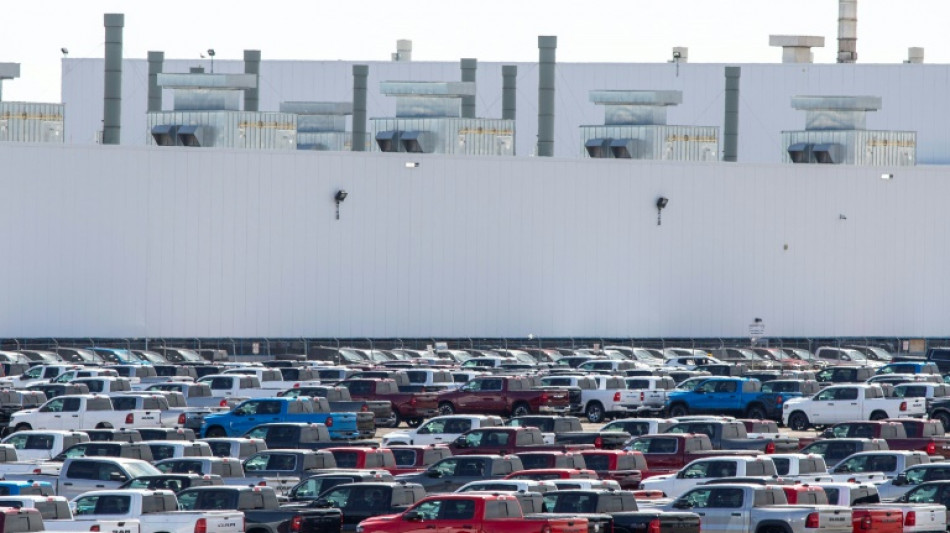
Trump tempers auto tariffs, winning cautious praise from industry / Photo: BILL PUGLIANO - GETTY IMAGES NORTH AMERICA/AFP/File

President Donald Trump moved Tuesday to soften tariffs on automakers, sparking cautious optimism in an industry that has been on tenterhooks as it awaits details on the fast-evolving policy.
Trump signed an executive order to limit the impact of overlapping tariffs on automakers. He also released a proclamation that gives the industry a two-year grace period to move supply chains back to the United States and reduce "American reliance on imports of foreign automobiles and their parts."
Automakers have been among the hardest-hit sectors by Trump's multi-pronged assault on free trade. The announcement of relief coincided with a visit by the president to the Detroit area to celebrate his 100th day in office.
"We just wanted to help them during this little transition," Trump said. "Short term."
The American Automotive Policy Council welcomed the steps, calling tariff duplication a "significant concern," according to its president, Matt Blunt. The council represents General Motors, Ford and Jeep-maker Stellantis.
"We will review the details of the Executive Order closely to assess how effectively it will mitigate the impact of tariffs on American Automakers, our domestic supply chains and ultimately American consumers," Blunt said.
Analysts have warned that the myriad levies could result in higher prices, denting US car sales and threatening jobs.
Trump, who has slammed free trade deals from his first presidential campaign in 2016, has embraced tariffs as necessary to spur more auto manufacturing in the United States.
But the administration determined that some relief was needed to give companies enough time to move supply chains to this country, a senior Commerce Department official said in a briefing.
"You're going to see a massive resurgence of domestic auto manufacturing," the official said.
- Grace period -
Besides a 25 percent tariff on finished imported cars, the industry has also been affected by Trump's 25 percent tariff on steel and aluminum. Automakers are also set to face new tariffs on foreign auto parts expected to take effect on May 3.
Trump's new policy means that a company wouldn't face both a 25 percent levy for an imported vehicle and 25 percent on steel or aluminum; the importer would pay the higher of the two levies, but not both, a Commerce official said.
The other change is that companies that import parts for vehicles assembled in the United States would be able to offset 3.75 percent of a vehicle's list price in the first year and 2.5 percent in the second year.
That modification is designed to give companies two years to move supply chains to the United States.
Automakers told the Trump administration there would be "dramatic increases in production... as the payoff to America" from a two-year grace period, the Commerce official said.
Roughly half the cars sold in the United States are assembled within the country, with another 25 percent coming from Mexico and Canada and the remainder from a broader swath of nations including Germany, Japan and South Korea.
Automakers have already announced some investment decisions in light of the tariffs.
But analysts have cautioned that Trump's approach will not incentivize multi-billion-dollar investments if the industry does not believe the tariffs will last throughout Trump's administration and beyond.
General Motors said this month that it plans to boost truck production at its plant in Fort Wayne, Indiana.
GM is looking at other actions "we could implement quickly, efficiently and with low near-term costs," Chief Financial Officer Paul Jacobson said Monday.
Jacobson declined to comment on GM's plans for South Korea, where it builds a number of low-cost vehicles that have become popular with US consumers focused on price.
Ford CEO Jim Farley said the company "welcomes and appreciates these decisions by President Trump, which will help mitigate the impact of tariffs on automakers, suppliers and consumers," according to a statement.
"Ford sees policies that encourage exports and ensure affordable supply chains to promote more domestic growth as essential," said Farley, who estimated that US factories could build four million more cars annually, supporting hundreds of thousands of new jobs.
Nissan, Honda and Volvo have been among the foreign automakers that have announced steps to boost investment in the United States.
(G.Gruner--BBZ)



