Demining Ukraine: from drones to risking it with a rake / Photo: Ivan SAMOILOV - AFP

There were so many mines on Larisa Sysenko's small farm in Kamyanka in eastern Ukraine after the Russians were pushed out that she and her husband Viktor started demining it themselves -- with rakes.
Further along the front line at Korobchyne near Kharkiv, Mykola Pereverzev began clearing the fields with his farm machinery.
"My tractor was blown up three times. We had to get a new one. It was completely unrepairable. But we ended up clearing 200 hectares of minefields in two months," he said.
"Absolutely everyone demines by themselves," declared Igor Kniazev on his farm half an hour from Larisa's.
Ukraine is one of the great bread baskets of the world, its black earth so rich and fertile you want to scoop it up in your hands and smell it.
But that dark soil is now almost certainly the most mined in the world, experts told AFP.
More than three years of unrelenting artillery barrages -- the biggest since World War II -- have sown it with millions of tons of ordnance, much of it unexploded.
One in 10 shells fail to detonate, experts estimate, with as much as a third of North Korean ordnance fired by Russia failing to go off, the high explosives moulding where they fall.
Yet the drones which have revolutionised the way war is fought in Ukraine may also now become a game-changer in demining the country.
Ukraine itself and some of the more than 80 NGOs and commercial groups working there are already using them to speed the mammoth task of clearing the land, with the international community pledging a massive sum to the unprecedented effort.
- Gallows in the garden -
But on the ground it is often the farmers themselves -- despite the dangers and official warnings -- who are pushing ahead on their own.
Like the Sysenkos.
They were among the first to return to the devastated village of Kamyanka, which was occupied by the Russian army from March to September 2022.
Two weeks after its recapture by Ukrainian soldiers, Larisa and Viktor went back to check their house and found it uninhabitable, without water or electricity.
So they let the winter pass and returned in March 2023 to clean up, first taking down the gallows Russian soldiers had set up in their yard.
And they began demining. With their rakes.
"There were a lot of mines and our guys (in the Ukrainian army) didn't have time to take care of us. So slowly we demined ourselves with rakes," said Larisa cheerily.
Boxes of Russian artillery shells are still stacked up in front of their house -- 152mm howitzer shells to be precise, said Viktor with a mischievous smile.
"I served in the artillery during Soviet times, so I know a bit," the 56-year-old added.
That summer a demining team from the Swiss FSD foundation arrived and unearthed 54 mines in the Sysenkos's field.
They were probably laid to protect a 2S3 Akatsiya self-propelled gun -- which looks like a big tank -- with which the Russians could hit targets up to 24 kilometres (15 miles) away.
- Deadly 'flowers' -
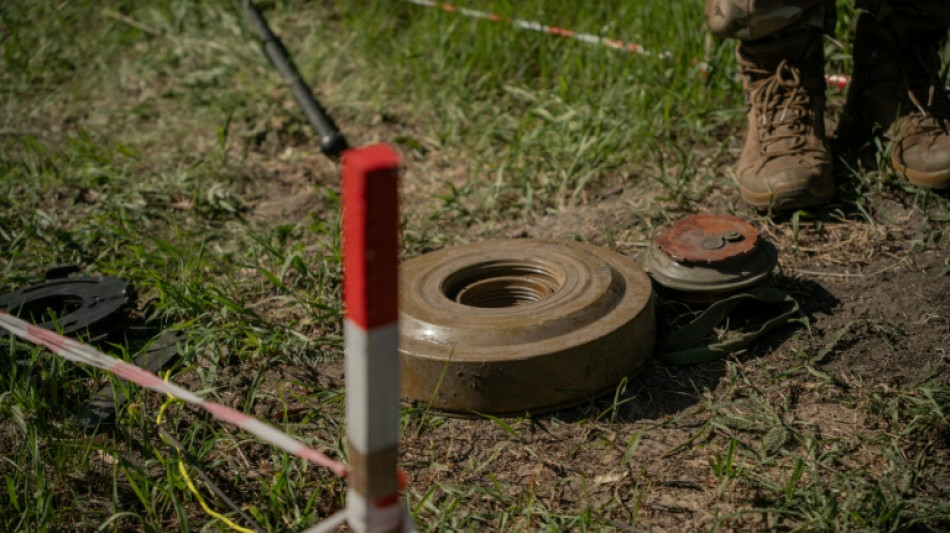
The PFM-1 anti-personnel mines they found are sensitive enough to detonate under the weight of a small child, exploding under only five kilograms of pressure.
Known as the "flower petal" or "butterfly" mine, they blend horrifyingly well into fields and forests, with their petal shape and khaki colour.
They are banned under the 1997 Ottawa International Convention, to which Russia never signed up.
Ukraine said on Sunday it was withdrawing from the treaty.
The deminers told the Sysenkos "to evacuate the house".
"Under their rules, we couldn't stay there. So we obeyed. The demining machine went back and forth and there were tons of explosions under it."
With its gutted homes, Kamyanka still looks like a ghost village but about 40 people have moved back. (Its pre-war population was 1,200.)
Many fear the mines and several people have stepped on them -- "99 percent on the flower petal ones", said Viktor.
Yet farmers cannot afford to wait and are back at work in the vast fields famous for Ukraine's intensely black and fertile "chernozem" soil, which is rich in humus.
"If you look at the villages around here, farmers have adapted tractors themselves to clear their land and they are already planting wheat and sunflowers," Viktor added.
- Most mined land -
Ukraine's "cereal production fell from 84 million tons before the war to 56 million tons" last year, a drop of one-third, agriculture minister Vitaliy Koval told AFP.
"Ukraine has 42 million hectares (103 million acres) of agricultural land. On paper, we can cultivate 32 million hectares. But usable, uncontaminated land not occupied by Russia -- (we have) only 24 million hectares," he added.
A fifth of Ukraine's total territory (123,000 square kilometres, 48,000 square miles) is "potentially contaminated" by mines or explosives, according to government data.
That's an area roughly the size of England.
So does that make Ukraine the most mined country in the world?
"I think that is probably true in terms of the most unexploded bombs and shells and the most mines in the ground," said Paul Heslop, the United Nations Mine Action Service adviser in Ukraine.
Like all experts AFP talked to, he said it was impossible to make an accurate count in a country at war with a front line stretching 1,000 kilometres (620 miles) and its Russian-controlled areas inaccessible.
"(But) if you have got maybe four to five million unexploded shells or munitions, and three to five million mines, you potentially have 10 million explosive devices in the ground."
Pete Smith, who leads the HALO Trust's 1,500 staff in Ukraine, is a veteran of demining Iraq and Afghanistan.
But "I can say with a large degree of certainty" that no other country has been strewn with so many explosives, he said.
- Tractors blown up -
Some semblance of normal life has returned for the Sysenkos.
Their two dogs frolic around a sign marked "Danger Mines".
Birds now nest in the bullet and shell holes in the peach-coloured walls of their farmhouse.
But the demining will be going on for some time around them.
To get some idea of how thankless it can be, the Swiss FSD team found only the remnants of three explosives after two years of searching a nearby 2.6-hectare plot (about the size of three football fields).
"Metal contamination was so intense that our detectors became unusable. They were constantly going off," their site chief told AFP.
But after checking the thousands of metal fragments they had found, almost all turned out not to be dangerous.
The snail's pace of the meticulous process exasperates farmer Kniazev, who rattles off his gripes with the demining groups at machine gun pace.
"Every year they promise: 'Tomorrow, tomorrow, we'll clear all the fields.'" So in the end, he did it himself.
Like the Sysenkos, Kniazev went back to his land as soon as the Russians withdrew and has since demined 10 hectares by himself.
He hopes to finish the final 40 within a year.
How?
"I took a metal detector and cleared the mines," he shot back.
"I was on my tractor when the harrow (being dragged behind) hit a mine and it exploded."
- Lost leg, went back to work -
Kniazev managed to repair the tractor but the harrow was a write-off.
"I was lucky," he said with a twinkle in his steel blue eyes.
Others not so much. "Demining will take a long, long time because people keep detonating mines," he said.
"Dozens (of farmers) around here have already hit TM anti-tank mines. Many of our folks also stepped on OZM mines."
These Soviet-era "jumping" anti-personnel mines are particularly dangerous, leaping up a metre (three feet) when triggered and spraying 2,400 bits of shrapnel at everything within 40 metres.
Kniazev has been turning the remnants of Russian shells into pipes.
"I'll make a lamp" with that empty cluster bomb on the floor, he said.
A prosperous farmer before the war, he is slowly getting back on his feet despite losing a large part of his agricultural machinery.
He had just planted wheat after growing potatoes last year. He plans to diversify into mushrooms, which are highly profitable, he said.
Andriy Ilkiv lost his left leg below the knee when an anti-personnel mine exploded under his foot on September 13, 2022.
"I returned to work about four months later," said the head of a Ukrainian Interior Ministry demining team, even though the father-of-five was eligible for an office job because of his disability.
"I'm used to this work, I like it," he told AFP.
"Staying in an office isn't for me," he added, his colleagues gently ribbing him as they begin their day's work, the engine of their huge 12.5-ton German-made excavator already humming.
- Hairdresser turned deminer -
Kniazev said many Ukrainians work in demining for the good pay and to avoid conscription.
Former hairdresser Viktoria Shynkar has been working for HALO Trust, the world's biggest non-governmental demining group, for a year.
And she happily admitted the pay was one part of what drew her to this field in Tamaryne near Mykolaiv, not far from the Black Sea.
The 1,000 euros ($1,180) monthly wage she gets after the three weeks of training is as much as a young doctor is paid.
And despite the heavy body armour and helmet, it is much less tiring than being a hairdresser, where she hated making small talk with customers and was always on her feet.
"Before I used to cut hair. Now I cut grass (looking for mines). Before I cut to the millimetre. Now it's to the centimetre," the 36-year-old said.
You need to be precise. In a field nearby, Shynkar and her colleagues uncovered 243 TM-62 Russian landmines, each armed with enough high explosive to blast through the armour of a battle tank and kill its crew.
The Ukrainian government wants to clear 80 percent of its territory by 2033, despite some questioning how the work will be funded and coordinated, never mind problems with corruption.
"I've seen contracts worth millions that made no sense," a foreign expert, who asked to remain anonymous, told AFP.
"So there are clearly things going on under the table."
- Drones armed with AI -
But some "of the most significant innovations in mine clearance in 20 to 30 years" are also happening in Ukraine, said Smith of the HALO Trust.
"Drones have been incredibly useful, particularly in areas we can't enter safely but they still allow us to survey the area," said Sam Rowlands, the trust's survey coordinator in Ukraine.
It uses 80 drones with various sensors depending on the ground conditions.
The images are sent to their headquarters near Kyiv to map out the minefield and are used to train AI in detecting different types of mines.
Volodymr Sydoruk, a data analyst there, works on the algorithms from partner company Amazon Web Services.
He enters multicoloured code for each type of mine that appears on his giant screen.
It is still early days for their machine learning but it is "already around 70 percent accurate, which is not bad", said Sydoruk.
And AI is likely to make drones a lot more effective in the future, experts say.
"One day we will see demining robots working 23 hours a day, with no risk to human lives," the UN's Heslop said.
"In five or 10 years, everything will be much more automated, thanks to what is happening today in Ukraine," he added.
Then Viktor and Larisa will finally be able to retire their rakes.
(U.Gruber--BBZ)