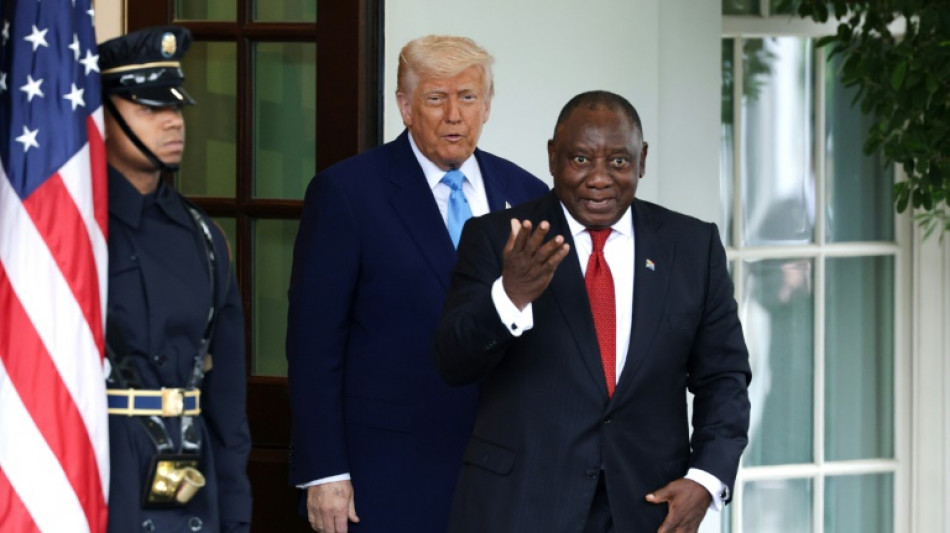
S.Africa eyes new markets after US tariffs: president / Photo: ALEX WONG - GETTY IMAGES NORTH AMERICA/AFP/File

South Africa is seeking new markets in Africa and Asia as it negotiates with the United States over looming 30-percent trade tariffs, which could cost around 30,000 jobs, officials said Monday.
Government ministers expressed frustration with the United States over the tariff -- among those due to take effect against several countries later this week -- saying South African exports do not compete with US industry and were only a fraction of that country's total imports.
The 30-percent tariff is the highest in sub-Saharan Africa and comes as diplomatic relations between South Africa and the United States are in tatters over a range of domestic and international policies.
"Our foremost priority is protecting our export industries," President Cyril Ramaphosa said in his weekly newsletter.
"We will continue to engage the US in an attempt to preserve market access for our products. We must also accelerate the diversification of our export markets, particularly by deepening intra-African trade," he said.
The United States is South Africa's second-largest trading partner by country after China.
The tariffs will in particular hit South Africa's agriculture, automotive and textiles sectors, officials said, although 35 percent of exports are exempted, including copper, pharmaceuticals, semiconductors, lumber articles and certain critical minerals.
The impact on growth depends on various factors, including the sourcing of alternative markets, Foreign Minister Ronald Lamola said in a statement.
He cited forecasts that the impact may shave 0.2 percent off growth, which was only around 0.1 percent in the first quarter of this year.
The South African Reserve Bank last week warned that the US levy could cost 100,000 jobs, with unemployment already at more than 30 percent.
But trade department director general Simphiwe Hamilton told reporters Monday their estimate was that approximately 30,000 jobs could be affected.
- S.Africa 'no threat' -
In a bid to avert the high tariff, South Africa has offered to import US liquefied natural gas and some US agricultural products, as well as invest in its mining and metals-recycling industries.
Pretoria is focused on negotiations for a new deal despite the "very extreme provocation" on the part of the United States, Lamola told reporters.
The 30-percent tariff was "inscrutable" considering that imports from South Africa only represented 0.25 percent of total US imports, the minister said.
"Moreover, South Africa poses no trade threat to the US economy nor its national security," he said, arguing the imports supported US industry and did not compete with it.
An example was that South African agriculture exports were "counter-seasonal" and so filled gaps in the US market without replacing domestic produce, he said.
Pretoria's plummeting ties with Washington and failure to reach a new trade deal has been heavily criticised at home, including by some of the parties in the coalition government who have accused Ramaphosa and his team of diplomatic missteps.
On top of disagreements over a range of issues, including South Africa's case accusing Israel of genocide in Gaza at the International Court of Justice, Washington in March expelled Pretoria's ambassador after he criticised Trump's Make America Great Again (MAGA) movement.
In his newsletter, Ramaphosa said the government has established a support desk that will help exporters and producers explore alternative markets in the rest of Africa, Asia and the Middle East.
It will also push forward with plans for a free-trade area for the African continent, he said.
The United States announced last week 15-percent tariffs on exports from several sub-Saharan countries, including the export-reliant small mountain kingdom of Lesotho, which had initially been threatened with 50-percent tariffs.
(U.Gruber--BBZ)