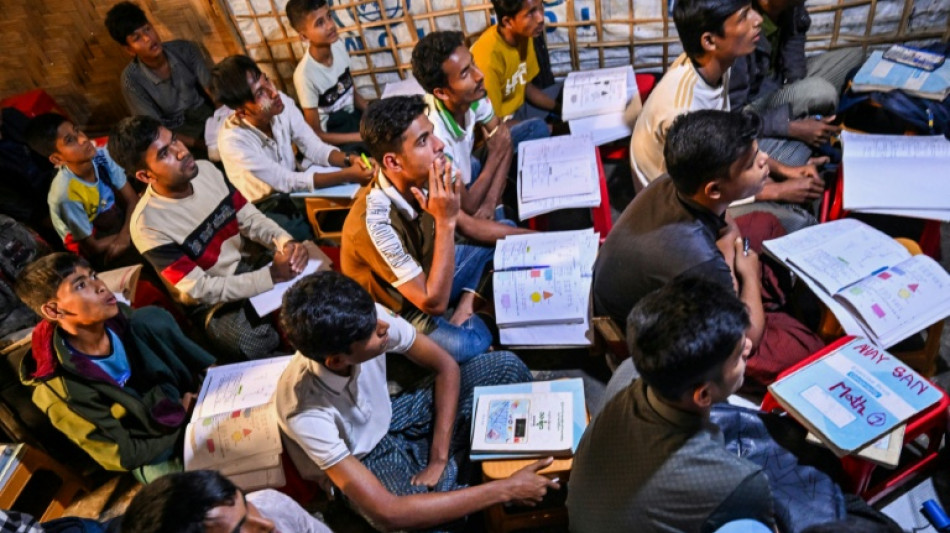
Dreams on hold for Rohingya children in Bangladesh camps / Photo: Munir UZ ZAMAN - AFP

Books tucked under their arms, children file into a small classroom in Bangladesh's vast refugee camps, home to more than a million Rohingya who have fled neighbouring Myanmar.
"They still dream of becoming pilots, doctors or engineers," said their teacher Mohammad Amin, standing in front of a crowded schoolroom in Cox's Bazar.
"But we don't know if they will ever reach their goals with the limited opportunities available."
Around half a million children live in the camps housing the waves of Rohingya who have escaped Myanmar in recent years, many during a brutal military crackdown in 2017.
The campaign, which saw Rohingya villages burned and civilians killed, is the subject of a genocide case at the United Nations' top court in The Hague, where hearings opened on Monday
- 'Severe shortage' -
In the aftermath of the 2017 exodus, international aid groups and UNICEF, the UN's children's agency, rushed to open schools.
Determined to avoid permanently settling refugees it said it lacked the resources to absorb, the Bangladeshi government consistently opposed enrolling Rohingya children in national schools and barred them from studying in Bangla, the national language.
By 2024, UNICEF and its partners were running more than 6,500 learning centres across the Cox's Bazar camps, educating up to 300,000 children.
But the system is severely overstretched -- a situation worsened by cuts to US aid under President Donald Trump, which slashed funding and forced sweeping closures or scale-backs.
"The current system provides three hours of instruction per day for children," said Faria Selim of UNICEF. "The daily contact hours are not enough."
Khin Maung, a member of the United Council of Rohingya which represents refugees in the camps, said the education on offer leaves students ill-prepared to re-enter Myanmar's school system should they return.
"There is a severe shortage of teachers in the camps," he said.
Hashim Ullah, 30, is the only teacher at a primary school run by an aid agency.
"I teach Burmese language, mathematics, science and life skills to 65 students in two shifts. I am not an expert in all subjects," he told AFP.
Such shortcomings are not lost on parents.
For them, education represents their children's only escape from the risks that stalk camp life -- malnutrition, early marriage, child labour, trafficking, abduction or forced recruitment into one of the armed groups in Myanmar's civil war.
As a result, some families supplement the aid-run schools with extra classes organised by members of their own community.
"At dawn and dusk, older children go to community-based high schools," said father-of-seven Jamil Ahmad.
"They have good teachers," and the only requirement is a modest tuition fee, which Jamil said he covered by selling part of his monthly food rations.
"Bangladesh is a small country with limited opportunities," he said. "I'm glad that they have been hosting us."
- 'Justice and peace' -
Fifteen-year-old Hamima Begum has followed the same path, attending both an aid-run school and a community high school.
"I want to go to college," she said. "I am aiming to study human rights, justice, and peace -- and someday I will help my community in their repatriation."
But such schoolsare far too few to meet demand, especially for older children.
A 2024 assessment by a consortium of aid agencies and UN bodies concluded that school attendance falls from about 70 percent among children aged five to 14, to less than 20 percent among those aged 15 to 18.
Girls are particularly badly affected, according to the study.
Even for those who stay enrolled, academic standards remain low.
"We organised a mid-year exam this year, and 75 percent of high school students failed," Khin Maung said.
Jaitun Ara, 19, is therefore an exception.
Having arrived in Cox's Bazar at the age of 12, she has now secured a place at the Asian University for Women in Chittagong on a support programme to prepare for degree studies.
But she doubts many others will be able to follow her path.
"Families can barely manage food," she said. "How would they spend money on their children's education?"
(A.Lehmann--BBZ)