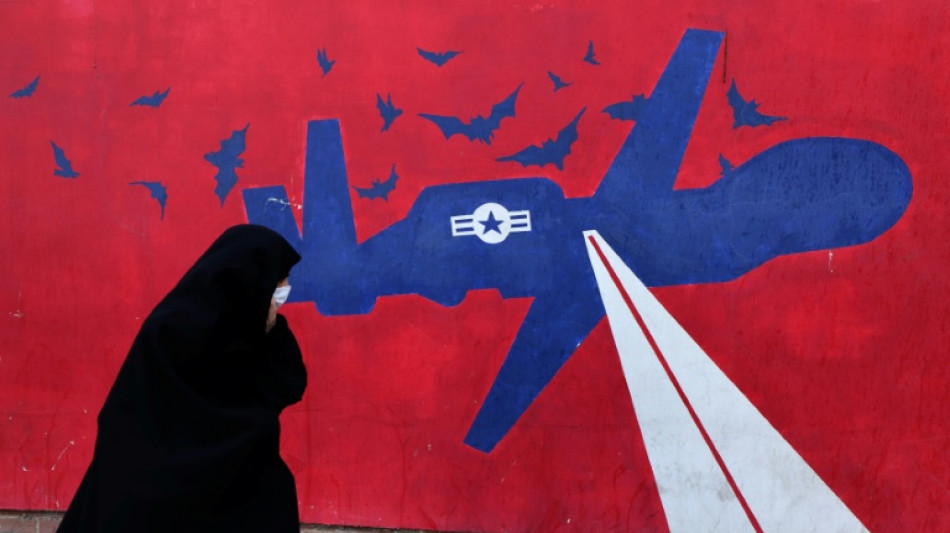
Iran president orders talks with US as Trump hopeful of deal / Photo: ATTA KENARE - AFP

Iranian President Masoud Pezeshkian has ordered the start of nuclear talks with the United States, local media said Monday, after US leader Donald Trump said he was hopeful of a deal to avert military action against the Islamic republic.
Following the Iranian authorities' deadly response to anti-government protests that peaked last month, Trump has threatened military action and ordered the dispatch of an aircraft carrier group to the Middle East.
Trump has maintained he is hopeful of making a deal and Tehran has also insisted it wants diplomacy, while vowing an unbridled response to any aggression.
"President Pezeshkian has ordered the opening of talks with the United States" on Iran's nuclear programme, the Fars news agency reported on Monday, citing an unnamed government source. The report was also carried by the government newspaper Iran and the reformist daily Shargh.
US news site Axios cited two unnamed sources saying Iranian Foreign Minister Abbas Araghchi was expected to meet with US envoy Steve Witkoff on Friday in Istanbul to discuss a possible deal on the nuclear file.
Trump had warned "time is running out" for Iran to reach a deal on its nuclear programme, which the West believes is aimed at making an atomic bomb, a claim Tehran has repeatedly denied.
In an interview Sunday with CNN, Araghchi said, "President Trump said no nuclear weapons, and we fully agree. We fully agree with that. That could be a very good deal," adding that, "in return, we expect sanctions lifting".
Iran foreign ministry spokesman Esmaeil Baqaei said earlier Monday Tehran was working on a method and framework for negotiations that would be ready in the coming days, with messages between the two sides relayed through regional players.
- 'Police the world' -
Turkey has led a diplomatic push to defuse tensions, with Araghchi visiting Istanbul last week and speaking with other regional counterparts, including in Egypt, Saudi Arabia and Jordan.
Jordan's top diplomat, Ayman Safadi, on Monday assured Araghchi the kingdom would "not be a battleground in any regional conflict or a launching pad for any military action against Iran".
Iranian authorities, including supreme leader Ayatollah Ali Khamenei, have warned any US attack would trigger a "regional war".
In Tehran, pensioner Ali Hamidi told AFP he was a veteran and "not afraid of war", but that "America should mind its own business, why does it want to police the world?"
But, the 68-year-old added, "Iranian officials are also at fault for not providing for the people. The economic troubles are back-breaking... The officials should do something tangible, not just talk."
The protests were sparked in late December by economic strain and exploded in size and intensity over several days in early January.
Authorities have said the protests were "riots" inflamed by its arch foes the United States and Israel, with Khamenei likening them to a "coup" attempt.
- Ambassadors summoned -
Tehran has acknowledged thousands of deaths during the protests, and on Sunday the presidency published the names of 2,986 people out of the 3,117 whom authorities said were killed in the unrest.
Authorities insist most were members of the security forces and innocent bystanders, attributing the violence to "terrorist acts".
US-based Human Rights Activists News Agency said it has confirmed 6,842 deaths, mostly protesters killed by security forces, with rights groups warning the figure is likely far higher.
Young Iranian Selina, who would not give her full name, travelled to Iraqi Kurdistan seeking some relief from "living in fear".
"It's not safe for us" in Iran, the 25-year-old told AFP.
"We don't even dare to go out after 6:00 pm because soldiers are everywhere."
The crackdown prompted the European Union to list the Islamic Revolutionary Guard Corps (IRGC) as a terrorist organisation, with Iranian lawmakers retaliating on Sunday by slapping the same designation on European armies.
The EU also issued fresh sanctions on Iranian officials, including the interior minister, a move echoed on Monday by Britain, which announced sanctions on 10 individuals over the "brutality against protesters".
Baqaei said Monday the foreign ministry had summoned all the EU member state ambassadors in Tehran over the designation, and that other responses were to come.
Iranian state television also announced four foreigners had been arrested in Tehran for "participation in riots", without specifying their nationalities.
Authorities have continued to announce arrests, with rights groups estimating at least 40,000 people have been detained over the protests.
burs-sw/ser
(F.Schuster--BBZ)