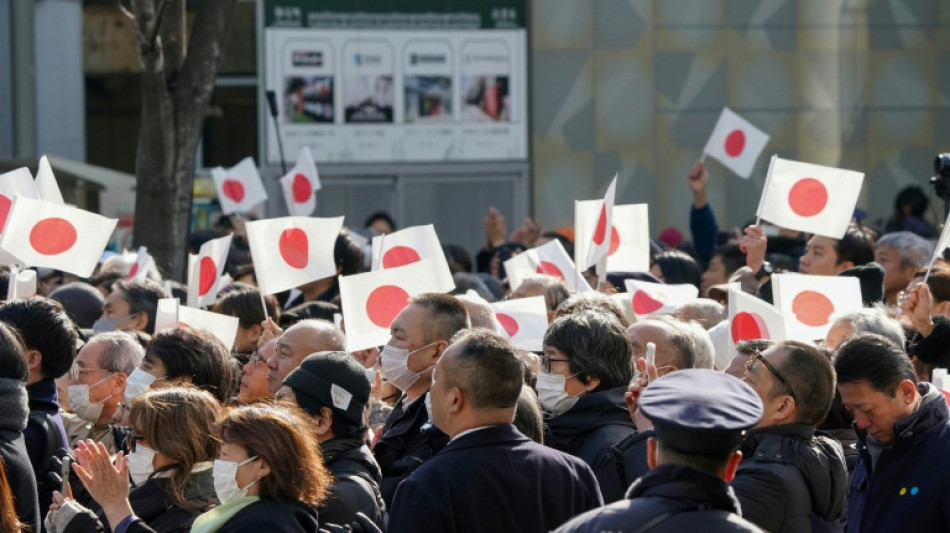
Japan's Liberal Democratic Party: an election bulldozer / Photo: Kazuhiro NOGI - AFP/File

Japan's Liberal Democratic Party (LDP) is one of the democratic world's most successful electoral machines, governing for all but four years since its founding seven decades ago.
And having misfired of late, polls suggest that Japan's first woman Prime Minister Sanae Takaichi might manage to bring back the glory days with a thumping election win on Sunday.
AFP looks at the history of the LDP, what it believes in and the reasons for its decades of success, even in the age of social media and populism.
- What were its beginnings? -
The LDP began in 1955 as a merger between two conservative parties and governed constantly until 1993, overseeing a huge expansion of the economy and living standards.
The United States, which still has 54,000 troops in Japan, reportedly channelled millions of dollars to the party during the Cold War as a bulwark against communism.
The smaller Japan Socialist Party largely served during that time as a check on the government rather than aiming to win power itself.
In the process, the LDP attracted all kinds of special interests, including farming and business lobbies, as well as religious groups, and multiple cases of corruption followed.
- What does the LDP believe? -
Fierce rivalry among factions lurks beneath the surface, resulting in regular changes of leader -- 28 since 1955 -- which act as a substitute for changes in government.
All its leaders were men until Takaichi took the helm in October.
However, only around 20 percent of its current lower house MPs are women. In 2021, women were invited to attend key party meetings but they weren't allowed to speak.
The party has generally leaned towards big government spending, market-friendly economic policies, socially conservative values and a robust alliance with the United States.
But it is a large tent, grouping big-government advocates, political doves focused on economic growth and nationalists pushing traditional family values.
Rather than basing their actions on a certain ideology, the party has acted as voters tell it, analysts said.
LDP factions, despite their deep divisions, have chosen to stick together to stay in power.
The LDP remains associated with the post-war economic miracle, especially among older voters in rural areas.
- When did it lose power? -
The LDP was kicked out of power for the first time in 1993, after a corruption scandal and Japan's 1980s asset bubble burst dramatically.
But the fragile coalition government of small groups, including several LDP defectors, didn't even last a year and the party was back in power in 1994, albeit with a Socialist Party prime minister.
The LDP lost power again in a landslide in 2009, replaced by the centre-left Democratic Party of Japan (DPJ) for three chaotic years.
The DPJ's policy failures and its clumsy response to the 2011 Fukushima nuclear disaster allowed the LDP under Shinzo Abe to return to office in late 2012.
- What has happened now? -
Unnerved in part by Takaichi's ultra-conservative stance, long-standing coalition partner Komeito exited its 26-year coalition with the LDP in October. That left the ruling party to form a new alliance with the Japan Innovation Party.
Takaichi replaced Shigeru Ishiba, whose one-year leadership saw voter discontent simmer over inflation and a slush fund scandal within the party.
Under the accident-prone and professorial Ishiba, disastrous elections left the LDP short of a majority in both houses of parliament.
Before him, Fumio Kishida was in power for three years, longer than his predecessor Yoshihide Suga, who lasted only one year.
However, none held as tight a grip on power as the late Abe.
Abe, known for his nationalist views and "Abenomics" policies, became Japan's longest-serving leader before resigning in 2020.
He was shot dead in July 2022 in an assassination in broad daylight.
The LDP has stayed in power partly by virtue of a fragmented opposition that has failed to offer voters a viable alternative.
Two smaller parties joined forces last month to form a new counterforce called the "Centrist Reform Alliance".
(Y.Berger--BBZ)