Nepal 'addicted' to the trade in its own people / Photo: Prakash MATHEMA - AFP

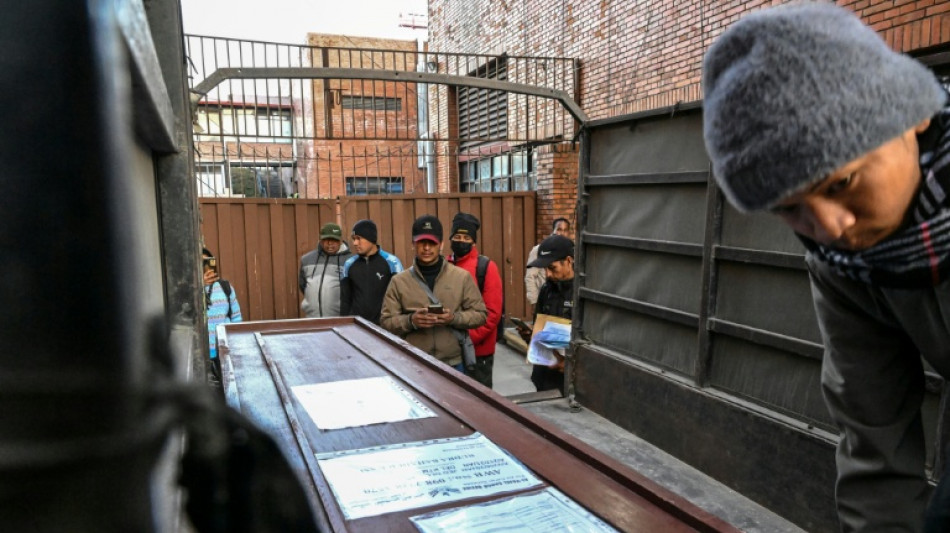
Rudra Bahadur Kami returned to Nepal through a back door of Kathmandu airport in a battered coffin after working for more than a decade in Saudi Arabia to feed his family back home.
His eldest son, Lalit Bishowkarma, 21, was there to sign the papers. The death certificate said he died of a heart attack. He was 43.
Baggage handlers loaded the box onto the bed of a truck like a piece of lost luggage. There was no time for ceremony. Two more lorries were queued up behind.
Every day the bodies of three or four migrant workers are handed back to their families at the airport, the final transaction in a well-oiled system -- overseen by the state -- that helps keep Nepal's economy afloat.
"He went to seek happiness for his children and his family, and now his body has returned in a coffin. It's unbearable," his son said.
Officially around 2.5 million Nepalis work abroad -- 7.5 percent of the population. Most toil on the building sites of the Gulf and Saudi Arabia or in hotels and factories there, while others work in India and Malaysia.
The money they send back represents more than a third of the country's GDP, according to the World Bank.
Most migrants are young, driven abroad by the chronic unemployment in South Asia's poorest country that helped spark the Gen Z uprising that toppled 73-year-old prime minister KP Sharma Oli's government of "the old" in September.
- Getting loans to leave -
Just beyond the Chitwan National Park, home of some of the last Bengal tigers, the southern town of Madi embodies Nepal's deep dependence on the export of its people.
Dipak Magar, 39, is proud of the small house he has built on a bend of a rutted road. The cube of concrete blocks topped with corrugated iron sheets cost him three years of sweat and sacrifice in a Saudi Arabian marble factory.
"I earned 700,000 Nepali rupees ($4,800), which was spent building this house," he said.
The father-of-four was rushing to plaster the outside walls before returning to work in Riyadh, leaving his family and the snow-capped Himalayas on the horizon behind yet again.
"I need to feed my family and provide education for my children," he told AFP. "It feels sad to leave my family, but there is no job here."
One of his brothers also works in Saudi Arabia, another in Romania.
"We haven't enough land to feed all the family," said his father, Dhana Bahadur Magar, 60.
It was the same story across the road, where Juna Gautam's two daughters have gone to Japan. "Even though they are educated, there are no job opportunities here."
Like many others, they went heavily into debt to pay the employment agencies that got them their jobs there, she said.
Local councillor Birendra Bahadur Bhandar said 1,500 young people -- in a district of some 50,000 souls -- were working abroad.
- Migration on industrial scale -
It is no better elsewhere. Nepal's steep mountain valleys are emptying of their young.
Young Nepali men have long left to fight for the British Army -- the famous Gurkhas -- a tradition that goes back to the late 19th century.
But the trickle of migration became a torrent during the 10 years of the Maoist insurgency that ended in 2006.
The young fled to the cities to escape the fighting and they found "this refuge in foreign employment", recalled Nilambar Badal of the National Network for Safe Migration (NNSM).
But the scale of the exodus has become industrial over the last decade as Nepal's agriculture and tourism industries have stagnated.
In 2016, the Department of Foreign Employment (DoFE) -- the government agency that oversees migrant workers -- granted 287,519 permits to work abroad. Last year, it issued nearly three times more.
Badal estimates that "almost half of (Nepali) households are receiving remittances" -- money earned abroad.
Migrant worker groups say the government has become "addicted" to the money to keep the economy going.
Rather than developing local industry, it promotes "foreign employment", Badal insisted. "They are expecting people to go out and send the money back so that they can run the country.
"We are a remittance-dependent economy," he added.
- 'Corrupt' system -
Former labour minister Sarita Giri went further, saying the government was at the heart of a "rotten and corrupt" system "exploiting migrant workers and their families".
She claimed the government's own licensed agency system that sends people abroad was a "mafia", bought off with money paid "to political parties through government officials. That is why this problem has not been solved... The system is so well-protected.
"The main player to blame is the government," she said.
A 2007 law was meant to regulate the 1,000 or so employment agencies -- known as "manpowers". But critics say would-be migrant workers are being made to pay 30 to 40 times the official service charge.
Many are forced into debt to pay the hundreds of dollars for visas, permits and travel organised by the agencies.
And the jobs they end up doing are often far from what they are promised.
- Slept on floor -
Sanjib Ghoraisaine left for Qatar last year thinking that he would be cleaning the pool of a five-star hotel. He found himself working as a domestic servant being paid half of what he was told and sleeping on a floor.
"I paid 200,000 rupees ($1,350) hoping for a monthly salary of $356, and I had to take out a loan that I took six months to pay off."
It was only when he "threatened to kill myself that my employer agreed to let me leave", Ghoraisaine said, "and I had to pay for my return".
His Nepali agent refused to reimburse him, offering to send him elsewhere for free. But after not hearing back for a month, Ghoraisaine complained to the DoFE.
- Dying for work -
Some 14,843 Nepalis lost their lives abroad between 2008 and 2025 -- 1,544 last year alone -- official figures show.
Few were recorded as workplace deaths. The official death toll of foreign construction workers in the run-up to the 2022 World Cup in Qatar was similarly small. While local authorities said less than 40 died, NGOs insisted several thousand migrant workers -- many from Nepal -- perished in deplorable conditions in the extreme heat, often from heart attacks.
Employment agencies deny they are at fault for the abuses, blaming the government for lack of enforcement.
"If you look at the complaints lodged with the Department of Foreign Employment, only five percent are due to faults of recruitment agencies, while the remaining complaints come from individuals who travel on their own initiative," said Dhana Maya Sinjali, of the Nepal Association of Foreign Employment Agencies.
"Just making rules and policies is not enough, DoFE should also monitor them," she said.
But NGOs say many agencies flout the rules, taking advantage of people desperate to work abroad.
- Rogue agencies -
Several migrants also told AFP they got work abroad through completely illegal agencies.
Kul Prasad Karki, of the Pravasi Nepal NGO, said "unofficial agents operate in violation of all government policies, rules and regulations. These problems occur frequently".
Karki, who worked in Saudi Arabia for 10 years himself, said even the certified companies do not play by the rules: "Only 10 percent of manpower agencies claim that they conduct ethical recruitment practices", with the rest demanding "perks" from their clients.
Human rights lawyer Barun Ghimire said no agency has ever been convicted of breaking the rules.
"The law was implemented to regulate the businesses of foreign employment. It does not talk about the rights of migrant workers and the obligation of government to ensure those rights."
Nepal's Ministry of Labour, Employment and Social Security said it was focused on "safeguarding migrant workers' interests". But spokesman Pitambar Ghimire admitted that "our only shortcoming is proper implementation".
- Election promises -
With Nepalis due to go to the polls in elections on March 5, many candidates are promising change.
Balendra Shah, the former mayor of the capital Kathmandu, who is seen by many as the next prime minister, said jobs, training and attracting investment will be his priorities.
"We can encourage those who left the country out of necessity to return," the 35-year-old said, even if "we cannot bring all Nepalis back on the second day" of a new administration.
And reversing Nepal's dependence on money transfers from abroad may take an awful lot longer. Monthly remittances broke the 200 billion-rupee barrier -- $1.4 billion -- for the first time just after September's "revolution".
Ironically, Nepalis abroad -- on whom the country depends -- will not be able to have their say on March 5.
Despite a supreme court decision, the electoral commission has still not organised postal voting for them.
Dipak Magar -- who is already back in Saudi Arabia -- expects nothing from a new government, even one inspired by the Gen Z rebellion.
"Whoever wins, no one ever does something for us," he said.
(S.G.Stein--BBZ)