After Greenland, Arctic island Svalbard wary of great powers
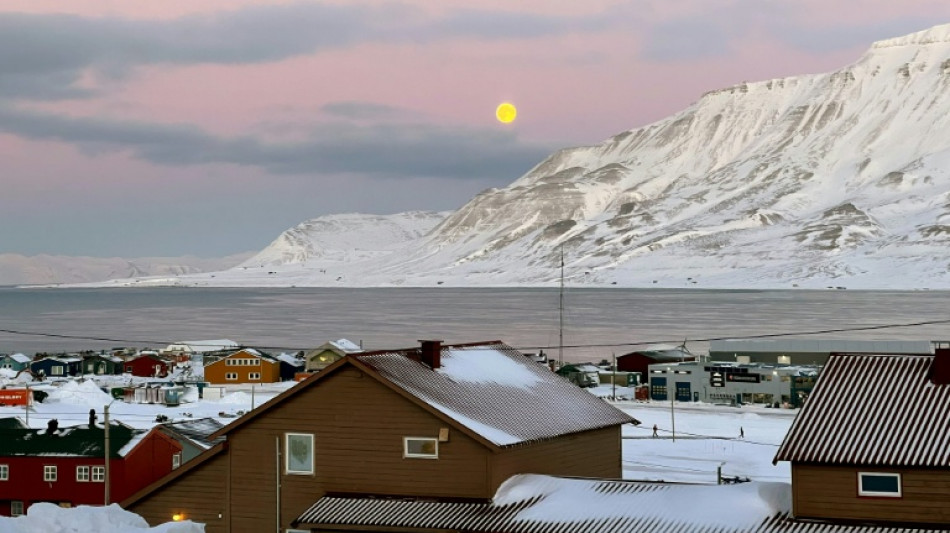
/ Photo: Oriane Laromiguière - AFP

There are no outward signs of jitters, at least not yet: people in Svalbard are going about their daily lives as normal despite speculation that this Norwegian archipelago could be the next Arctic territory coveted by the United States or Russia.
"Today Greenland, tomorrow Svalbard?" -- Terje Aunevik, mayor of Svalbard's main town Longyearbyen, says he has been asked the question many times.
US President Donald Trump's expansionist ambitions have turned the global spotlight on the Arctic, where geo-strategic and financial stakes are mounting.
"The Arctic is no longer a quiet corner on the map," the European Union's top diplomat Kaja Kallas told a conference in Tromso in northern Norway in early February. "It is the front line of the global power competition."
Longyearbyen is an unusual place. A former mining community turned tourist destination and academic hotspot, it lies in the fastest-warming region on the planet.
One of the northernmost towns in the world, located halfway between continental Norway and the North Pole, Longyearbyen is home to 2,500 people.
It is plunged in darkness with no sun for four months in winter, then bathed in round-the-clock daylight in summer.
Venturing outside the town means carrying a mandatory rifle in case of encounters with polar bears.
- Strategic importance -
Some political observers have suggested that Trump's desire to control the Arctic may extend beyond Greenland to Svalbard, or that Russia may want to match his appetite and seize the archipelago.
In addition to the riches believed to lie under its seabed, Svalbard -- twice the size of Belgium -- is strategically located, controlling the northern part of the so-called "Bear Gap".
The military term refers to the maritime zone where the Barents Sea meets the Norwegian Sea. It is this zone Russia's Northern Fleet missile-launching submarines based on the Kola Peninsula must cross to disappear into the deep waters of the Atlantic.
Svalbard's "strategic relevance does not necessarily lie in the island itself, but in the waters around it," Barbara Kunz, director of the European Security Programme at Stockholm peace research institute SIPRI, told AFP.
"Russia wants to protect its nuclear deterrence, and so it wants to make sure that nobody can approach its northern coast", while the United States "would like to prevent" Russian submarines from having access to the Atlantic, she said.
Longyearbyen's residents, who hail from around 50 countries, are staying cool-headed amid the speculation.
"Maybe we talk a bit more about what's happening in Greenland and with Trump and everything, but at the same time I feel like we're not more anxious than we usually are," shop employee Charlotte Bakke-Mathiesen told AFP.
"We're just in our own bubble."
- Svalbard treaty -
In his office, where his mayor's chain is displayed alongside a polar bear femur, Terje Aunevik echoed that sentiment.
"The situation is as it is, but I don't feel it as a threat," he said.
"I strongly believe that both our allies and our neighbours are living very well with Norway having sovereignty over this island."
By "neighbours", he means the 350 or so Russians and Russian-speaking Ukrainians who live in the Svalbard town of Barentsburg, around 40 kilometres (25 miles) away as the crow flies.
It is hard to believe that Barentsburg, a small mining community under Russian control for almost a century, is located on NATO territory: a Lenin bust takes centre stage in the town, where all of the signs are written in Cyrillic lettering.
A treaty signed in 1920 recognises Norway's "full and absolute" sovereignty over Svalbard, but it also gives citizens of the almost 50 signatory powers -- which include China, Russia and the US -- equal rights to exploit its resources.
Since Russia's 2014 annexation of Crimea, Norway has tried to tighten its control of Svalbard, for example by blocking the sale of land to foreigners and drastically reducing voting rights.
Moscow has argued that Oslo is not respecting the Svalbard treaty and has increased its provocations in recent years.
It held a quasi-military parade in Barentsburg celebrating Russia's victory over Nazi Germany and erected a giant unauthorised Orthodox cross in Pyramiden, another small Russian community.
- 'Anything can happen' -
"The Russians have other more strategic priorities right now and have no interest in an escalation beyond the hybrid actions they've been conducting for a long time," polar geopolitics researcher Mikaa Blugeon-Mered said when asked about a possible Russian takeover attempt.
"For Norway, the United States is a much bigger concern today when it comes to Svalbard, because it is more likely to carry out an operation that could destabilise the territory's precarious balance," he said.
"With the current Trump administration, anything can happen."
For a long time, experts spoke of "Arctic exceptionalism": the concept that the region had its own set of unwritten rules of cooperation, a zone of peace immune to geopolitical rivalries.
But now, said Barbara Kunz, "the era of High North, low tension is over".
(U.Gruber--BBZ)