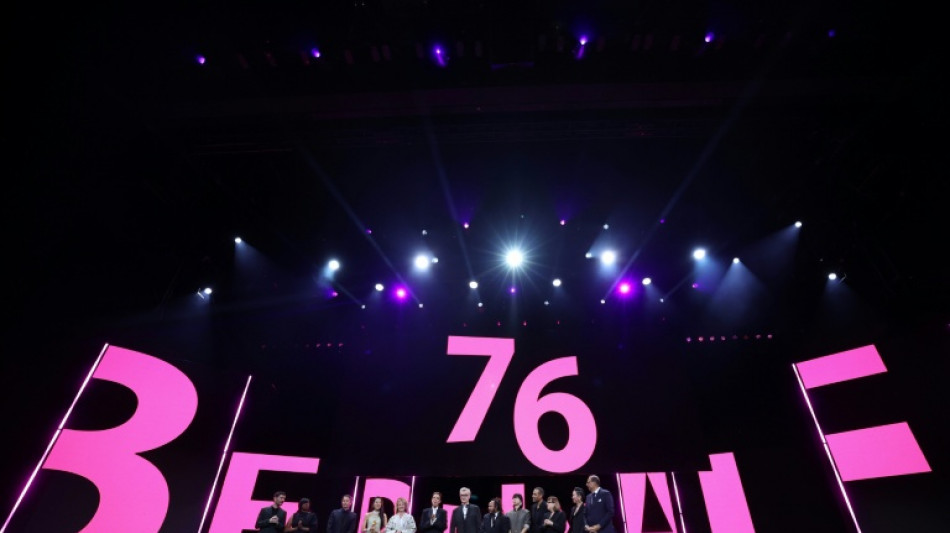
Impact of Israeli-Palestinian conflict plays out on screen in Berlin / Photo: Ronny HARTMANN - AFP

This year's Berlin Film Festival has seen controversy raging off-screen over the Gaza war, with some of the works being shown also grappling with the Israeli-Palestinian conflict and its global impact.
Gaza has been a point of heated debate since the first day of the festival, when jury president Wim Wenders answered a question about the German government's support for Israel by saying: "We cannot really enter the field of politics."
That sparked a backlash from figures including Arundhati Roy, Javier Bardem and Tilda Swinton.
Festival director Tricia Tuttle has defended Wenders and denied accusations that the festival has engaged in censorship.
On screen, one of the films dealing with the global ramifications of the conflict -- past and present -- is the documentary "Who Killed Alex Odeh?"
Directed by Jason Osder and William Lafi Youmans, the film looks at the aftermath of the killing of the Palestinian-American activist of the title.
Odeh was the West Coast regional director of the American-Arab Anti-Discrimination Committee and was killed in a bomb attack at the ADC's offices in Santa Ana, California in 1985.
Among the film's wealth of archive footage is testimony to a congressional committee from Oliver Revell, then FBI assistant director, who said "members of a Jewish extremist element" were likely responsible.
Odeh's widow and daughter also speak movingly about the killing's impact on their lives.
No one has ever been convicted for the bombing.
The film traces how suspicion fell in particular on several members of the Jewish Defense League, a group founded by extremist rabbi Meir Kahane before his own assassination in 1990.
Youmans told AFP that despite dealing with an event from more than 40 years ago, the film took on "a burning kind of urgency" given the influence that Kahane's ideology has gained in Israel in recent years.
The current far-right National Security Minister Itamar Ben Gvir previously campaigned for Kahane's now-banned political party, Kach, and became notorious for his anti-Arab rhetoric.
Did Youmans himself have any qualms about coming to Berlin, given the controversy around the festival?
"I feel that Alex's story is a necessary one to be told," Youmans said, adding it would be "self-defeatist" not to show it at the festival.
As for the response from German audiences, he said he has found that there is "a public opinion here... that is more willing to question unconditional support for Israel, is more willing to show solidarity with the Palestinians".
- 'Rare' collaboration -
In "Where To?" by Israeli director Assaf Machnes, the conflict remains off screen but makes its presence felt.
It follows 55-year-old Palestinian cab driver Hassan, played with warmth and subtlety by Ehab Salami, as he ferries passengers through the nocturnal streets of Berlin.
He strikes up an unlikely bond with Israeli passenger Amir, a lost soul in his early 20s played by Ido Tako, which leads Hassan to reflect on roads not taken in his own life.
Salami is himself a Palestinian who lives in Israel and Machnes says that the film represents a collaboration which is "very, very rare" in Israeli cinema.
"Actors that were auditioning for (Hassan's) role were very thirsty for a role like that," Machnes told AFP.
He said that the film was partially inspired by his own chance meeting with a Palestinian cab driver in Berlin.
"It was different than the usual encounters I have with my Palestinian artist friends; there was this unbinding connection, because we don't know if we're going to see each other" again, he said.
While Machnes says he does not think of his own work as inherently political, he wryly observes that "in Israel, if you film a cat drinking milk, it's political".
While recognising that "we all live in a political context", Machnes told AFP he tries in his work to avoid any "intention to preach".
If the film does have a message, it is about the possibility of empathy in even the most difficult situations.
Salami said he hoped the government in Israel would heed the film's example to "make the way for peace... and something different".
(G.Gruner--BBZ)