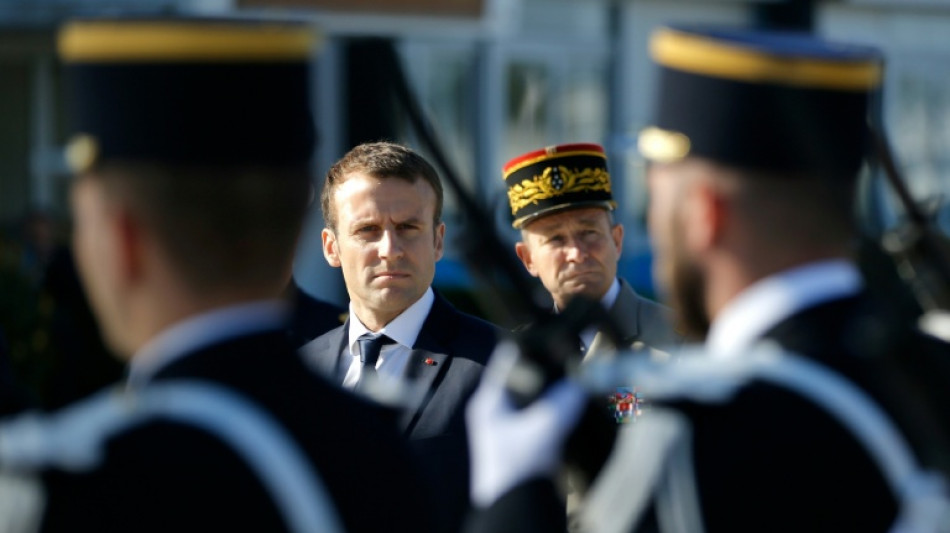
Macron to set out how France's nuclear arms could protect Europe / Photo: STEPHANE MAHE - POOL/AFP

French President Emmanual Macron is Monday to reveal his vision for how France's nuclear arsenal could bolster defence in Europe, with the continent scrambling to re-arm against an aggressive Russia and as Washington turns away.
The speech by Macron, at France's Ile Longue nuclear submarine base, will be closely watched across Europe, which for decades has relied on the United States' nuclear deterrent but is now increasingly debating whether to bolster its own arsenals.
He is expected to update France's nuclear doctrine, with a member of his team telling AFP to expect "fairly significant shifts and developments" but declining to give any further details.
Macron has previously proposed to consider how France -- the European Union's only nuclear power -- could contribute to protecting Europe.
He said this month he is considering a doctrine that could include "special cooperation, joint exercises, and shared security interests with certain key countries".
Last year, Macron said he was ready to discuss possible deployment of French aircraft armed with nuclear weapons in other European countries.
France maintains the world's fourth-largest nuclear arsenal, estimated at around 290 warheads. Britain, which exited the EU in 2106, is the only other European nuclear power.
By contrast, the United States and Russia, the world's two main atomic powers, have thousands of nuclear warheads each.
Reassurances from US officials that Washington's deterrent would continue to cover Europe under the NATO alliance have done little to quell European fears of fickleness under US President Donald Trump.
"It is clear that we will need to reflect together on how French and British deterrence can fit into a more assertive European defence," Bernard Rogel, who served as top military adviser to Macron, told AFP.
- '27 buttons' -
This month, German Chancellor Friedrich Merz said that he was holding "confidential talks with the French president about European nuclear deterrence".
Britain's Prime Minister Keir Starmer has said the UK's nuclear deterrent already protects fellow NATO members, but stressed that he was "enhancing our nuclear cooperation with France".
But how exactly nuclear cooperation would work between the EU's 27 states is another story.
Rogel insisted that control over the launch decision will remain in French hands.
"I can't see us having 27 buttons. From a credibility standpoint, that just doesn't work," he said.
On top of that, France's austerity drive and strains in the relationship between it and fellow EU powerhouse Germany, have exposed fault lines in any potential security agreement.
This month, German Foreign Minister Johann Wadephul criticised French defence spending, calling for Paris to do more to turn calls for European security sovereignty into concrete action.
"We are looking forward to and eagerly await another speech by the French president," Wadephul added.
But Rafael Loss, a policy fellow at the European Council on Foreign Relations, said leaders should find confidence in European support for strengthening nuclear deterrence.
He said people in Bulgaria, Denmark, Estonia, Germany, Poland, Portugal, Spain and Switzerland now tend to support rather than oppose the idea of developing an alternative European nuclear deterrent.
"French and British nuclear forces -- as the core of a future European strategic deterrent -- likely need to grow in size and change composition (or both)," he wrote.
While a NATO member, France does not make its atomic weapons available to the alliance.
But in his last nuclear doctrine update in 2020, Macron called for dialogue among EU countries about what role the French nuclear deterrent could play.
- 'Expectations' -
NATO's secretary-general at the time, Jens Stoltenberg, dismissed Macron's call for strategic dialogue in Europe, arguing that a "tried and tested" deterrent was already in place.
But the picture changed after Russian leader Vladimir Putin invaded Ukraine in 2022, repeatedly brandishing the threat of Moscow's nuclear arsenal, while Trump has pushed Europe down his list of priorities.
Florian Galleri, a historian specialising in contemporary military studies and nuclear doctrines, also warned that Macron would have to tread carefully, pointing to his low approval ratings one year before the end of his presidency.
"This speech creates expectations," he said. "If it is weak, people will wonder why it was made in the first place. If it is strong, with real changes, the consequences could be significant."
But Macron's address could also spark a domestic political backlash ahead of the 2027 presidential election, in which Marine Le Pen's eurosceptic far right is seen as having its best chance yet at winning the top job.
"The fear is that it could discredit any form of European dimension," said Galleri.
(P.Werner--BBZ)