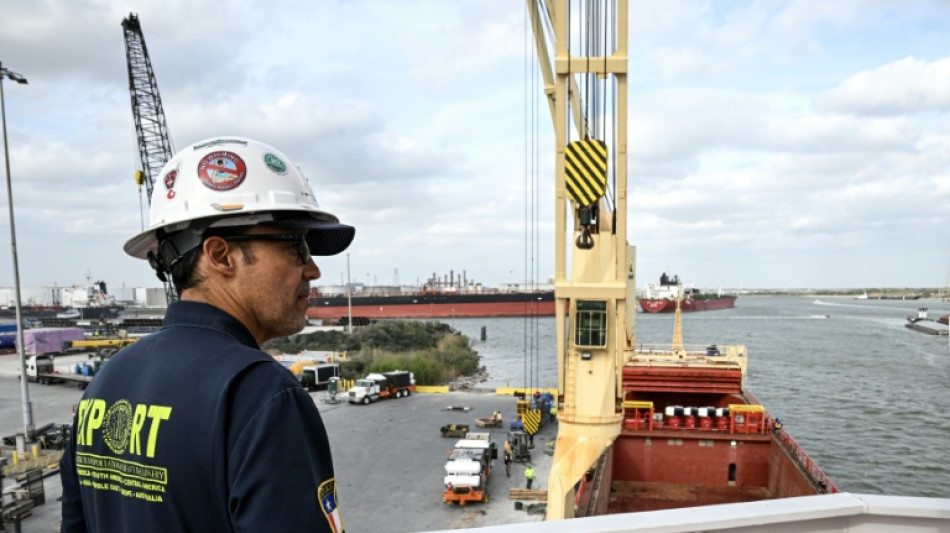
Texas port humming as Trump ramps up Venezuela oil / Photo: RONALDO SCHEMIDT - AFP

A cargo ship teems with workers in hard hats at the Port of Houston, the latest US vessel headed to Venezuela after President Donald Trump lifted restrictions to boost oil production in the crisis-hit country.
US sanctions have crippled Venezuela for years, but Trump's administration has been working with interim president Delcy Rodriguez after toppling autocratic leader Nicolas Maduro.
Washington has used a carrot-and-stick approach with Rodriguez, praising her for welcoming US oil companies but at the same time threatening Venezuela with punishment if she does not cooperate.
At the Port of Houston this past week, a crane loaded trucks, generators and machinery onto the Roibeira as it prepared to set sail to Venezuela, the second vessel from the shipping company International Frontier Forwarders to head to the South American nation.
Greg Diaz, the company's Venezuelan-American owner, said there were more than 8,500 cubic meters of goods onboard, equivalent to around 120 containers.
"Before, it took us six to eight months to accumulate enough cargo to go to Venezuela," he told AFP.
"And now, in 20 days, we're able to complete the orders to fill our ship to max capacity and go to Venezuela and complete the orders right away."
That demand, he said, comes from private companies in Venezuela that are investing massively -- something that was impossible under Maduro.
- 'Venezuelan dream' -
Venezuela was once a major crude supplier to the United States, and has the world's largest proven reserves with more than 303 billion barrels, according to global oil cartel OPEC.
This amounts to about a fifth of the world's oil reserves.
But in 2024, Venezuela produced only about one percent of global crude, its industry left haggard by years of underinvestment, mismanagement and US sanctions.
That all changed when US forces captured Venezuela's socialist leader Maduro in a deadly raid on the capital Caracas on January 3.
Rodriguez, who was vice president under Maduro, was accepted by Trump as Maduro's replacement on condition she submit to Washington demands for access to Venezuelan oil.
The US Treasury has since eased a seven-year-old oil embargo on Venezuela and issued licenses allowing a handful of multinationals to operate in the country under certain conditions.
In his recent State of the Union address, Trump said the United States had received more than 80 million barrels of oil from Venezuela, describing the nation as "our new friend and partner."
But despite American enthusiasm, major companies remain cautious.
"I think the politics of it is moving a little bit too fast," Jorge Pinon, a researcher at the Energy Institute at the University of Texas, told AFP.
"Everybody was willing to sign" at the White House meeting with oil company executives in January, "except for Exxon, which was the only one that had the courage to say 'we need assurances.'"
Pinon said there was no sense of urgency from the Americans to revive Venezuela's oil industry, though, as the United States is the world's largest producer of crude oil with secure supplies.
For now, the industry is more interested in Guyana, Brazil, and even the Gulf of Mexico.
Oil companies first "have to see what's the state of the infrastructure" in Venezuela, Pinon added.
Political instability is another concern.
"What about if in two years, three years from now, Venezuela has free elections and a new government suddenly changes the rules?" he said.
Back at Houston's port, Greg Diaz remained optimistic.
"It's amazing because we're not only helping the American drilling companies, but also the Venezuelan private companies in the oil and gas sector to buy quality US-made drill rigs," he said.
"But also, we help the mid-size to small companies and entrepreneurs that now can buy, whether it's one piece of machinery or a large order, and make possible the Venezuelan dream."
(F.Schuster--BBZ)