Energy infrastructure emerges as war target, lifting prices / Photo: Fadel SENNA - AFP/File

Energy prices surged Monday as the war in the Middle East led to outages of key energy production operations and a critical waterway was essentially emptied of traffic.
European natural gas prices finished the day up more than 39 percent after surging more than 50 percent earlier in the day.
Brent oil futures rose to above $82 dollars a barrel, a gain of more than 13 percent early in the session. The benchmark finished up 7.3 percent at $77.74 a barrel, up around $15 compared with the start of 2026.
US benchmark West Texas Intermediate ended at $71.23 a barrel, up 6.3 percent.
- Suspended output -
The surge in prices comes as key energy facilities emerge as targets in the war.
Qatar's state-run energy firm said it had halted liquefied natural gas production following Iranian attacks on facilities at two of its main gas processing bases.
Earlier, the massive Ras Tanura refinery on Saudi Arabia's Gulf coast went into partial shutdown after a strike by drones led to a fire.
A terminal in Abu Dhabi was also attacked by a drone.
- Hormuz exodus -
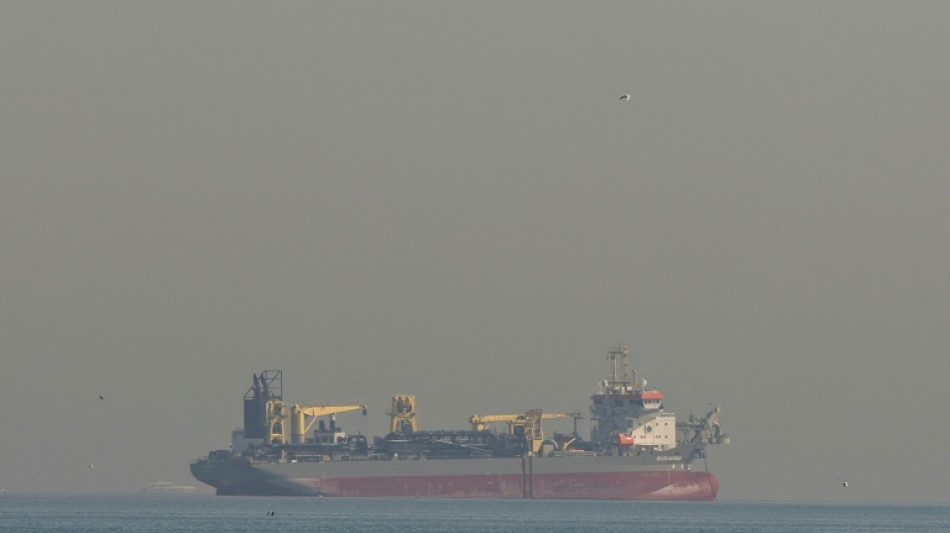
In parallel, energy markets are also absorbing a de facto halt to traffic in the Strait of Hormuz, through which about 20 percent of global supply of oil and LNG travel.
The waterway has not technically been closed, but major maritime companies have suspended travel through it as insurance costs soar amid heightened risk.
Since Israel and the United States launched strikes on Iran on Saturday, the world's largest shipping firms -- Italian-Swiss MSC, Denmark's Maersk, France's CMA CGM, Germany's Hapaq Lloyd and China's Cosco -- have ordered their ships to find shelter and stay safe.
The exodus of ships from the waterway will prevent some 15 million barrels per day of oil from reaching global markets, estimated Rystad Energy senior vice president Jorge Leon.
"Whether the Strait is closed by force or rendered inaccessible by risk avoidance, the impact on flows is largely the same," Leon said in a note. "Nations with strategic petroleum reserves may take action and release volumes if the disruption of the Strait risks being extended."
- Asia, Europe impacted -
The upheaval in the Middle East poses particular risks for Asian countries, the market for about 80 percent of the petroleum through the Hormuz, according to the International Energy Agency.
But the conflict also poses risks to Europe, a major market for LNG from Qatar.
"The closure has potentially severe implications for Europe's energy security," said a note from Eurasia Group that pointed out that European gas markets are "very tight" after a cold winter.
- $100 oil? -
Petroleum-importing countries within the Organization for Economic Co-operation and Development are required to keep 90 days of emergency crude stockpiles that in theory should limit price increases.
But under a "worst-case scenario" gamed out by Eurasia Group, damage to Iran's oilfields permanently hits the country's exports, while the precarity to Hormuz traffic persists.
"In that case, the combination of heightened risk to traffic, the long-term loss of Iranian exports, and the short-term loss of other regional production would be enough to push the Brent per barrel price close to $100 per barrel," said Eurasia, which projected prices of $75-$85 a barrel as a more likely outcome.
The last time oil prices topped $100 a barrel was at the start of the Ukraine war, when natural gas prices also spiked well above Monday's level.
Kpler analyst Michelle Brouhard described high oil prices as "the Achilles heel of (US President Donald) Trump," adding that Iran was likely to look to keep crude prices lofty to pressure the US president ahead of midterm elections in November.
Trump himself has said he expects the operation to go four or five weeks.
After a bad start, Wall Street stocks finished Monday's session mixed, a sign investors don't expect an especially lengthy impact.
Oxford Economics predicted that Iran would struggle to keep the Strait of Hormuz quiet for long, but that a period of "lower-level disruption to trade flows" was more plausible.
Oxford expects oil prices to rise to almost $80 a barrel in the second quarter before eventually dropping back to $60.
"The duration of the conflict and the nature of any regime change in Iran is key to understanding the economic impact, but these remain highly uncertain," Oxford said.
(S.G.Stein--BBZ)