Berliner Boersenzeitung - Will Iran's missiles drain US interceptor stocks?

EUR -
AED 4.208998
AFN 72.774404
ALL 93.577791
AMD 421.999833
ANG 2.051954
AOA 1051.53652
ARS 1646.623073
AUD 1.63367
AWG 2.062953
AZN 1.947365
BAM 1.931357
BBD 2.309471
BDT 140.759755
BGN 1.937893
BHD 0.432193
BIF 3427.940235
BMD 1.146085
BND 1.469008
BOB 7.952354
BRL 5.83449
BSD 1.146687
BTN 108.3744
BWP 15.364544
BYN 3.174622
BYR 22463.266
BZD 2.306212
CAD 1.620255
CDF 2658.917339
CHF 0.922169
CLF 0.025793
CLP 1015.156102
CNY 7.744612
CNH 7.766835
COP 3936.801975
CRC 522.289832
CUC 1.146085
CUP 30.371253
CVE 109.279294
CZK 23.840917
DJF 203.682073
DKK 7.376364
DOP 67.160516
DZD 152.290598
EGP 57.199036
ERN 17.191275
ETB 181.511237
FJD 2.560011
FKP 0.855512
GBP 0.867901
GEL 3.031394
GGP 0.855512
GHS 12.948124
GIP 0.855512
GMD 83.663843
GNF 10059.75996
GTQ 8.740456
GYD 239.864247
HKD 8.982006
HNL 30.597257
HRK 7.534595
HTG 149.754685
HUF 344.570045
IDR 20341.404231
ILS 3.369117
IMP 0.855512
INR 108.086701
IQD 1501.37135
IRR 1575866.874934
ISK 142.492784
JEP 0.855512
JMD 181.354751
JOD 0.812596
JPY 183.675019
KES 148.441133
KGS 100.22486
KHR 4598.658114
KMF 487.085909
KPW 1031.476901
KRW 1732.725795
KWD 0.353107
KYD 0.955606
KZT 559.197841
LAK 25248.252325
LBP 102631.911812
LKR 384.151481
LRD 208.759188
LSL 18.560684
LTL 3.384091
LVL 0.693255
LYD 7.306314
MAD 10.595576
MDL 20.009754
MGA 4813.556941
MKD 60.841799
MMK 2406.716372
MNT 4102.276195
MOP 9.251709
MRU 45.935138
MUR 54.015262
MVR 17.718754
MWK 1989.603855
MXN 19.890316
MYR 4.658611
MZN 73.237244
NAD 18.568774
NGN 1557.666645
NIO 41.958286
NOK 11.166896
NPR 173.39794
NZD 1.990457
OMR 0.440668
PAB 1.146687
PEN 3.911027
PGK 5.028735
PHP 69.1926
PKR 318.953377
PLN 4.18054
PYG 6997.439501
QAR 4.172325
RON 5.165447
RSD 115.836019
RUB 83.631595
RWF 1705.37448
SAR 4.29999
SBD 9.239077
SCR 16.177131
SDG 688.223267
SEK 10.983557
SGD 1.469315
SHP 0.855668
SLE 28.365938
SLL 24032.833607
SOS 654.996204
SRD 42.785675
STD 23721.645564
STN 24.526219
SVC 10.033107
SYP 126.679179
SZL 18.563001
THB 37.287303
TJS 10.62967
TMT 4.022758
TND 3.337113
TOP 2.759498
TRY 53.22103
TTD 7.789416
TWD 36.168726
TZS 3008.476529
UAH 51.354795
UGX 4242.308791
USD 1.146085
UYU 46.294495
UZS 13758.750262
VES 683.108374
VND 30171.83371
VUV 136.371395
WST 3.139988
XAF 647.75888
XAG 0.017499
XAU 0.000273
XCD 3.097353
XCG 2.066626
XDR 0.806497
XOF 647.53823
XPF 119.331742
YER 273.484562
ZAR 18.838778
ZMK 10316.133246
ZMW 20.267492
ZWL 369.038902
  • RBGPF

    -1.7300

    61.14

    -2.83%

  • NGG

    -1.2400

    79.44

    -1.56%

  • CMSD

    0.0000

    22.29

    0%

  • CMSC

    0.0500

    22.37

    +0.22%

  • VOD

    -0.2300

    14.3

    -1.61%

  • RELX

    -0.8300

    31.18

    -2.66%

  • RYCEF

    -0.1600

    18.43

    -0.87%

  • JRI

    0.0500

    12.67

    +0.39%

  • BCC

    3.8500

    74.66

    +5.16%

  • BCE

    0.0000

    23.28

    0%

  • RIO

    -2.5900

    100.08

    -2.59%

  • BP

    -1.0400

    39.1

    -2.66%

  • BTI

    -0.5800

    58.91

    -0.98%

  • AZN

    -2.9600

    174.93

    -1.69%

  • GSK

    -1.4800

    50.67

    -2.92%

Will Iran's missiles drain US interceptor stocks?
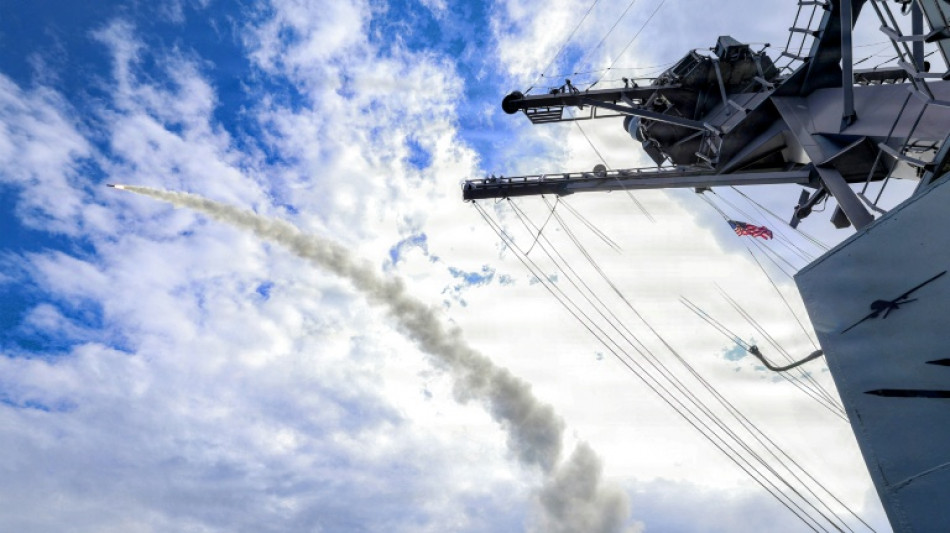
Will Iran's missiles drain US interceptor stocks? / Photo: - - US NAVY/AFP

Will Iran's missiles drain US interceptor stocks?

US forces have shot down hundreds of Iranian ballistic missiles in recent days, raising questions about how long American air defense interceptor stocks will last in a war that could continue for weeks or more.

Text size:

Iran responded to the massive US-Israeli air campaign launched over the weekend with barrages of hundreds of missiles and drones against countries in the Middle East that host American forces and bases.

Since the start of the war, the United States has "intercepted hundreds of ballistic missiles targeting US forces, our partners and regional stability," General Dan Caine, the top US military officer, said Monday.

Those intercepts are a success -- they prevented the missiles from striking their targets -- but they also come at the cost of pricey, high-tech interceptors that are in short supply.

"There is a risk the United States and its partners could run out of interceptors before Iran runs out of missiles, though it is far from certain," said Kelly Grieco, a senior fellow at the Stimson Center think-tank.

At the beginning of the conflict, Israel estimated Iran had some 2,500 ballistic missiles -- "almost certainly more than the combined ballistic missile interceptor totals of Israel and the United States," Grieco said.

However, the United States and Israel are hunting for launchers and storage sites, so "the race is, in short, between Iranian launchers and American and Israeli strikes on the sources of those launches," she said.

- Demand outpacing production -

Caine said Iranian drones also pose a threat but did not provide a figure for the number that had been shot down, only saying that "our systems have proven effective in countering these platforms, engaging targets rapidly."

Grieco said that while interceptors are being expended on drones, it is not to the same degree as for missiles, and "the most acute shortage is with the ballistic interceptors."

The length of the conflict is a factor affecting how many interceptors will be needed, and it is currently unclear how long it will last.

US officials including Donald Trump have referred to a multi-week war, though the president said Monday that "we're already substantially ahead of our time projections."

"From the beginning we projected four to five weeks, but we have capability to go far longer than that," Trump said.

Pentagon chief Pete Hegseth had earlier given various possible timelines for the conflict: "Four weeks, two weeks, six weeks, it could move up. It could move back."

Joe Costa, director of the Atlantic Council's defense program, said that "sustained conflict with Iran could severely strain US stocks of critical air defense interceptors for China and other global priorities."

"It depends on how effective the US and Israel will be in neutralizing Iran's launch capability of missiles and drones," he said.

Grieco said that when it comes to interceptors, "production simply cannot keep pace with demand."

"Every theater, from Europe and the Indo-Pacific to the Middle East, has an acute need (of) more missile defense launchers and interceptors, and the United States is simply consuming them faster than it can replace them."

(A.Lehmann--BBZ)