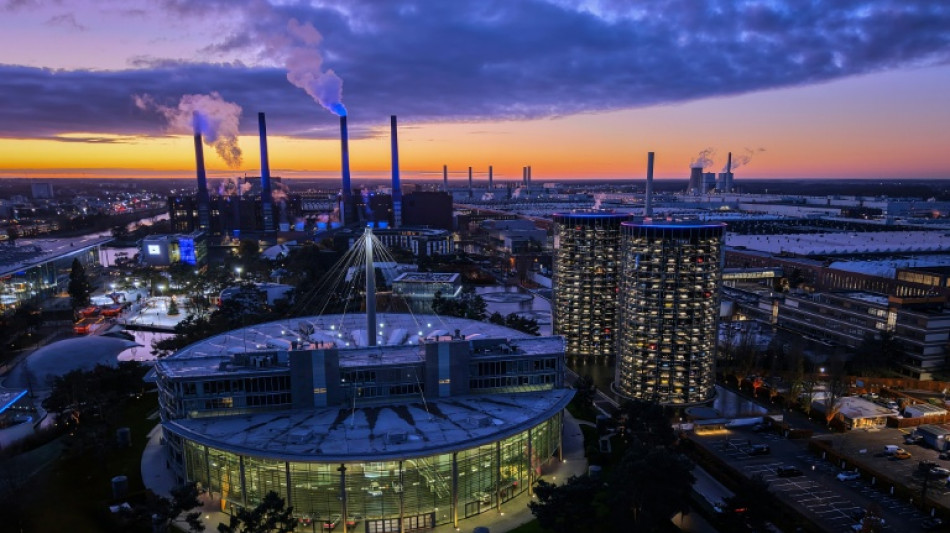
EU to unveil 'Made in Europe' rules despite pushback / Photo: Ronny HARTMANN - AFP/File

The EU will on Wednesday unveil "Buy European" rules to boost domestic production, which Brussels says will help defend European businesses against fierce global competition, especially from China.
Ramping up the European Union's competitivity has gained urgency since the Covid-19 pandemic and soaring energy prices following the Ukraine war exposed the vulnerability of the bloc to supply shocks.
Expected last year, the "Made in Europe" measures were pushed back several times due to disagreements over its scope inside the European Commission and divisions among member states.
The commission will propose that if companies want public money, they must meet minimum thresholds for EU-made parts in "strategic sectors", set to include cars, green tech and "energy-intensive" industries such as aluminium and steel.
For example, electric-vehicle manufacturers will have to make sure at least 70 percent of their car's components are made in the EU if they want to access public money, according to the draft document, which could change.
France has led the push for the proposal that will be announced by EU industry chief Stephane Sejourne, a former French government minister.
The proposal will be subject to approval by EU states and parliament.
Its supporters say that if the EU does not shield its strategic sectors it will not have any industry left to defend.
But sceptics, including the EU's largest economy Germany, argue that Europe can support domestic industries through a "Made with Europe" approach instead, that would see the bloc include its trading partners.
The looming rules are unpopular outside the EU with fears in countries including Britain, Canada, Japan and Turkey over how strict they will be.
- Screening foreign investment -
The proposal, known as the "Industrial Accelerator Act", aims to to ensure foreign companies partner with European firms if they want to set up shop in the bloc and gain better access to its market, according to the draft document.
To do so it imposes conditions on foreign investments of over 100 million euros ($116 million) in "emerging strategic sectors" such as batteries and electric vehicles.
These kick in when they involve an investor from a country that holds more than 40 percent of the related global manufacturing capacity -- an implicit reference to China's dominance in those sectors.
For such projects to go ahead, foreign investors need to meet conditions including employing at least 50 percent EU workers, holding no more than 49 percent of the related EU company, and passing on technological know-how.
"If access to the EU market is one of the most valuable industrial assets in the world, it is legitimate to attach conditions that strengthen European capabilities," said Joseph Dellatte of the Paris-based Institut Montaigne, dismissing criticism that the plans amounted to "protectionism".
The measures are among many the EU will push to regain its competitive edge.
Later this month, the EU will propose creating a pan-European legal regime for innovative start-ups, which it says will make it easier to do business by slashing the time it takes to set up enterprises across the 27 countries.
For many, the plans are necessary to boost the development of EU green tech.
The goal is to make sure EU taxpayers' money is "used strategically to strengthen Europe's industrial base -- rather than subsidising Chinese overcapacity", said Neil Makaroff of the Strategic Perspectives climate think tank.
But some experts argue that if the EU wants to confront what it sees as unfair competition, Brussels has other tools at its disposal.
"If the policy goal is to make sure that your industry is not being destroyed by China, I think we have better instruments," said Niclas Poitiers, an international trade specialist at the Bruegel think tank, pointing to rules that give the EU the power to investigate and counteract unfair foreign subsidies.
(S.G.Stein--BBZ)