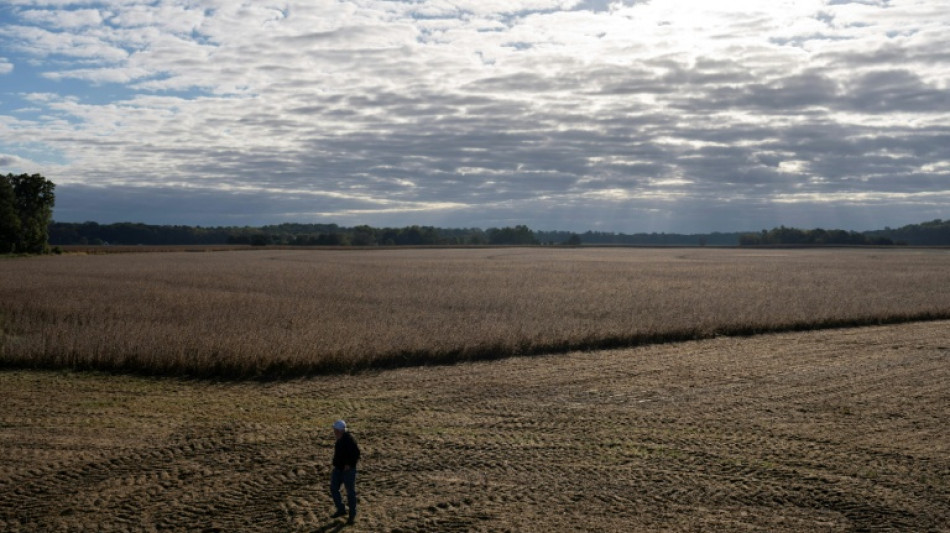
Fertilizer prices surge from Iran war, squeezing weary US farmers / Photo: ROBERTO SCHMIDT - AFP/File

American farmers are again feeling the squeeze after a year marked by trade turmoil and low crop prices, with the US-Israeli war on Iran fueling a fertilizer cost surge as planting season approaches.
Jim Martin, an Illinois farmer who grows soybeans, corn and other crops, said fertilizer and input costs were "everybody's nightmare right now."
While he considers himself lucky enough to have already bought what he needs for this planting season, costs are "still the highest that they've been in years," he told AFP.
Around 33 percent of the world's fertilizers transit through the Strait of Hormuz, where traffic has all but halted since the war broke out, according to analytics firm Kpler.
US-Israeli strikes targeting Iran on February 28 sparked a war that has caused regional chaos, with missiles flying across the Strait snarling maritime traffic.
About 35 percent of fertilizer in the United States is imported, said Veronica Nigh, chief economist at The Fertilizer Institute.
This includes phosphorus and nitrogen from the Middle East, she added.
Costs of urea, a nitrogen fertilizer, rose nearly 30 percent per short ton between the week of February 27 and the week of March 6, she said.
"Without strategically prioritizing the delivery of critical farm inputs such as urea, ammonia, nitrogen, phosphate, and sulfur-based products, the US risks a shortfall in crops," American Farm Bureau Federation President Zippy Duvall warned Monday.
He added in his letter to US President Donald Trump that such a production shock could fuel inflation across the US economy.
- 'Tremendous' stress -
Most US producers would have already acquired a lot of their fertilizer supplies for the year, said American Soybean Association economist Jacquie Holland.
"But because prices have been so high, we saw a lot of producers this year wait till the last minute to book those supplies," she told AFP.
Those farmers bear the brunt of soaring costs.
Others like Iowa-based Aaron Lehman, who grows corn, soybeans and oats, fret about the autumn planting season.
The fertilizer problem comes as other costs -- for pesticides, seeds and health care -- have gone up, Lehman told AFP.
"Farmers are under a tremendous amount of economic stress," he said.
He noted the number of farm bankruptcies was up, as were the amounts that farmers are borrowing.
While Trump last year announced $12 billion in one-time payments to help farmers hit by lower crop prices, trade uncertainty and other issues, this was "not enough" to offset the pressures, Lehman said.
- Caught by surprise -
"People are extremely worried just because there's so much uncertainty" about how long the war in the Middle East would last, Lehman added.
"To be honest, it's not something that we feel adequately prepared for."
Nigh estimates that about 50 percent of agricultural production can be attributed to fertilizer use.
If farmers pulled back on fertilizers due to the price surge, there would be lower output and, in turn, less revenue for struggling producers.
Farmers could also shift away from crops like corn that need more fertilizers.
"My planning is already done for the year, but there might be a change to more soybean acres," Martin said.
Beyond the high price of inputs, crop prices have also been near multi-year lows, he added.
"It's kind of a double-whammy."
(L.Kaufmann--BBZ)