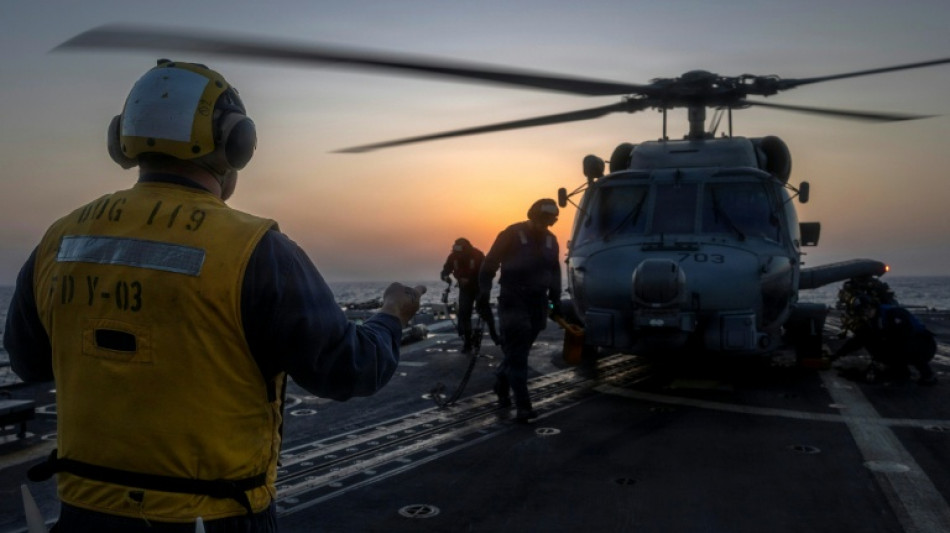
Mideast tanker escort: high-risk mission for US Navy / Photo: - - US NAVY/AFP/File

US Navy escorts could help increase the flow of tankers through the Strait of Hormuz, but American warships accompanying slow-moving commercial vessels would face threats including mines, missiles and drones in the narrow waterway bordering Iran.
Iran has threatened to block oil exports via the key maritime chokepoint -- through which nearly 20 percent of the world's crude usually transits -- in response to the US-Israeli war against the Islamic republic.
President Donald Trump -- who warned of "Death, Fire, and Fury" if Tehran disrupted oil flows -- has also floated the idea of the US Navy accompanying commercial vessels, but Washington's forces have yet to begin the potentially risky mission.
"There are a number of threats that Iran...potentially could bring to bear against that type of escort mission," said Jonathan Schroden, chief research officer at the Center for Naval Analyses.
These include sea mines, fast-attack craft, missiles and one-way attack drones.
"If you put mines in the water and you can reinforce those with both surface and air threats as well, you create a layered threat that extends from under the sea all the way up through the surface into the air," Schroden said. "That just makes it much, much harder to defend."
Trump on Tuesday warned Iran against mining the strait, saying in a social media post: "If for any reason mines were placed, and they are not removed forthwith, the Military consequences to Iran will be at a level never seen before."
The United States has an array of ships deployed in the Middle East, including two aircraft carriers.
But an escort mission would be carried out by smaller vessels such as destroyers or frigates -- possibly with warplanes or helicopters providing cover overhead -- that would accompany several tankers at a time, Schroden said.
- 'Global economic disruption' -
US Navy ships would "provide a deterrent effect," and could also "respond if the tankers get fired upon," he said.
The Strait of Hormuz -- less than 30 miles (48 kilometers) across at its narrowest point -- is shared by Iran on one side and Oman on the other.
At least 10 oil tankers in or near the strait were struck, targeted, or reported attacks between March 1 and 10, according to data compiled by the UK Maritime Trade Organisation, the International Maritime Organization, and Iranian authorities.
In addition, three bulk carriers, two container ships, a tugboat, and an oil drilling vessel have reported explosions, strikes, or suspicious activity in the area.
"It's really a global economic disruption that could escalate very, very quickly if it's not addressed," Schroden said.
The United States previously carried out a tanker escort mission -- dubbed Operation Earnest Will -- in the same region to protect ships from attacks by Tehran's forces during the Iran-Iraq war, between 1980-88.
"The major difference is in the scope and scale of military capabilities of both sides," said Schroden.
"Iran didn't have drones, for example, they didn't have nearly the missile capacity that they have now," while US forces now have "much, much greater...ability to bring air and space and cyber effects" to bear that "didn't exist back in the '80s."
Daniel Schneiderman, an adjunct senior fellow in the Center for a New American Security's Middle East Security Program, said Iran's forces remain a danger despite more than 10 days of US-Israeli strikes.
"The threats are significant and very real, even (with) what the US military has been able to do, what the Israeli military has been able to do," Schneiderman said.
A US mission to escort tankers "is absolutely a very high risk, especially when you consider the number of ships that will be involved in this kind of mission -- it's very resource-intensive," he added.
(G.Gruner--BBZ)