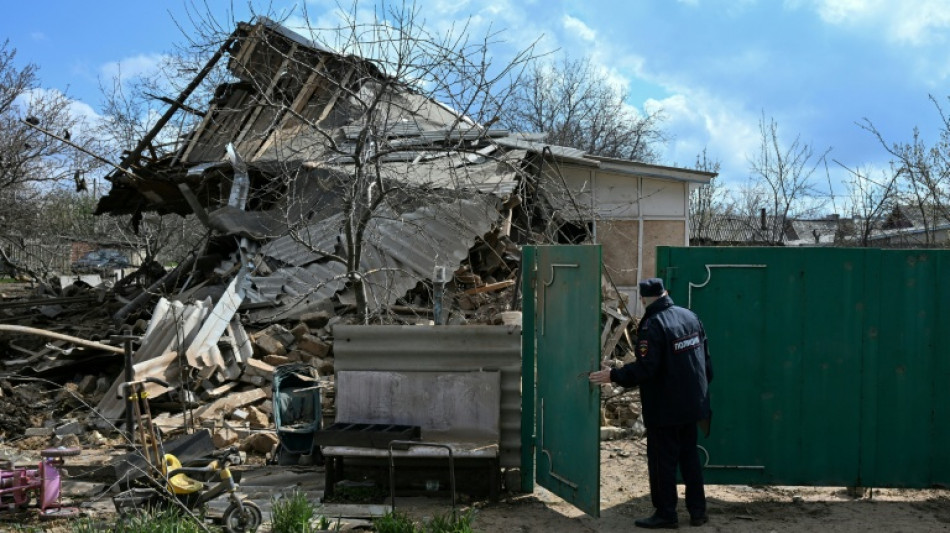
Ukraine, Russia accuse each other of Easter truce violations / Photo: STRINGER - AFP

Ukraine and Russia accused each other on Sunday of violating a truce in place for Orthodox Easter thousands of times, as the war dragged through its fifth year.
Both sides had agreed to observe the ceasefire, which Russian President Vladimir Putin ordered on Thursday and which Ukrainian counterpart Volodymyr Zelensky proposed more than a week earlier.
But as with a similar agreement last year, only relative calm reigned along the 1,200-kilometre (745-mile) front line.
"As of 7:00 am (0400 GMT) on 12 April, 2,299 ceasefire violations were recorded. Specifically: 28 enemy assault actions, 479 enemy shellings, 747 strikes by attack drones... and 1,045 strikes by FPV drones," the Ukrainian army said in a post on Facebook.
Russia's defence ministry accused Kyiv of nearly 2,000 breaches of its own.
"A total of 1,971 ceasefire violations by units of the Ukrainian armed forces were recorded between 4:00 pm Moscow time on April 12 and 8:00 am on April 12," the ministry said on the state-pushed MAX messenger.
The Russian ministry claimed Kyiv had fired 258 times using artillery or tanks, carried out 1,329 FPV drone strikes, and dropped "various types of munitions" on 375 occasions, notably via drones.
Moscow also accused the Ukrainian military of launching "three nighttime attacks" against Russian positions and also "four attempts to advance" along the front line, while claiming to have thwarted each.
Zelensky had called for a longer ceasefire in his evening address Saturday, saying Ukraine had put the proposal to Russia.
But in comments aired Sunday, the Kremlin's spokesman Dmitry Peskov rejected any extension unless the Ukrainian leader accepted Russia's "well-known" terms.
"Until Zelensky musters the courage to assume this responsibility, the special military operation will continue after the truce expires," Peskov added, referring to the war in Ukraine.
- 'Holiday joy' -
In a sign that the truce had some effect, the Ukrainian army said it had recorded no long-range Shahed drone attacks, guided aerial bombings or missile strikes.
Ukraine has had to deal with barrages of hundreds of Russian drones on a near-nightly basis, prompting retaliation from Kyiv.
In northeastern Ukraine's Kharkiv region, Lieutenant Colonel Vasyl Kobziak told AFP on Sunday morning that things were "rather calm" in his sector.
While the 32-year-old officer said the truce had not been "fully" observed, the lull had allowed his soldiers of the 33rd Mechanised Brigade to attend an Easter Sunday mass outside in the freezing forest chill.
"Our comrades have the chance, as you can see, to have their Easter baskets blessed and to feel the warmth and joy of this holiday," he told AFP, referring to the religious tradition of priests blessing food and eggs.
The truce had been due to last for 32 hours, from 4:00 pm (1300 GMT) on Saturday until the end of the day on Sunday, according to the Kremlin.
In Russia's Kursk region, which borders Ukraine, Governor Alexander Khinshtein also accused Kyiv of breaking the ceasefire by attacking a gas station in the town of Lgov with a drone, injuring three people, including a baby.
Residents in Ukraine's southern city of Zaporizhzhia were sceptical about Russia's intentions.
"I think they're using this as a cover to reconvene," said 28-year-old manager Vladyslav.
"If we're going to declare a ceasefire, it shouldn't be for just one day," said 58-year-old economist Maryna.
- Frontline freeze -
Recent months have seen several rounds of US-brokered negotiations fail to bring the warring parties closer to an agreement to stop the fighting, triggered by Russia's February 2022 invasion.
The process has stalled further since the outbreak of the war in the Middle East, with Washington's attention having shifted towards Iran.
But even before the Iran war, progress towards a peace deal in Ukraine had been slow, due to differences over the issue of territory.
Ukraine has proposed freezing the conflict along the current front lines.
But Russia has rejected this, saying it wants the whole of the Donetsk region despite it being partly controlled by Ukraine -- a demand Kyiv says is unacceptable.
The war has cost hundreds of thousands of lives and forced millions to flee their homes, making it Europe's deadliest conflict since World War II.
Russia, whose battlefield advances have slowed since last year, has paid a high price in manpower for relatively small territorial gains.
Moscow occupies just over 19 percent of Ukraine, most of which was seized during the first weeks of the conflict.
(Y.Yildiz--BBZ)