Berliner Boersenzeitung - Morocco farmers saw hope in rain, but Mideast war inflates production costs

EUR -
AED 4.175768
AFN 72.198245
ALL 94.132133
AMD 418.999752
ANG 2.035751
AOA 1042.661054
ARS 1672.630319
AUD 1.644124
AWG 2.048085
AZN 1.937411
BAM 1.9544
BBD 2.294546
BDT 139.959707
BGN 1.922591
BHD 0.42871
BIF 3394.050129
BMD 1.137035
BND 1.475842
BOB 7.889347
BRL 5.89331
BSD 1.139279
BTN 107.864706
BWP 15.491899
BYN 3.199707
BYR 22285.890295
BZD 2.291258
CAD 1.616512
CDF 2579.932771
CHF 0.921885
CLF 0.026405
CLP 1039.215589
CNY 7.72104
CNH 7.737997
COP 3900.9518
CRC 516.822835
CUC 1.137035
CUP 30.131433
CVE 110.718763
CZK 24.216178
DJF 202.074182
DKK 7.475228
DOP 66.57325
DZD 151.6237
EGP 56.449025
ERN 17.055528
ETB 183.671576
FJD 2.552871
FKP 0.858323
GBP 0.861469
GEL 3.007442
GGP 0.858323
GHS 12.763207
GIP 0.858323
GMD 82.42736
GNF 9977.484175
GTQ 8.691772
GYD 238.349203
HKD 8.915965
HNL 30.481024
HRK 7.535589
HTG 148.953263
HUF 355.72597
IDR 20397.72961
ILS 3.399792
IMP 0.858323
INR 107.58422
IQD 1492.430549
IRR 1563480.278048
ISK 144.005798
JEP 0.858323
JMD 179.330706
JOD 0.806151
JPY 183.790942
KES 147.257318
KGS 99.433484
KHR 4559.511485
KMF 490.062106
KPW 1023.332095
KRW 1751.545555
KWD 0.351355
KYD 0.94942
KZT 554.172889
LAK 25228.921367
LBP 102020.593707
LKR 381.166862
LRD 207.341423
LSL 18.786738
LTL 3.357369
LVL 0.687781
LYD 7.310729
MAD 10.662859
MDL 20.056628
MGA 4759.589356
MKD 61.649922
MMK 2387.077383
MNT 4069.449066
MOP 9.200307
MRU 45.250182
MUR 54.816455
MVR 17.578635
MWK 1975.475719
MXN 19.947634
MYR 4.708919
MZN 72.661936
NAD 18.786738
NGN 1558.704814
NIO 41.919961
NOK 11.146482
NPR 172.582571
NZD 2.00909
OMR 0.43719
PAB 1.139284
PEN 3.856437
PGK 4.996442
PHP 69.935455
PKR 316.856346
PLN 4.280864
PYG 6944.992792
QAR 4.153024
RON 5.245826
RSD 117.421319
RUB 84.710286
RWF 1670.69546
SAR 4.269898
SBD 9.170235
SCR 16.196778
SDG 682.792377
SEK 11.068964
SGD 1.474104
SHP 0.848912
SLE 28.14191
SLL 23843.064194
SOS 651.130547
SRD 42.619506
STD 23534.333371
STN 24.481273
SVC 9.968856
SYP 125.678888
SZL 18.780542
THB 37.911599
TJS 10.566628
TMT 3.990994
TND 3.372283
TOP 2.737708
TRY 52.865998
TTD 7.735457
TWD 36.075284
TZS 2991.263349
UAH 51.140154
UGX 4170.011838
USD 1.137035
UYU 45.697254
UZS 13688.191265
VES 701.397543
VND 29935.294731
VUV 135.032626
WST 3.134038
XAF 655.484408
XAG 0.018267
XAU 0.000278
XCD 3.072894
XCG 2.053229
XDR 0.815216
XOF 655.484408
XPF 119.331742
YER 271.352991
ZAR 18.812474
ZMK 10234.680975
ZMW 20.437355
ZWL 366.124877
  • RBGPF

    0.9600

    61.3

    +1.57%

  • RELX

    0.3800

    31.21

    +1.22%

  • CMSD

    -0.1200

    21.96

    -0.55%

  • RIO

    -3.7800

    95.58

    -3.95%

  • NGG

    0.6000

    81.57

    +0.74%

  • CMSC

    -0.0500

    22.11

    -0.23%

  • GSK

    1.3300

    52.07

    +2.55%

  • BCC

    -0.7400

    71.8

    -1.03%

  • BCE

    0.3900

    23.04

    +1.69%

  • JRI

    -0.0200

    12.63

    -0.16%

  • AZN

    4.5900

    181.02

    +2.54%

  • RYCEF

    -0.4700

    18.16

    -2.59%

  • BTI

    1.8400

    60.74

    +3.03%

  • VOD

    -0.0700

    14.05

    -0.5%

  • BP

    -0.4500

    39.33

    -1.14%

Morocco farmers saw hope in rain, but Mideast war inflates production costs
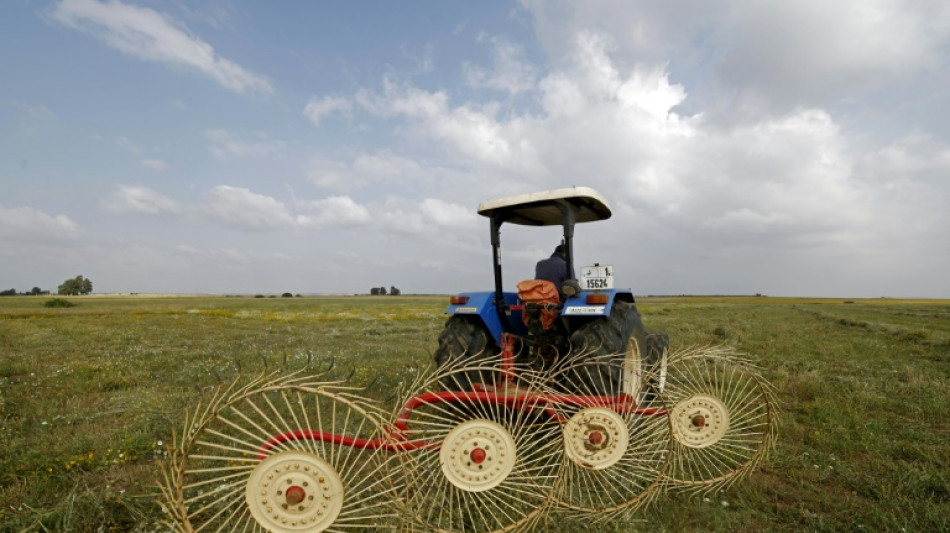
Morocco farmers saw hope in rain, but Mideast war inflates production costs / Photo: Abdel Majid BZIOUAT - AFP

Morocco farmers saw hope in rain, but Mideast war inflates production costs

Like many Moroccan farmers, Mehdi el-Maazi was hopeful that rare heavy rains would yield an abundant harvest this year -- but those hopes were quickly shattered as the Middle East war sent fuel and fertiliser costs soaring.

Text size:

Morocco, where agriculture employs about a quarter of the working population and where drought had persisted for seven consecutive years, recorded massive rainfalls last February and December.

Across the rural region of Marchouch, about 70 kilometres (43 miles) south of Rabat, landscapes that had long been parched have turned green again, and farmers have taken back to working their fields.

Following the rains this winter, the country expected a strong cereal harvest, with output estimated to reach nearly nine million tonnes -- more than double last year's. Overall agricultural output was also set to rise by about 15 percent from last season.

But the war in the Middle East, which began in late February, has disrupted maritime traffic through the Strait of Hormuz, not only sending global energy markets into a tailspin but also choking fertiliser supplies.

Prior to the war, Maazi would normally spend around 1,200 dirhams ($130) per hectare on diesel to run his tractor. Now, he said, the cost has climbed to 1,800 dirhams.

"We were happy at first about the arrival of the rain," said the 32-year-old lentil farmer. "But with the increase in diesel prices, everything changed."

Farmers also say higher fuel prices are driving up the cost of nearly everything needed to produce crops.

Abdelkader Toukati, another farmer in the area, said he hoped "the price of diesel will fall before the beginning of the harvest season".

- 'Working to pay for fuel' -

High prices have meant that workers' wages have also risen and even "the cost of renting harvesting machines doubled", Toukati added.

Abdelaziz Drissi, who rents out agricultural machinery, also complained that there was little to no financial reward.

"There is no longer any profit," he said. "We are only working to pay for fuel."

Rising energy costs have had a direct impact on key farming supplies, driving up prices for seeds, fertilisers, pesticides and animal feed.

Livestock breeder Abdessadaq el-Fayd said grain feed prices had sharply risen in recent months.

"We used to buy it for 90 dirhams" per sack, he said. "Today, it costs 110 to 120 dirhams."

A recent report by the kingdom's High Commission for Planning projected economic growth of five percent in the first quarter of 2026, up from 4.1 percent in the previous quarter, driven in part by agricultural activity.

In an effort to alleviate rising costs, the Moroccan government in March announced aid for transport operators.

And last month, Prime Minister Aziz Akhannouch pledged to "improve distribution chains so that prices remain at a reasonable level".

But farmers interviewed by AFP said the measures have yet to rein in prices.

Rachid Benali, president of the Moroccan Confederation of Agriculture and Rural Development, said the price hikes "mainly concern fuels and nitrogen fertilisers".

But while the high costs "will have no impact on either volume or quality" of harvests, they "will automatically be reflected" in produce prices at markets, he added.

(Y.Yildiz--BBZ)