RYCEF
0.7000

Ships continued to leave the Gulf, some of them braving a route not authorised by Tehran, despite an attack on a freighter that forced the suspension of a UN evacuation, tracking platforms showed Friday.
The UN operation had freed 115 vessels and 2,500 seafarers trapped by the dispute over control of the Strait of Hormuz, before the attack struck a ship in the Gulf of Oman, the UN maritime agency said.
US President Donald Trump was angered by what he called an Iranian drone strike that hit the upper deck of a cargo vessel on Thursday, declaring: "Obviously, this is a foolish violation of our Ceasefire Agreement."
Iran has warned vessels not to enter or leave the Gulf through Hormuz without permission, but around half of the 42 ships that made the passage on Thursday used a non-approved southern passage along the coast of Oman, according to the Kpler tracking platform.
Oil prices fell sharply, reflecting optimism that shipping through the Strait of Hormuz will return to normal while the United States and Iran negotiate a final settlement to the Middle East war, which began with US-Israeli strikes on Tehran on February 28.
Brent Crude, the international oil benchmark, dived more than five percent to around $71.50 a barrel and the main US contract, West Texas Intermediate, shed 4.5 percent to under $69.
- 'Strong verification' -
The chief of the UN's nuclear watchdog, meanwhile, warned that the eventual post-war settlement between Tehran and Washington should include strong safeguards to hold Tehran to its pledge to never build a nuclear weapon.
Iran's nuclear programme is a sticking point in talks to end the Middle East war, and there has been contrasting information from Tehran and Washington on whether any deal will ensure UN inspectors have access to Iranian nuclear facilities.
"I think the objective of this agreement is to ensure that there is no development of nuclear weapons in Iran. The government of Iran has declared quite clearly that this is not their intention," International Atomic Energy Agency (IAEA) head Rafael Grossi said.
"But of course intentions are not enough. We have to have a very strong verification system in place... as soon as is practicable," Grossi added, warning that the nuclear watchdog had so far "barely initiated" talks with Iran.
The interim agreement specifies that the country's stockpile of enriched uranium -- estimated before the war at 440 kilogrames of uranium (970 pounds) enriched to 60 percent -- should be "downblended" under IAEA supervision.
In Tehran meanwhile, people told AFP that despite the diplomatic progress, there had so far been no tangible benefits in everyday life.
"Overall, nothing has improved," said Amir, 28, a government employee. "Life has simply become more difficult."
Mehdi, 35, a content creator, said that "until such changes are felt in people's everyday lives, it is only natural that hope will remain accompanied by doubt, and that anticipation will give way to exhaustion and anxiety".
- Obstacles ahead -
The dispute threatens to derail efforts to reach a permanent settlement between the US and Iran following months of war, with other key disputes being Hormuz and Lebanon.
The strait is a narrow stretch of water between Iran and Oman that leads to the Indian Ocean, making it a chokepoint for crucial energy shipments out of the Gulf.
Iran closed the waterway during the war in retaliation for US-Israeli strikes, and its control of the strait has emerged as key leverage in the negotiations, as the world economy reels from energy shortages.
Iran plans to introduce fees for crossing the strait, a scheme vehemently opposed by Washington and most Gulf countries. Secretary of State Marco Rubio, visiting the Gulf on Wednesday, dismissed the idea of charges, saying it would open the door to "total chaos".
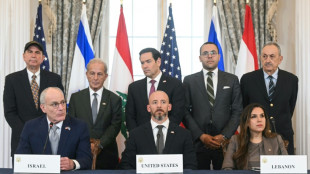
Tehran has also insisted that a Lebanon ceasefire be included in the regional deal. Lebanon's president Joseph Aoun has tried to separate Lebanon from the US-Iran talks.
On Friday, he insisted on Lebanon's eagerness for "any international formula that strengthens the capabilities of its armed forces, preserves its territorial integrity, and prevents its land from becoming an arena for escalation or regional tensions".
burs-dc/dcp
(K.Müller--BBZ)