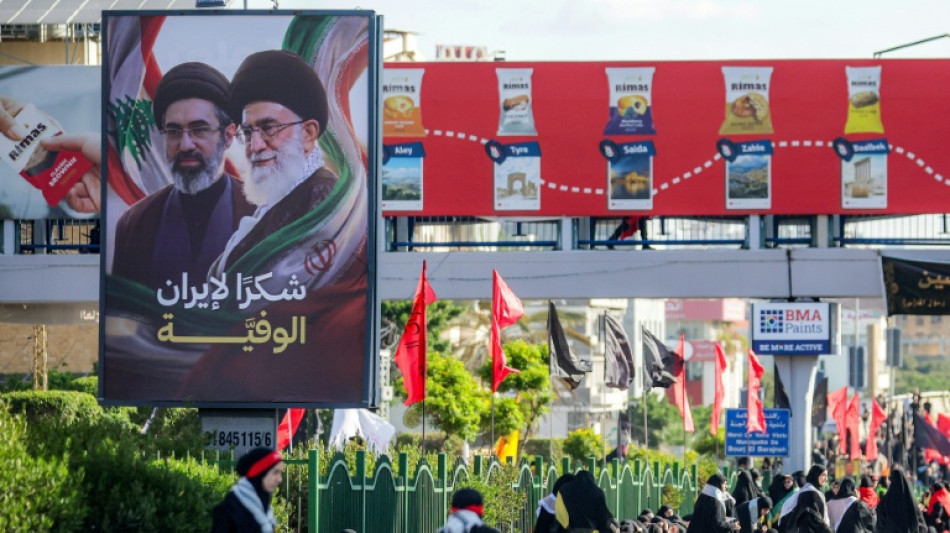
Israel and Lebanon hail Washington deal, rejected by Hezbollah / Photo: ibrahim AMRO - AFP

Israel and Lebanon hailed an agreement signed Friday with the United States to pave a way towards peace on their front in the Middle East war, while Iran-backed Hezbollah warned the deal would thwart plans to resolve the broader conflict.
At the signing ceremony in Washington, US Secretary of State Marco Rubio -- flanked by envoys from Israel and Lebanon -- said the trilateral agreement "begins to put in place a framework for lasting peace and security."
"It's the beginning of the beginning. There's a lot of work ahead," he said.
Israel's Prime Minister Benjamin Netanyahu welcomed the framework document as a victory against Iran.
Tehran argues that the Israeli conflict in Lebanon against its ally Hezbollah is inseparable from the broader war and should be part of the final settlement being negotiated by Washington and Tehran.
"Iran has been trying to force us to withdraw from southern Lebanon through pressure, but in effect Israel, Lebanon, and the United States are telling them: this is none of your business," Netanyahu said. "You have no role in Lebanon -- not you, not Hezbollah and not any terrorist organisation."
- 'Pilot areas' -
Netanyahu said that, under the agreement, the Lebanese army would be allowed to return to two "pilot areas" to begin taking charge of parts of southern Lebanon, but that Israeli forces would remain in the security zone it has seized until Hezbollah is disarmed and displaced civilians not allowed to return.
Lebanon's President Joseph Aoun also welcomed the framework, the text of which was not immediately published, as a "first step" toward allowing Lebanese civilians to return home "under the sovereignty of the Lebanese state that has no partner in its sovereignty over its land and people."
"We swear to continue to work until this is fully achieved. There will be no more occupation, prisoners, subordination or tutelage," he said.
But Hassan Fadlallah, a Hezbollah MP, warned that the Washington signing was an attempt to undermine the ceasefire deal between the United States and Iran, which foresaw that the Lebanese conflict would be resolved as part of the ongoing peace negotiations.
The Lebanese government, Fadlallah said, "will be unable to impose the implementation of the agreement signed in Washington unless they go, with American support, to civil war".
- Gulf tensions -
The agreement in Washington came against the backdrop of renewed tension in the Gulf, where Iran is attempting to exert leverage on the talks process by putting pressure on commercial shipping through the Strait of Hormuz, a key route for global energy supplies.
Ships continue to leave the Gulf, some of them braving a route not authorised by Tehran, despite an attack on a freighter that forced the suspension of a UN evacuation, tracking platforms showed Friday.
The UN operation had freed 115 vessels and 2,500 seafarers trapped by the dispute over control of the Strait of Hormuz, before the attack struck a ship in the Gulf of Oman, the UN maritime agency said.
US President Donald Trump was angered by what he called an Iranian drone strike that hit the upper deck of a cargo vessel on Thursday, declaring: "Obviously, this is a foolish violation of our Ceasefire Agreement."
Iran has warned vessels not to enter or leave the Gulf through Hormuz without permission, but around half of the 42 ships that made the passage on Thursday used a non-approved southern passage along the coast of Oman, according to the Kpler tracking platform.
Oil prices fell sharply, reflecting optimism that shipping through the Strait of Hormuz will return to normal while the United States and Iran negotiate a final settlement to the Middle East war, which began with US-Israeli strikes on Tehran on February 28.
- 'Strong verification' -
The chief of the UN's nuclear watchdog, meanwhile, warned that the eventual post-war settlement between Tehran and Washington should include strong safeguards to hold Tehran to its pledge to never build a nuclear weapon.
Iran's nuclear programme is a key sticking point in talks to end the Middle East war, and there has been contrasting information from Tehran and Washington on whether any deal will ensure UN inspectors have access to Iranian nuclear facilities.
"I think the objective of this agreement is to ensure that there is no development of nuclear weapons in Iran. The government of Iran has declared quite clearly that this is not their intention," International Atomic Energy Agency (IAEA) head Rafael Grossi said.
"But of course intentions are not enough. We have to have a very strong verification system in place... as soon as is practicable," Grossi added, warning that the nuclear watchdog had so far "barely initiated" talks with Iran.
The interim agreement specifies that the country's stockpile of enriched uranium -- estimated before the war at 440 kilogrames of uranium (970 pounds) enriched to 60 percent -- should be "downblended" under IAEA supervision.
burs-dc/dcp
(K.Müller--BBZ)