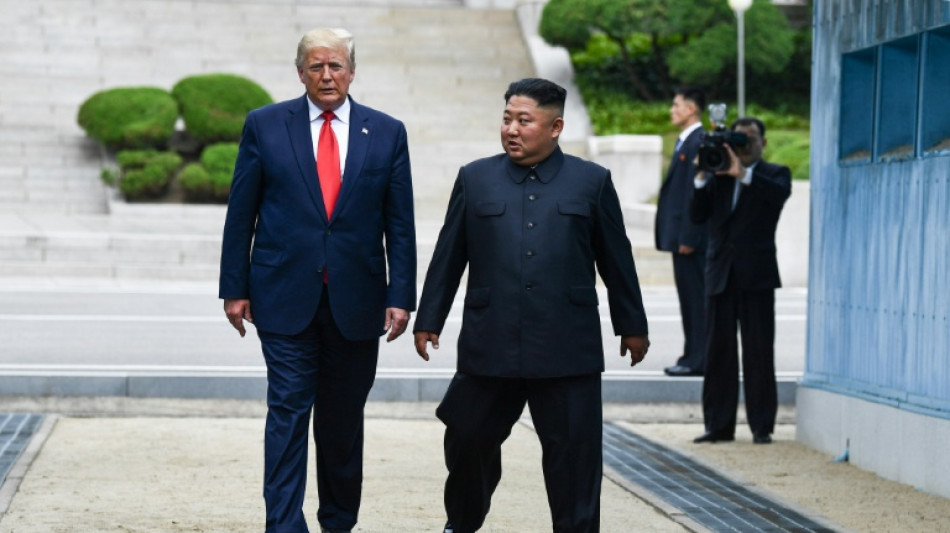
US, South Korea cut drills short after Trump criticism / Photo: Brendan Smialowski - AFP

Annual war games between South Korea and the United States will end around a week earlier than planned, both countries said on Wednesday, after US President Donald Trump ordered the "inappropriate and hostile" drills scaled back.
Trump said on Sunday that he had told the Pentagon to curtail the annual Ulchi Freedom Shield exercises -- a day before they started -- citing his "good relationship" with North Korean leader Kim Jong Un.
Pyongyang's state media criticised the drills on Wednesday as a "most immediate and open threat", without mentioning Trump's order.
Hours later, Seoul's military said the drills would wrap up on Friday, not on August 27 as originally planned.
"We have decided to adjust the UFS exercise period to run from the 17th to the 21st," South Korea's Joint Chiefs of Staff said in a statement.
The decision was made "at the suggestion of the US side", it added.
The Pentagon said the "substantially reduced" drills would "preserve essential readiness and... (cause) no degradation to US training objectives".
The exercises are designed to prepare for a possible attack by North Korea.
They were understood to consist of two phases: the first, focused on defending against potential North Korean threats, was due to run until Friday; and the second, focused on a counteroffensive, from August 24 to 27.
The second phase is now understood to have been scrapped.
A South Korean military official told AFP that Seoul viewed the decision as "unusual".
Nuclear-armed North Korea has long voiced outrage at the exercises, considering them dress rehearsals for an invasion.
Wednesday's commentary by the state-run Korean Central News Agency said they pose "the most immediate and open threat" to North Korea and "regional security".
It did not mention Trump's order or his desire to resume talks with Kim, with whom he has hinted at being in contact.
- 'Much safer' -
In the initial announcement on his Truth Social platform, Trump described the drills as unfriendly towards a country that had been respectful to him.
Seoul's presidential office said on Tuesday the drills did not reflect "any intention to attack North Korea or escalate tensions on the Korean peninsula".
Trump has insisted that he is making the situation "much safer" through his ties with Kim.
Asked on Monday whether Kim had responded to his requests for a conversation, Trump said: "Yeah, he has."
He said the discussions had been "very positive", but provided no further detail.
The Wall Street Journal reported on Tuesday, citing unnamed US officials, that Trump is pushing aides to set up a meeting with Kim as soon as this autumn.
"Reducing exercises could have a positive impact on the possibility of US-North Korea dialogue," Park Won-gon, a professor at Ewha Womans University, told AFP.
"The suspension of joint exercises has always been a prerequisite for North Korea to engage in dialogue with the US," he added.
Trump and Kim met three times in his first spell in the White House, but they have not held talks during his second term.
The United States stations about 28,500 troops in South Korea to bolster the country's defences, a legacy of the 1950-53 Korean War that ended with an armistice rather than a peace treaty.
However, Trump's repeated criticism of time-honoured alliances has cast doubt on US commitments to security in East Asia and alarmed regional allies.
Japan's defence minister underlined the "critical" importance of security cooperation with the United States and South Korea on Tuesday.
(P.Werner--BBZ)