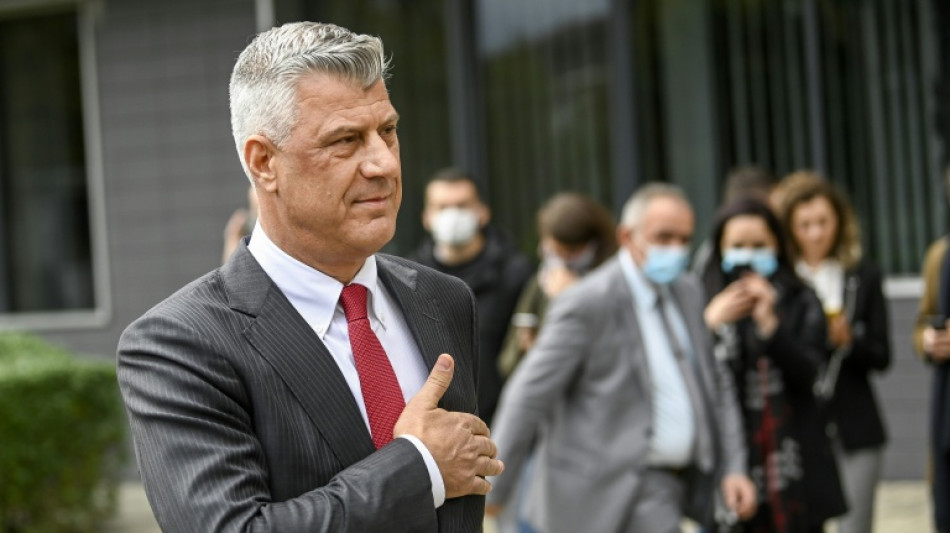
Hashim Thaci: From 'George Washington of Kosovo' to Hague convict / Photo: Armend NIMANI - AFP

Kosovo's former president Hashim Thaci, sentenced to 25 years in prison Wednesday for war crimes, has long been seen within the Balkan country as a guerilla hero and symbol of its bloody independence struggle.
Thaci, who was found guilty by a special court in The Hague of war crimes committed by guerilla fighters including murder, arbitrary arrest and detention, cruel treatment and torture, led the pro-independence Kosovo Liberation Army (KLA) during the 1998-1999 war with Serbia.
The 58-year-old -- who also served more than seven years as prime minister -- saw his popularity soar when he helped oversee Kosovo's declaration of independence in 2008.
But his image was tarnished by a 2010 Council of Europe report alleging links to organised crime and serious abuses committed during and immediately after the war.
Critics also accused the former leader and his party of corruption and concentrating power among political allies.
But it was the wartime allegations that abruptly ended his presidency and left him detained in The Hague.
He was indicted in 2020 on charges of war crimes and crimes against humanity, accused of bearing responsibility for murder, torture, illegal detention and enforced disappearances during and after the conflict.
"These are not easy moments for me and my family, and for those who have supported and believed in me in the past three decades of our struggle for freedom, independence and nation-building," he said in 2020, when he announced his resignation and surrender to the court.
Many watched the verdict live Wednesday on a screen in a square in the capital, Pristina, where a countdown clock had been ticking down to the ruling for days.
On Saturday, tens of thousands of people had rallied in Pristina to demand the acquittal of Thaci and other former guerrilla leaders.
- 'Snake' -
Born in 1968 in the Drenica region of western Kosovo -- a hotbed of ethnic Albanian resistance to Serbian rule -- Thaci became involved in passive resistance efforts against Belgrade's rule as a student in the 1990s.
While studying history in Switzerland, home to a large Albanian diaspora, he became frustrated with the policy of peaceful resistance espoused by the late Kosovo president Ibrahim Rugova.
On his return to Kosovo, he earned the nom de guerre "Snake" as he helped build an underground guerrilla army, the KLA, to fight for independence from the forces of Serbian strongman Slobodan Milosevic.
The conflict left some 13,000 people dead, mainly ethnic Albanians, and ended after NATO intervened in 1999, pushing Serbian forces out.
International courts later convicted several senior Serbian army and police officials for crimes committed during the conflict.
As Kosovo continued to push for statehood, Thaci became one of its most prominent political figures.
During a visit to the White House, Joe Biden, then US vice president, hailed him as the "George Washington of Kosovo".
-'War crimes, never' -
After the death of Rugova, who was widely regarded as the father of the nation, Thaci became prime minister following elections in 2007.
Three months later, he read the declaration of independence in parliament, announcing Kosovo's unilateral split from Serbia -- a move Belgrade still does not recognise.
Despite allegations of corruption, he remained at the heart of politics and was elected president in 2016.
He has always denied any wrongdoing during the war, describing it as a "just" rebellion against Serbian repression.
"Political mistakes in peace I could have made, but war crimes, never," he said in 2020.
(A.Lehmann--BBZ)