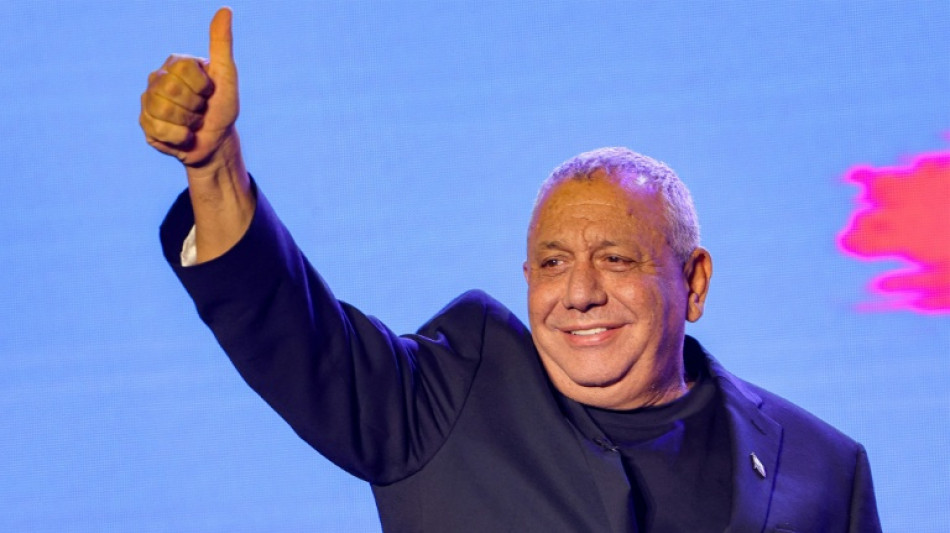
In Israel, Eisenkot tries quiet appeal to oust Netanyahu / Photo: Jack GUEZ - AFP/File

Gadi Eisenkot, the man who could unseat Israeli Prime Minister Benjamin Netanyahu, almost always dresses in plain black, speaks halting English and, reflecting the military culture that shapes him, responds in interviews in bullet-point lists.
For some voters, the 66-year-old Eisenkot's lack of charisma may be one of his greatest assets.
Serious and unassuming, Eisenkot is in many ways the opposite of Netanyahu, Israel's longest serving prime minister, who has flawless American-accented English and is ever ready with headline-grabbing soundbites on US television or social media.
Eisenkot, the military chief of staff from 2015 to 2019, has vowed to unite Israelis after the divisive tenure of Netanyahu, who has moved the country sharply to the right.
"There is a large camp in Israel whose main goal in the coming election is just for things to be calmer," said Tal Elovits, a researcher at the Molad think tank.
"The middle class," he said, "is looking for someone who will look responsible, boring. I think Eisenkot has that appeal."
Eisenkot, who is neck and neck with Netanyahu in polls, has promised to try to restore the international image of Israel, badly strained after three years of war in Gaza and violence in the occupied West Bank.
Eisenkot has vowed to crack down on West Bank settlers who have attacked Palestinians with impunity and recently beat up an American journalist and a French mayor, decrying the incidents as "Jewish terror" abetted by Netanyahu's government.
But the military man is no peacenik. He has even sought to play to the right of Netanyahu by vowing no Palestinian state, replaying clips from an earlier political era in which the long-serving prime minister begrudgingly voiced openness to the idea under US pressure.
Commanding the military during the 2006 war with Hezbollah, Eisenkot devised the so-called "Dahiya doctrine", named after a Beirut suburb, in which Israel vowed massive force against civilian infrastructure in areas populated by the Lebanese militants.
Israel has adopted the doctrine again in Gaza, causing destruction that critics say amount to war crimes, an assertion disputed by Israel.
- Working-class roots -
Eisenkot has garnered broad public sympathy after his son Gal and two nephews were killed fighting in Gaza.
His working-class roots constitute another element of his appeal. He would be the first prime minister who is Sephardic, Jews who trace their recent origins to the Middle East and North Africa.
Unlike Netanyahu, who comes from an elite family and whose father was a prominent professor in the United States, Eisenkot is the son of Moroccan Jews, and grew up on Israel's geographic periphery.
His background came into the spotlight when a senior commentator on the pro-Netanyahu Channel 14 television station described Eisenkot as "a monkey" controlled by "Ashkenazi elitists". He was referring to Jews of European descent who have historically dominated Israel's political and economic institutions.
While the term is not necessarily a racial slur in Hebrew and can mean a "fall guy" taking the blame on behalf of others, the remark drew widespread condemnation from opposition politicians and from Netanyahu himself.
Eisenkot swiftly sought to turn the episode to his advantage.
His campaign erected billboards denouncing discrimination against the Sephardim, and his party accused Netanyahu of sidelining Sephardic members of the Likud by limiting their media appearances during the campaign.
- Limited change on security -
In a pair of weekend appearances, Eisenkot went from meeting LGBTQ activists, promising the community greater protection in a forum at a hip cafe, to meeting religious Jews to whom he defended Israeli control over the West Bank.
"Israeli settlement (of the West Bank) is a value, on condition that it serves the interests of the state of Israel, and it's done according to the law," he told representatives of the Religious Zionist movement on Sunday.
He appeared to be rejecting the establishment of unauthorised settlement outposts, which have fuelled a recent rise in violence against Palestinians.
On Gaza, he has vowed to end Hamas rule within 18 months. Last week he said this could be achieved either through the implementation of US President Donald Trump's ceasefire plan, which envisages Hamas's gradual disarmament and a transfer of power, or through "creative operations" aimed at destroying the movement's military wing.
Addressing a key source of resentment among Israelis following three years of war, Eisenkot has promised to curb exemptions from military service for religious students.
He promised a "universal national service law" requiring ultra-Orthodox Jews and Arab citizens to perform either military or civil service.
He has sought to appeal to centrist and liberal voters by pledging to "protect judicial independence, the rule of law, minority rights and a free press".
(O.Joost--BBZ)