Berliner Boersenzeitung - 'F1 materials' rev high-speed Germany to Beijing Olympic gold

EUR -
AED 4.105324
AFN 71.542464
ALL 90.628261
AMD 402.871928
ANG 2.00072
AOA 1025.073259
ARS 1727.109028
AUD 1.624683
AWG 2.014933
AZN 1.898296
BAM 1.9504
BBD 2.253949
BDT 139.384078
BGN 1.953821
BHD 0.422427
BIF 3344.310468
BMD 1.117855
BND 1.428625
BOB 13.512466
BRL 6.153123
BSD 1.119101
BTN 105.668121
BWP 15.331414
BYN 3.338951
BYR 21909.956447
BZD 2.250648
CAD 1.573102
CDF 2587.833965
CHF 0.914897
CLF 0.027776
CLP 1093.172731
CNY 7.476778
CNH 7.453007
COP 3623.828546
CRC 507.490338
CUC 1.117855
CUP 26.857278
CVE 109.957112
CZK 24.325026
DJF 199.278245
DKK 7.474582
DOP 67.203328
DZD 152.256386
EGP 60.167761
ERN 16.767824
ETB 183.669319
FJD 2.529674
FKP 0.829062
GBP 0.834764
GEL 2.912045
GGP 0.829062
GHS 13.05374
GIP 0.829062
GMD 83.28554
GNF 9912.333381
GTQ 8.552054
GYD 234.468713
HKD 8.764324
HNL 30.077453
HRK 7.566771
HTG 146.662613
HUF 364.07137
IDR 20207.519295
ILS 3.573944
IMP 0.829062
INR 105.047731
IQD 1696.487646
IRR 2114258.25802
ISK 136.791593
JEP 0.829062
JMD 177.496965
JOD 0.7925
JPY 176.813315
KES 145.265597
KGS 97.755632
KHR 4553.392719
KMF 492.97406
KPW 1006.069385
KRW 1513.999937
KWD 0.347295
KYD 0.932605
KZT 503.170088
LAK 25185.928087
LBP 100500.507095
LKR 372.03493
LRD 190.240715
LSL 18.338423
LTL 3.300735
LVL 0.676179
LYD 7.164164
MAD 10.905707
MDL 20.007619
MGA 5073.906149
MKD 61.532335
MMK 2347.442725
MNT 4026.482407
MOP 9.042582
MRU 45.210418
MUR 52.561718
MVR 17.276449
MWK 1940.509822
MXN 20.916575
MYR 4.536708
MZN 71.44198
NAD 18.339077
NGN 1503.257696
NIO 41.185047
NOK 10.496876
NPR 169.072366
NZD 2.015845
OMR 0.429817
PAB 1.119091
PEN 3.854627
PGK 5.09784
PHP 70.433843
PKR 309.505882
PLN 4.393801
PYG 6894.909605
QAR 4.090546
RON 5.339545
RSD 117.622903
RUB 91.471711
RWF 1648.42116
SAR 4.196038
SBD 9.000652
SCR 15.385384
SDG 672.391853
SEK 11.039203
SGD 1.431877
SHP 0.833412
SLE 25.610177
SLL 23440.863677
SOS 639.523588
SRD 41.983297
STD 23137.339919
STN 24.432135
SVC 9.791758
SYP 14534.349327
SZL 18.332079
THB 37.487822
TJS 10.323378
TMT 3.923671
TND 3.334563
TOP 2.691526
TRY 56.068915
TTD 7.578914
TWD 36.563356
TZS 2957.044883
UAH 50.834197
UGX 4526.426889
USD 1.117855
UYU 45.074996
UZS 13353.906691
VES 999.104046
VND 28597.52351
VUV 133.598599
WST 3.105977
XAF 655.957
XAG 0.021435
XAU 0.000274045508
XCD 3.021059
XCG 2.016798
XDR 0.790381
XOF 655.957
XPF 119.331742
YER 264.009433
ZAR 18.44284
ZMK 10062.034488
ZMW 22.688977
ZWL 359.948828
SSP 6422.29579
MXV 2.353197
  • CMSD

    -0.1200

    19.81

    -0.61%

  • JRI

    0.0000

    10.77

    0%

  • BCC

    -1.8200

    74.15

    -2.45%

  • CMSC

    -0.2228

    19.53

    -1.14%

  • BCE

    0.2000

    20.34

    +0.98%

  • RIO

    0.0100

    94.17

    +0.01%

  • AZN

    -2.7400

    161.47

    -1.7%

  • GSK

    -1.1800

    48.17

    -2.45%

  • RBGPF

    0.0000

    65

    0%

  • NGG

    0.8800

    75.82

    +1.16%

  • RYCEF

    -0.7300

    19.08

    -3.83%

  • BTI

    -0.4500

    54.4

    -0.83%

  • BP

    0.4700

    43.99

    +1.07%

  • RELX

    -0.0600

    33.18

    -0.18%

  • VOD

    -0.1800

    16.15

    -1.11%

'F1 materials' rev high-speed Germany to Beijing Olympic gold

'F1 materials' rev high-speed Germany to Beijing Olympic gold

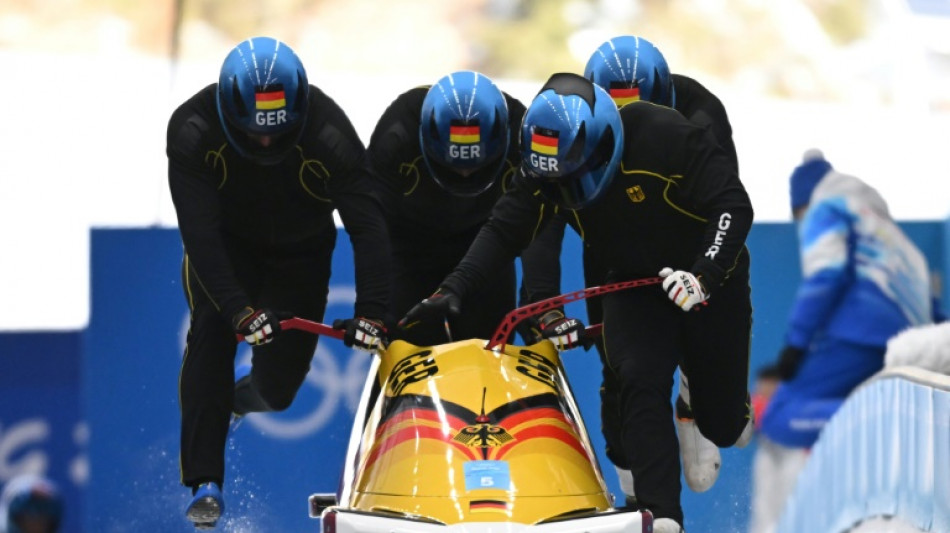
Germany have dominated sliding sports at the Beijing Olympics on high-speed sleds using materials "basically similar to Formula One", says one of the men who builds them.

Text size:

Going into the final weekend of the Games, the Germans have won 12 of the 24 medals at Yanqing National Sliding Centre, including seven of the eight golds.

Together with the expertise and determination of their athletes, Germany's success is down to technology from about 7,000 kilometres (4,00 miles) away in Berlin.

The Institute for Research and Development of Sports Equipment (FES) in the German capital builds and tests the bobsleigh, luge and skeleton sleds.

The materials for them would not be out of place on a Formula One racing car, says engineer Konstantin Schulze, who oversees their construction.

Underlining the comparison, in Friday's training for the four-man bobsleigh, Germany's Johannes Lochner was fastest, clocking speeds of up to 136 kilometres per hour.

Germany's top bobsleigh pilot Francesco Friedrich rates FES as "enormously important" as he looks to win a second gold in Beijing in Sunday's four-man bobsleigh.

Like the other German pilots, Friedrich works closely with FES experts whenever he races.

"You have to imagine it like a sports car that the athlete needs to deliver the perfect performance," says Schulze.

German sleds are sought after and Friedrich sold a bobsleigh he no longer needed to Canadian rival Christopher Spring before the Winter Games.

"He (Friedrich) definitely wouldn't have sold it if he didn't have something better, right?" said Canadian pilot Justin Kripps last week.

FES engineers tinker with the sleds on the ice at one of Germany's four tracks or in the wind tunnel at their Berlin headquarters.

"We try to cut two tenths (of a second) from each run during an Olympic cycle," said FES director Michael Nitsch.

In a sport often decided by fine margins, that could make the difference between winning an Olympic medal or not.

Such technology does not come cheap.

The German government provides annual funding of seven million euros ($8 million) to FES, which has 80 employees.

Their know-how benefits German athletes in other Olympic sports such as speed skating, canoeing and cycling.

Germany's success on the Yanqing ice track is born out of bitter defeat.

At the 2014 Sochi Games, Germany failed to win a bobsleigh medal for the first time in 50 years.

As a result, the German federation turned to FES and Austrian manufacturer Wallner.

The two-pronged approach saw Germany win all three bobsleigh medals at the 2018 Pyeongchang Games. Friedrich won two- and four-man golds while Mariama Jamanka took the two-woman title -- all in FES sleds.

Nitsch dismisses suggestions that FES gives German racers an unfair advantage.

Other national teams are "also allowed to do what we do", says the FES boss.

(P.Werner--BBZ)