Berliner Boersenzeitung - Webb telescope spies hidden stars in stellar graveyard

EUR -
AED 4.353601
AFN 77.648761
ALL 96.587303
AMD 443.03802
ANG 2.122066
AOA 1087.065574
ARS 1700.534016
AUD 1.712126
AWG 2.135605
AZN 2.012072
BAM 1.955535
BBD 2.363699
BDT 143.560522
BGN 1.990825
BHD 0.446973
BIF 3475.728416
BMD 1.185459
BND 1.501096
BOB 8.109934
BRL 6.253259
BSD 1.173546
BTN 107.726929
BWP 16.27886
BYN 3.322377
BYR 23234.999496
BZD 2.3603
CAD 1.622212
CDF 2584.30098
CHF 0.921724
CLF 0.025909
CLP 1022.837799
CNY 8.266913
CNH 8.239937
COP 4320.500738
CRC 580.823644
CUC 1.185459
CUP 31.414668
CVE 110.250506
CZK 24.243591
DJF 208.992526
DKK 7.467764
DOP 73.94028
DZD 153.297434
EGP 55.780118
ERN 17.781887
ETB 182.807768
FJD 2.622177
FKP 0.870101
GBP 0.867708
GEL 3.189216
GGP 0.870101
GHS 12.792318
GIP 0.870101
GMD 86.538848
GNF 10279.691976
GTQ 9.00774
GYD 245.537721
HKD 9.243558
HNL 30.95693
HRK 7.53407
HTG 153.919116
HUF 381.761119
IDR 19873.215143
ILS 3.715377
IMP 0.870101
INR 108.71257
IQD 1537.497878
IRR 49937.467216
ISK 145.669386
JEP 0.870101
JMD 184.735714
JOD 0.840501
JPY 182.356217
KES 152.924143
KGS 103.668086
KHR 4723.359139
KMF 497.892538
KPW 1066.934009
KRW 1710.32124
KWD 0.363652
KYD 0.978071
KZT 590.794825
LAK 25361.772878
LBP 105095.927221
LKR 363.583736
LRD 217.105049
LSL 18.94229
LTL 3.500352
LVL 0.717072
LYD 7.467018
MAD 10.749887
MDL 19.974458
MGA 5309.302032
MKD 61.613262
MMK 2489.387033
MNT 4227.428236
MOP 9.426161
MRU 46.92103
MUR 53.962092
MVR 18.314731
MWK 2035.032472
MXN 20.597981
MYR 4.700942
MZN 75.762297
NAD 18.94229
NGN 1672.599378
NIO 43.184505
NOK 11.584834
NPR 172.364341
NZD 1.985751
OMR 0.455818
PAB 1.173646
PEN 3.937182
PGK 5.019361
PHP 69.983556
PKR 328.372132
PLN 4.205713
PYG 7847.968296
QAR 4.278738
RON 5.095461
RSD 117.405444
RUB 90.391986
RWF 1711.674981
SAR 4.445453
SBD 9.630209
SCR 17.384008
SDG 713.04446
SEK 10.611075
SGD 1.504816
SHP 0.889401
SLE 28.93543
SLL 24858.484944
SOS 669.511985
SRD 45.190881
STD 24536.611137
STN 24.496883
SVC 10.26865
SYP 13110.674342
SZL 18.93751
THB 36.839392
TJS 10.972926
TMT 4.149107
TND 3.416522
TOP 2.854301
TRY 51.418933
TTD 7.971986
TWD 37.32833
TZS 3034.776587
UAH 50.603648
UGX 4148.454639
USD 1.185459
UYU 44.44322
UZS 14244.307662
VES 417.596262
VND 31044.211699
VUV 141.977452
WST 3.266638
XAF 655.870778
XAG 0.010807
XAU 0.000233
XCD 3.203763
XCG 2.115122
XDR 0.815693
XOF 655.870778
XPF 119.331742
YER 282.49338
ZAR 19.004036
ZMK 10670.558428
ZMW 23.02407
ZWL 381.717365
  • RIO

    3.1300

    90.43

    +3.46%

  • CMSC

    0.1000

    23.75

    +0.42%

  • CMSD

    0.0900

    24.13

    +0.37%

  • SCS

    0.0200

    16.14

    +0.12%

  • RBGPF

    -0.8100

    83.23

    -0.97%

  • NGG

    1.3200

    81.5

    +1.62%

  • RYCEF

    0.3000

    17.12

    +1.75%

  • BCE

    0.4900

    25.2

    +1.94%

  • VOD

    0.2300

    14.17

    +1.62%

  • RELX

    0.0600

    39.9

    +0.15%

  • BCC

    -1.1800

    84.33

    -1.4%

  • JRI

    0.0100

    13.68

    +0.07%

  • GSK

    0.5000

    49.15

    +1.02%

  • BTI

    0.9400

    59.16

    +1.59%

  • AZN

    1.2600

    92.95

    +1.36%

  • BP

    1.1000

    36.53

    +3.01%

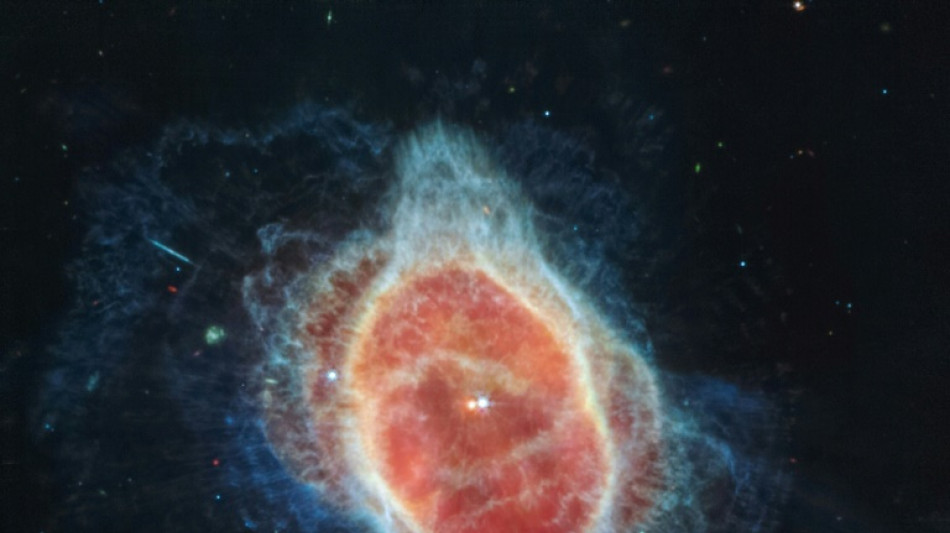
Webb telescope spies hidden stars in stellar graveyard
Webb telescope spies hidden stars in stellar graveyard / Photo: Handout - NASA/AFP/File

Webb telescope spies hidden stars in stellar graveyard

It was one of the first famous images revealed by the James Webb Space Telescope earlier this year: a stunning shroud of gas and dust illuminated by a dying star at its heart.

Text size:

Now researchers analysing the data from history's most powerful telescope have found evidence of at least two previously unknown stars hiding in the stellar graveyard.

The Southern Ring Nebula, which is in the Milky Way around 2,000 light years from Earth, had previously been thought to contain two stars.

One, nestled in the nebula's centre, is a white dwarf star which in its death throes has been casting off torrents of gas and dust for thousands of years that in turn formed the surrounding cloud.

Sapped of its brightness, the extremely hot white dwarf is the less visible of the two stars seen in Webb images released in July.

The white dwarf has offered astronomers a view of how our own Sun may die one day -- billions of years from now.

Unlike our lonely Sun, it has a companion, the brighter of the two stars in Webb's images.

However this binary system, which is common across the Milky Way, does not explain the nebula's "atypical" structure, Philippe Amram, an astrophysicist at France's Marseille Astrophysics Laboratory, told AFP.

Amram is one of the co-authors of a study published in the journal Nature Astronomy on Thursday that has used Webb's observations to uncover more of the nebula's secrets.

Since the nebula was discovered by English astronomer John Herschel in 1835, astronomers have wondered why it has "such a bizarre shape, not really spherical," Amram said.

By analysing the data from Webb's infrared cameras, the researchers said they found evidence of at least two other stars inside the nebula, which has a diameter equivalent 1,500 times the distance from the Sun to Pluto.

While the new pair are slightly farther away from the white dwarf and its companion, all four stars -- or possibly even five -- are located in the centre of the nebula.

They are close enough to interact with each other, and their "exchanges of energy" create the nebula's strange shape, Amram said.

The Webb telescope, which has been operational since July, has already unleashed a raft of unprecedented data and scientists are hopeful it will herald a new era of discovery.

(G.Gruner--BBZ)