Berliner Boersenzeitung - Sea cows threatened with extinction

EUR -
AED 4.202616
AFN 72.094453
ALL 95.950395
AMD 432.17846
ANG 2.048479
AOA 1049.367706
ARS 1600.022322
AUD 1.630858
AWG 2.059827
AZN 1.945028
BAM 1.954789
BBD 2.308706
BDT 140.657283
BGN 1.956045
BHD 0.432099
BIF 3402.940745
BMD 1.144348
BND 1.466842
BOB 7.920905
BRL 6.149838
BSD 1.146307
BTN 105.807762
BWP 15.619993
BYN 3.391747
BYR 22429.228522
BZD 2.305308
CAD 1.567706
CDF 2582.794158
CHF 0.903612
CLF 0.026683
CLP 1053.590327
CNY 7.892115
CNH 7.8976
COP 4228.390203
CRC 539.323537
CUC 1.144348
CUP 30.325232
CVE 110.208506
CZK 24.450037
DJF 204.124472
DKK 7.472092
DOP 70.4239
DZD 151.598659
EGP 59.989607
ERN 17.165226
ETB 178.92658
FJD 2.541374
FKP 0.860295
GBP 0.863806
GEL 3.123775
GGP 0.860295
GHS 12.448564
GIP 0.860295
GMD 84.106574
GNF 10049.594928
GTQ 8.790494
GYD 239.81602
HKD 8.961025
HNL 30.342446
HRK 7.534276
HTG 150.297702
HUF 391.283042
IDR 19459.644439
ILS 3.592459
IMP 0.860295
INR 105.748949
IQD 1501.630247
IRR 1512513.881139
ISK 144.199443
JEP 0.860295
JMD 179.857803
JOD 0.811299
JPY 182.379955
KES 147.864781
KGS 100.072924
KHR 4596.603561
KMF 493.213819
KPW 1029.913492
KRW 1713.306969
KWD 0.351452
KYD 0.95521
KZT 561.172337
LAK 24562.301764
LBP 102647.333309
LKR 356.744012
LRD 209.762473
LSL 19.252247
LTL 3.378963
LVL 0.692205
LYD 7.314219
MAD 10.796119
MDL 19.996662
MGA 4759.560195
MKD 61.738788
MMK 2402.456928
MNT 4084.153335
MOP 9.240563
MRU 45.86229
MUR 53.487137
MVR 17.680052
MWK 1987.581143
MXN 20.464016
MYR 4.498459
MZN 73.135382
NAD 19.252331
NGN 1586.993511
NIO 42.178379
NOK 11.140546
NPR 169.292219
NZD 1.968211
OMR 0.439998
PAB 1.146207
PEN 3.952956
PGK 5.012409
PHP 68.50012
PKR 320.063733
PLN 4.270296
PYG 7395.176836
QAR 4.166864
RON 5.094415
RSD 117.434143
RUB 92.542735
RWF 1672.742533
SAR 4.294458
SBD 9.21397
SCR 16.415072
SDG 687.753669
SEK 10.779047
SGD 1.465979
SHP 0.858558
SLE 28.093563
SLL 23996.426035
SOS 653.96477
SRD 42.967959
STD 23685.701325
STN 24.487341
SVC 10.029859
SYP 126.479084
SZL 19.24605
THB 37.224569
TJS 10.986968
TMT 4.005219
TND 3.389962
TOP 2.755316
TRY 50.566698
TTD 7.774015
TWD 36.651763
TZS 2981.027425
UAH 50.548988
UGX 4309.771931
USD 1.144348
UYU 46.046396
UZS 13840.784107
VES 506.608327
VND 30087.780148
VUV 135.32294
WST 3.130039
XAF 655.620921
XAG 0.014533
XAU 0.00023
XCD 3.092659
XCG 2.065841
XDR 0.815382
XOF 655.618058
XPF 119.331742
YER 272.984009
ZAR 19.317785
ZMK 10300.512291
ZMW 22.311465
ZWL 368.479716
  • RIO

    -2.8700

    87.83

    -3.27%

  • CMSC

    -0.1500

    22.99

    -0.65%

  • BTI

    0.0400

    59.93

    +0.07%

  • CMSD

    -0.1100

    22.99

    -0.48%

  • BCE

    -0.1100

    25.57

    -0.43%

  • BP

    0.5100

    42.67

    +1.2%

  • BCC

    0.3800

    70

    +0.54%

  • GSK

    -0.8900

    53.39

    -1.67%

  • RBGPF

    0.1000

    82.5

    +0.12%

  • NGG

    0.0900

    90.9

    +0.1%

  • JRI

    -0.2300

    12.59

    -1.83%

  • AZN

    -2.6000

    189.9

    -1.37%

  • RYCEF

    -1.1300

    16.12

    -7.01%

  • RELX

    -0.0400

    34.14

    -0.12%

  • VOD

    0.1000

    14.41

    +0.69%

Sea cows threatened with extinction
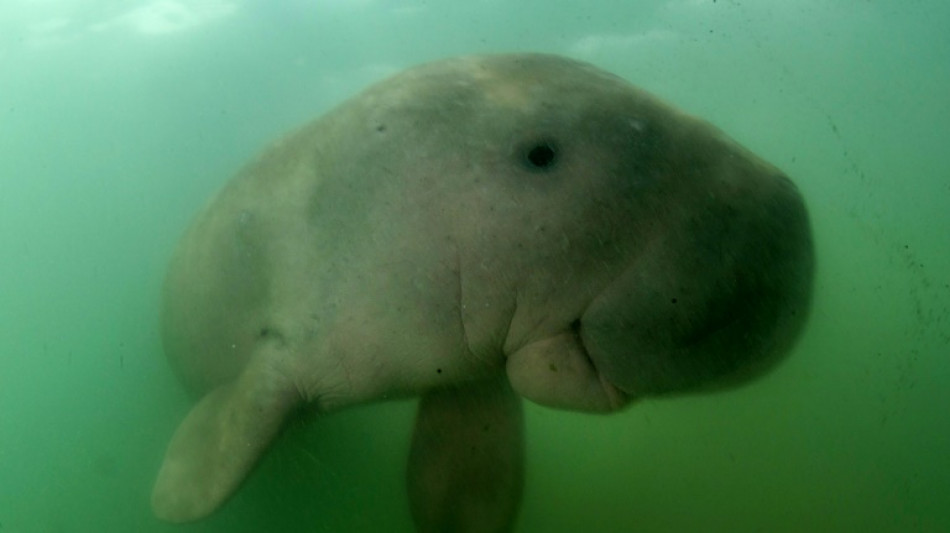
Sea cows threatened with extinction / Photo: Sirachai ARUNRUGSTICHAI - AFP/File

Sea cows threatened with extinction

Dugongs -- large herbivorous marine mammals commonly known as "sea cows" -- are now threatened with extinction, according to an official list updated Friday.

Text size:

These gentle cousins of the manatee graze on seagrass in shallow coastal waters -- but their populations in East Africa and New Caledonia have now entered the IUCN (International Union for Conservation of Nature) Red List as "critically endangered" and "endangered," respectively.

Globally, the species remains classified as "vulnerable."

Their primary threats are unintentional capture in fishing gear in East Africa and poaching in New Caledonia, as well as boat injuries in both locations.

In East Africa, fossil fuel exploration and production, pollution and unauthorized development are also degrading their seagrass food source, while in New Caledonia seagrass is being damaged by agricultural run-off and pollution from nickel mining, among other sources.

Habitat degradation is compounded by climate change throughout the dugongs' range.

"Today's IUCN Red List update reveals a perfect storm of unsustainable human activity decimating marine life around the globe," said Bruno Oberle, IUCN Director General.

The updated list comes as delegates from across the world meet in Montreal for a UN biodiversity conference to finalize a new framework for "a peace pact with nature," with key goals to preserve Earth's forests, oceans and species.

In other updates to the IUCN list, 44 percent of all abalone shellfish are now threatened with extinction, while pillar coral has moved to "critically endangered."

Abalone species are considered gastronomic delicacies, leading to unsustainable extraction and poaching by international organized crime networks, for example in South Africa.

They are also deeply susceptible to climate change, with a marine heatwave killing 99 percent of Roe's abalones off Western Australia in 2011.

Agricultural and pollution run-off also cause harmful algal blooms, which have eliminated the Omani abalone, a commercial species found in the Arabian Peninsula, across half of its former range.

Twenty of the world's 54 abalone species are now threatened with extinction.

"Abalones reflect humanity's disastrous guardianship of our oceans in microcosm: overfishing, pollution, disease, habitat loss, algal blooms, warming and acidification, to name but a few threats," said Howard Peters of the University of York who led the assessment.

"They really are the canary in the coal mine."

Pillar coral, which are found throughout the Caribbean, moved from "vulnerable" to "critically endangered" after its population shrunk by over 80 percent across most of its range since 1990.

Bleaching caused by sea surface temperature rise -- as well as antibiotics, fertilizers and sewage running into the oceans -- have left them deeply susceptible to Stony coral tissue soss disease, which has ravaged their numbers over the past four years.

Overfishing around coral reefs has piled on more pressure by depleting the number of grazing fish, allowing algae to dominate.

(G.Gruner--BBZ)