Berliner Boersenzeitung - Russia to send spacecraft to ISS to bring home crew of damaged capsule

EUR -
AED 4.331285
AFN 75.468553
ALL 95.455853
AMD 435.133136
ANG 2.110613
AOA 1082.496254
ARS 1649.279971
AUD 1.625795
AWG 2.125489
AZN 2.009303
BAM 1.960362
BBD 2.374715
BDT 144.673819
BGN 1.967008
BHD 0.445031
BIF 3508.088307
BMD 1.179189
BND 1.49518
BOB 8.147963
BRL 5.795828
BSD 1.179039
BTN 111.34021
BWP 15.830843
BYN 3.332255
BYR 23112.111202
BZD 2.371308
CAD 1.612011
CDF 2670.864298
CHF 0.916177
CLF 0.026704
CLP 1051.00014
CNY 8.019372
CNH 8.014083
COP 4422.526062
CRC 542.013173
CUC 1.179189
CUP 31.248518
CVE 110.903223
CZK 24.334582
DJF 209.565995
DKK 7.476537
DOP 69.985351
DZD 155.960046
EGP 62.195977
ERN 17.68784
ETB 185.491052
FJD 2.574218
FKP 0.866493
GBP 0.864889
GEL 3.154379
GGP 0.866493
GHS 13.313508
GIP 0.866493
GMD 86.674958
GNF 10353.282886
GTQ 9.002953
GYD 246.714182
HKD 9.235117
HNL 31.390478
HRK 7.538916
HTG 154.379289
HUF 353.981307
IDR 20491.303919
ILS 3.421187
IMP 0.866493
INR 111.345548
IQD 1544.738045
IRR 1546506.829043
ISK 143.873347
JEP 0.866493
JMD 185.842514
JOD 0.836092
JPY 184.734208
KES 152.328133
KGS 103.085327
KHR 4728.549695
KMF 492.90156
KPW 1061.212561
KRW 1723.880942
KWD 0.36279
KYD 0.982687
KZT 544.929701
LAK 25889.102525
LBP 105596.406437
LKR 379.599647
LRD 216.385693
LSL 19.327363
LTL 3.48184
LVL 0.71328
LYD 7.458419
MAD 10.754655
MDL 20.163928
MGA 4911.324039
MKD 61.616155
MMK 2475.833955
MNT 4220.203791
MOP 9.507427
MRU 47.102764
MUR 55.210091
MVR 18.163925
MWK 2054.148249
MXN 20.255648
MYR 4.623647
MZN 75.362436
NAD 19.327358
NGN 1609.593864
NIO 43.293982
NOK 10.859513
NPR 178.160636
NZD 1.976185
OMR 0.453919
PAB 1.179144
PEN 4.04993
PGK 5.129916
PHP 71.358689
PKR 328.581553
PLN 4.239717
PYG 7202.120307
QAR 4.29269
RON 5.21945
RSD 117.297547
RUB 87.543025
RWF 1722.206041
SAR 4.459737
SBD 9.456429
SCR 16.459646
SDG 708.107537
SEK 10.86706
SGD 1.494391
SHP 0.880384
SLE 29.067455
SLL 24727.006491
SOS 673.91103
SRD 44.100547
STD 24406.83871
STN 24.939855
SVC 10.317092
SYP 130.352242
SZL 19.303765
THB 37.973479
TJS 11.001504
TMT 4.127163
TND 3.379601
TOP 2.839205
TRY 53.475102
TTD 7.990886
TWD 36.927538
TZS 3063.998569
UAH 51.791223
UGX 4417.888438
USD 1.179189
UYU 47.025255
UZS 14309.46312
VES 588.693738
VND 31022.113342
VUV 139.175172
WST 3.188636
XAF 657.487181
XAG 0.014668
XAU 0.00025
XCD 3.186819
XCG 2.124956
XDR 0.82014
XOF 657.402298
XPF 119.331742
YER 281.384102
ZAR 19.315951
ZMK 10614.123377
ZMW 22.449247
ZWL 379.698489
  • CMSD

    0.1140

    23.534

    +0.48%

  • RBGPF

    0.7000

    63.61

    +1.1%

  • GSK

    -0.0900

    50.41

    -0.18%

  • BCE

    -0.4300

    24.14

    -1.78%

  • CMSC

    0.1400

    23.11

    +0.61%

  • RELX

    0.0759

    33.58

    +0.23%

  • RYCEF

    -0.4100

    16.37

    -2.5%

  • AZN

    0.3300

    182.85

    +0.18%

  • RIO

    2.2700

    105.38

    +2.15%

  • NGG

    0.9800

    86.89

    +1.13%

  • JRI

    0.0000

    13.15

    0%

  • BCC

    -2.0900

    70.67

    -2.96%

  • BTI

    0.2000

    58.28

    +0.34%

  • VOD

    0.5100

    16.2

    +3.15%

  • BP

    -0.4700

    43.34

    -1.08%

Russia to send spacecraft to ISS to bring home crew of damaged capsule
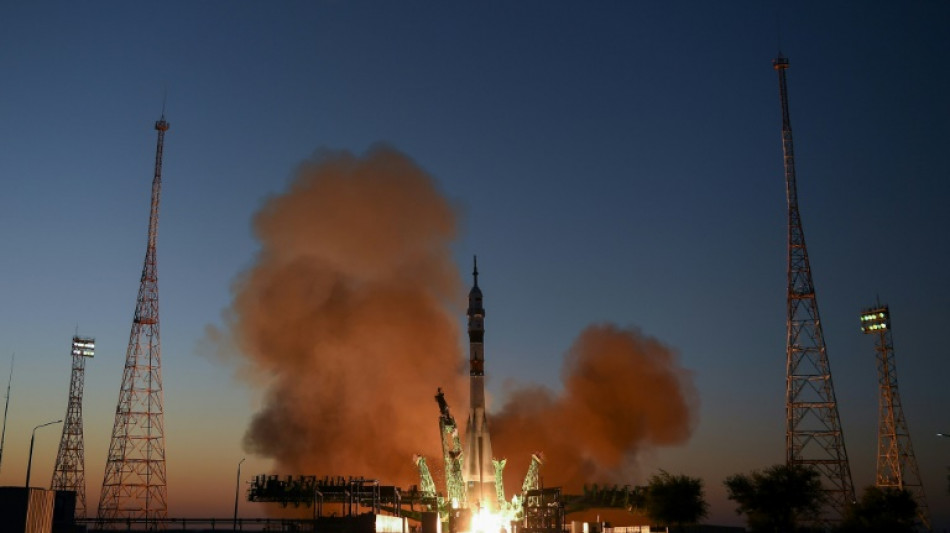
Russia to send spacecraft to ISS to bring home crew of damaged capsule / Photo: NATALIA KOLESNIKOVA - AFP/File

Russia to send spacecraft to ISS to bring home crew of damaged capsule

Russia said Wednesday that it will send an empty spacecraft to the International Space Station (ISS) next month to bring home three astronauts whose planned return vehicle was damaged by a strike from a tiny meteorite.

Text size:

The Russian space agency, Roscosmos, made the announcement after examining the flight worthiness of the Soyuz MS-22 crew capsule docked with the ISS that sprang a radiator coolant leak in December.

Roscosmos and NASA officials said at a joint press briefing that an uncrewed Soyuz spacecraft, MS-23, would be sent to the ISS on February 20 to bring Russian cosmonauts Dmitry Petelin and Sergei Prokopyev and NASA astronaut Frank Rubio back to Earth.

"We're not calling it a rescue Soyuz," said Joel Montalbano, the ISS program manager at NASA's Johnson Space Center in Houston. "I'm calling it a replacement Soyuz.

"Right now the crew is safe onboard the space station."

MS-22 flew Petelin, Prokopyev and Rubio to the ISS in September. They were scheduled to return home in the same spacecraft in mid-March.

But MS-22 began leaking coolant on December 14 after being hit by what US and Russian space officials said they believe was a micrometeorite.

"Everything does point to a micrometeorite," Montalbano said.

Sergei Krikalev, executive director of Human Space Flight Programs at Roscosmos, said the "current theory is that this damage was caused by a small particle about one millimetre in diameter".

Krikalev said the decision to use MS-23 to fly the crew home was made because of concern over high temperatures in MS-22 during re-entry.

"The main problem to land the current Soyuz with crew would be thermal conditions because we lost heat rejection capability," he said.

"We may have a high temperature situation on Soyuz in the equipment compartment and in the crew compartment."

- SpaceX Crew Dragon -

Montalbano said discussions were also underway with SpaceX officials about potentially returning one or more crew members on the SpaceX Crew Dragon capsule currently docked with the ISS.

Four astronauts were flown to the ISS by a SpaceX rocket in October for a mission expected to last about six months.

"We could safely secure the crew members in the area that the cargo normally returns on the Dragon," Montalbano said.

"All that is only for an emergency, only if we have to evacuate ISS," he stressed. "That's not the nominal plan or anything like that."

Krikalev said MS-22 would return to Earth after the two cosmonauts and the NASA astronaut leave on MS-23. It would bring back equipment and experiments that are not "temperature sensitive", he said.

Soyuz MS-23 had been initially scheduled to fly Russian cosmonauts Oleg Kononenko and Nikolai Chub and NASA's Loral O'Hara to the ISS on March 16.

Space has remained a rare venue of cooperation between Moscow and Washington since the start of the Russian offensive in Ukraine and ensuing Western sanctions on Russia.

The ISS was launched in 1998 at a time of increased US-Russia cooperation following the Cold War "Space Race".

Russia has been using the ageing but reliable Soyuz capsules to ferry astronauts into space since the 1960s.

(G.Gruner--BBZ)