Berliner Boersenzeitung - How three dust specks reveal an asteroid's secrets

EUR -
AED 4.364552
AFN 78.426697
ALL 96.878983
AMD 450.193226
ANG 2.127122
AOA 1089.656166
ARS 1708.476407
AUD 1.717322
AWG 2.138911
AZN 2.008692
BAM 1.96031
BBD 2.393567
BDT 145.414313
BGN 1.995568
BHD 0.448039
BIF 3529.202359
BMD 1.188284
BND 1.508165
BOB 8.229416
BRL 6.276159
BSD 1.188414
BTN 107.996806
BWP 15.640903
BYN 3.388695
BYR 23290.359005
BZD 2.390139
CAD 1.629268
CDF 2620.165597
CHF 0.922649
CLF 0.026034
CLP 1027.948186
CNY 8.286616
CNH 8.258173
COP 4388.92556
CRC 588.087527
CUC 1.188284
CUP 31.489516
CVE 110.525773
CZK 24.242709
DJF 211.181814
DKK 7.468339
DOP 74.416203
DZD 153.505927
EGP 55.815705
ERN 17.824254
ETB 185.694425
FJD 2.62789
FKP 0.872174
GBP 0.868275
GEL 3.196584
GGP 0.872174
GHS 12.959631
GIP 0.872174
GMD 86.744985
GNF 10409.560197
GTQ 9.120596
GYD 248.637679
HKD 9.266176
HNL 31.345109
HRK 7.532545
HTG 155.748783
HUF 381.753337
IDR 19890.620146
ILS 3.703185
IMP 0.872174
INR 108.976719
IQD 1556.786164
IRR 50056.447794
ISK 145.398398
JEP 0.872174
JMD 187.072952
JOD 0.842482
JPY 183.11035
KES 153.229362
KGS 103.915762
KHR 4788.31765
KMF 499.079349
KPW 1069.476077
KRW 1715.216032
KWD 0.364326
KYD 0.990332
KZT 597.128859
LAK 25638.599297
LBP 106421.589874
LKR 367.938109
LRD 219.858732
LSL 19.056622
LTL 3.508692
LVL 0.718781
LYD 7.504707
MAD 10.800182
MDL 20.048217
MGA 5359.668091
MKD 61.775753
MMK 2495.318225
MNT 4237.50047
MOP 9.544679
MRU 47.392818
MUR 54.090869
MVR 18.358894
MWK 2060.670593
MXN 20.632068
MYR 4.712142
MZN 75.943472
NAD 19.055336
NGN 1682.027508
NIO 43.733552
NOK 11.606263
NPR 172.793961
NZD 1.988046
OMR 0.456897
PAB 1.188404
PEN 3.985437
PGK 5.157168
PHP 70.22934
PKR 332.782764
PLN 4.207659
PYG 7986.37249
QAR 4.332422
RON 5.097023
RSD 117.401267
RUB 90.936877
RWF 1733.883609
SAR 4.456151
SBD 9.653154
SCR 16.616665
SDG 714.734911
SEK 10.614694
SGD 1.508716
SHP 0.89152
SLE 28.994764
SLL 24917.712555
SOS 677.979648
SRD 45.303294
STD 24595.071855
STN 24.558149
SVC 10.398534
SYP 13141.911722
SZL 19.041086
THB 37.014823
TJS 11.093821
TMT 4.158993
TND 3.431826
TOP 2.861102
TRY 51.514712
TTD 8.076123
TWD 37.373304
TZS 3018.240682
UAH 51.235986
UGX 4212.904425
USD 1.188284
UYU 44.595217
UZS 14361.885267
VES 418.591223
VND 31118.17737
VUV 142.315726
WST 3.274421
XAF 657.511091
XAG 0.01102
XAU 0.000235
XCD 3.211396
XCG 2.141753
XDR 0.817636
XOF 657.508318
XPF 119.331742
YER 283.166138
ZAR 19.050943
ZMK 10695.97016
ZMW 23.203747
ZWL 382.626842
  • SCS

    0.0200

    16.14

    +0.12%

  • CMSC

    0.0300

    23.78

    +0.13%

  • RBGPF

    -1.5400

    82.5

    -1.87%

  • NGG

    1.0800

    82.58

    +1.31%

  • GSK

    1.1700

    50.32

    +2.33%

  • CMSD

    0.0300

    24.16

    +0.12%

  • BTI

    -0.1700

    58.99

    -0.29%

  • BCE

    -0.0500

    25.15

    -0.2%

  • RIO

    0.0400

    90.47

    +0.04%

  • BP

    0.2300

    36.76

    +0.63%

  • BCC

    -0.9300

    83.4

    -1.12%

  • RELX

    -0.3900

    39.51

    -0.99%

  • AZN

    1.2800

    94.23

    +1.36%

  • RYCEF

    -0.1200

    17

    -0.71%

  • JRI

    0.0500

    13.73

    +0.36%

  • VOD

    0.0600

    14.23

    +0.42%

How three dust specks reveal an asteroid's secrets
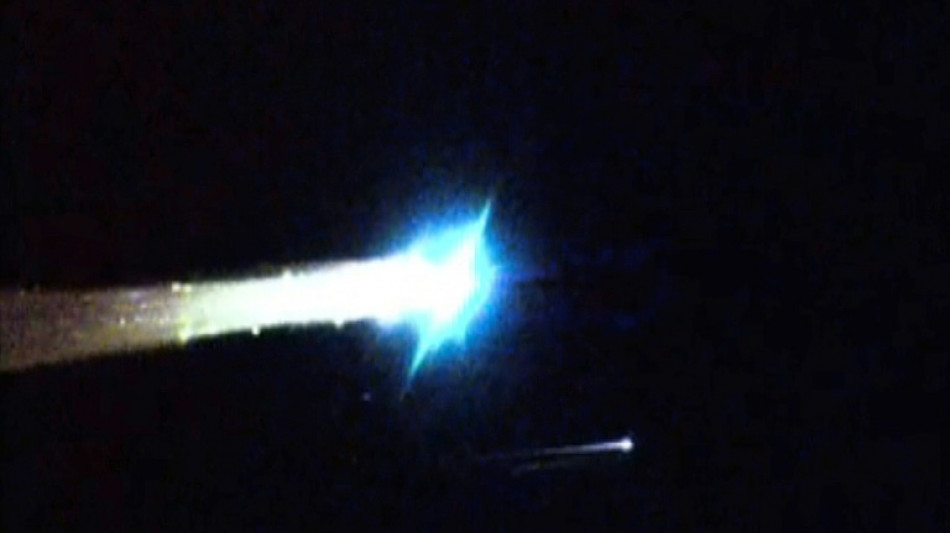
How three dust specks reveal an asteroid's secrets / Photo: NASA - NASA/AFP/File

How three dust specks reveal an asteroid's secrets

The specks are tiny. No, really tiny. Smaller than the diameter of a hair. But they hold billions of years of history that reveal some of the secrets of asteroids.

Text size:

The three minute particles from an asteroid called Itokawa show some of these space rocks are vastly older than was thought, and are much tougher.

And that could mean we need bolder ways to prevent catastrophic collisions with Earth, according to research published Tuesday.

The three samples were collected in 2005 from the peanut-shaped Itokawa, some 300 million kilometres (186 million miles) from Earth.

It took the Japanese spacecraft Hayabusa five years to return them to Earth, along with hundreds of other particles from Itokawa, and scientists have been analysing them for clues ever since.

Fred Jourdan, professor at Curtin University's School of Earth and Planetary Sciences, wanted to see what the specks could reveal about the age of rubble-pile asteroids like Itokawa.

These form when solid asteroids collide and the resulting fragments assemble into new structures.

Solid asteroids are thought to have a lifespan of several hundred million years, and are gradually ground down by constant collisions.

But rubble-pile asteroids have a very different structure, composed of rocks, dust, pebbles and a void, and held together by the gravitational pull of their various components.

"It's like a giant space cushion, and cushions are good at absorbing shock," Jourdan said.

To find out just how good, the team analysed crystal structures in the samples, looking for deformations caused by the impact that created Itokawa.

And they dated the samples by measuring the decay of potassium into argon.

The methods suggest Itokawa was formed by an asteroid collision at least 4.2 billion years ago, ten times older than solid asteroids of similar size are predicted to be.

"We were really surprised," said Jourdan.

"I mean that's really, really old, and I'm sure some of my colleagues are not even going to believe it."

Rubble-pile asteroids are so resilient to the constant battering they face that they are likely to be much more abundant than previously assumed, the research published in the journal Proceedings of the National Academy of Sciences concludes.

That might mean we need new ways to tackle such asteroids on a collision course with Earth, Jourdan said.

NASA's recent DART test showed asteroids like Itokawa can be nudged off course, but that would likely require a lead time of several years.

An asteroid just weeks from colliding with Earth would require a different approach, and Jourdan argues a nuclear blast might be needed.

"It's not 'Armageddon'-style," blowing it up, he hastens to add, referring to the 1998 sci-fi movie.

"The shockwave should push the asteroid out of the way."

It is a far-reaching conclusion to draw from such tiny specks of dust, but each particle is analysed at the atomic level.

"We can get big stories like that out of (something) very, very small, because those machines, what they're doing, is the measuring and counting of atoms," Jourdan said.

"Every grain has its own story to tell."

(F.Schuster--BBZ)