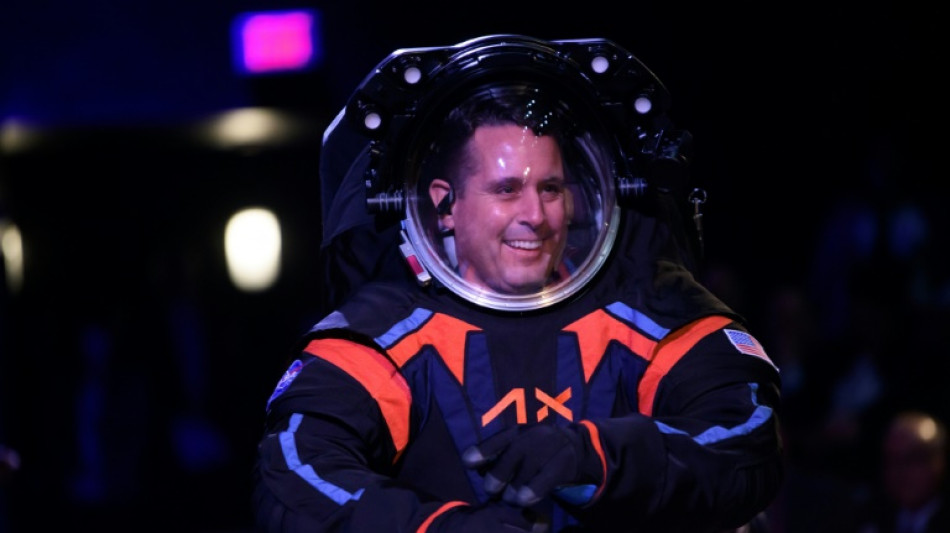
Prototype spacesuit for future NASA mission to Moon unveiled / Photo: Mark Felix - AFP

NASA and the private aerospace company Axiom Space unveiled a prototype on Wednesday of the next-generation spacesuit that astronauts will wear on the next walk on the Moon.
The suit revealed at an event at the Johnson Space Center in Houston features greater flexibility and thermal protection than those worn by the Apollo astronauts who first stepped foot on the lunar surface more than 50 years ago.
The pressurized garment has multiple protective layers, a backpack with life support systems, and lights and a high-definition video camera mounted on top of the bubble-shaped helmet.
The US space agency's Artemis program aims to return humans to the Moon in late 2025 for the first time since the historic Apollo missions ended in 1972, an initial step towards an eventual voyage to Mars.
Axiom Space was awarded a $228.5 million contract to design the suit -- the Axiom Extravehicular Mobility Unit in space jargon -- for the mission known as Artemis III.
Axiom Space chief engineer Jim Stein appeared on stage at the NASA facility wearing the suit, waving his arms, performing squats and dropping to one knee to display the range of motion it provides.
The spacesuit modeled by Stein featured a cover layer in all black with blue and orange trim which Axiom Space said was required to "conceal the suit's proprietary design."
The final version will be in the traditional white used to reflect heat from the Sun and protect astronauts from the temperatures of the harsh lunar environment.
The suit features a backpack Axios Space described as a "portable life support system."
"Inside of this box are all the parts and the components to keep you alive," said Russell Ralston, deputy program manager for extravehicular activity at Axiom Space.
"You can think of it as like a very fancy scuba tank and air conditioner kind of combined into one."
The suit is designed to be worn for up to eight hours at a time.
It features multiple layers -- an inner layer called a bladder layer that holds air inside the spacesuit like a balloon and a restraint layer that maintains its shape.
An insulation layer made of different fabrics protects the astronauts against the huge temperature fluctuations on the Moon while the outer layer is designed to be resistant to dust and potential tears from sharp rocks.
- 'More functionality, more performance' -
Vanessa Wyche, the Johnson Space Center director, said the new suit has "more functionality, more performance, more capability" than the bulky version worn by Apollo astronauts.
"We have not had a new suit since the suits that we designed for the space shuttle and those suits are currently in use on the space station," Wyche said. "So for 40 years we've been using the same suit based on that technology."
Artemis III is scheduled to take place in late 2025, about 12 months after Artemis II, which is to see four astronauts -- three Americans and one Canadian -- fly in a spacecraft called Orion around the Moon without landing on it.
NASA is to reveal the names of the four astronauts for the Artemis II mission on April 3.
The first Artemis mission wrapped up in December with an uncrewed Orion capsule returning safely to Earth after a 25-day journey around the Moon.
The Artemis III astronauts will land for the first time on the south pole of the Moon.
NASA is planning to send a woman and a person of color to the Moon for the first time as part of the Artemis program.
Only 12 people -- all of them white men -- have set foot on the Moon.
NASA hopes to establish a lasting human presence on the lunar surface and later launch a years-long trip to Mars.
While Axiom Space described the spacesuit unveiled on Wednesday as "revolutionary," one thing has not changed since the days of Apollo.
"We're still using diapers in the spacesuits," Ralston said. "They're just honestly a very effective solution.
"Sometimes simplicity is best and this is one of those cases."
(T.Renner--BBZ)