Berliner Boersenzeitung - Milky Way's fate? Astronomers reveal what ignites quasars

EUR -
AED 4.282057
AFN 76.361227
ALL 96.670332
AMD 445.136316
ANG 2.086894
AOA 1069.063329
ARS 1676.166309
AUD 1.754184
AWG 2.099946
AZN 1.982882
BAM 1.959652
BBD 2.348106
BDT 142.460053
BGN 1.958554
BHD 0.439488
BIF 3457.842356
BMD 1.165827
BND 1.511271
BOB 8.055836
BRL 6.393975
BSD 1.165787
BTN 104.810591
BWP 15.529528
BYN 3.386658
BYR 22850.205727
BZD 2.344709
CAD 1.612281
CDF 2599.793993
CHF 0.935179
CLF 0.027493
CLP 1078.529955
CNY 8.234932
CNH 8.238263
COP 4464.743667
CRC 574.028445
CUC 1.165827
CUP 30.894411
CVE 111.044843
CZK 24.274887
DJF 207.190728
DKK 7.468735
DOP 74.904584
DZD 151.665323
EGP 55.447188
ERN 17.487402
ETB 180.994406
FJD 2.652842
FKP 0.875427
GBP 0.873496
GEL 3.13605
GGP 0.875427
GHS 13.348527
GIP 0.875427
GMD 85.704047
GNF 10128.119778
GTQ 8.924544
GYD 243.909486
HKD 9.071654
HNL 30.602608
HRK 7.534392
HTG 152.659449
HUF 383.633382
IDR 19422.441702
ILS 3.774079
IMP 0.875427
INR 104.788478
IQD 1527.233138
IRR 49081.309604
ISK 148.596599
JEP 0.875427
JMD 186.947508
JOD 0.826583
JPY 182.262451
KES 150.683027
KGS 101.951516
KHR 4669.13657
KMF 494.310913
KPW 1049.240277
KRW 1713.147679
KWD 0.357862
KYD 0.97151
KZT 604.415589
LAK 25280.954904
LBP 104399.792175
LKR 360.007716
LRD 206.351293
LSL 19.88902
LTL 3.442383
LVL 0.705197
LYD 6.33621
MAD 10.787405
MDL 19.848018
MGA 5234.562516
MKD 61.575431
MMK 2448.875157
MNT 4137.934338
MOP 9.344269
MRU 46.446581
MUR 53.802861
MVR 17.954774
MWK 2024.45812
MXN 21.234195
MYR 4.800839
MZN 74.508526
NAD 19.889122
NGN 1694.109867
NIO 42.855745
NOK 11.809575
NPR 167.697666
NZD 2.01347
OMR 0.448263
PAB 1.165792
PEN 3.920696
PGK 4.954185
PHP 68.918998
PKR 326.839868
PLN 4.226273
PYG 7943.615835
QAR 4.244893
RON 5.092684
RSD 117.447725
RUB 91.808075
RWF 1692.780547
SAR 4.374827
SBD 9.595445
SCR 15.706211
SDG 701.242796
SEK 10.846649
SGD 1.509332
SHP 0.874672
SLE 28.082425
SLL 24446.803391
SOS 666.256225
SRD 45.020729
STD 24130.261437
STN 24.890403
SVC 10.201054
SYP 12890.35916
SZL 19.888908
THB 37.085445
TJS 10.783799
TMT 4.092052
TND 3.420244
TOP 2.807031
TRY 49.672092
TTD 7.905541
TWD 36.33474
TZS 2858.157395
UAH 49.354823
UGX 4162.164276
USD 1.165827
UYU 45.689819
UZS 14001.580837
VES 300.324317
VND 30727.697568
VUV 142.138455
WST 3.250103
XAF 657.249043
XAG 0.019225
XAU 0.000278
XCD 3.150705
XCG 2.101121
XDR 0.817899
XOF 656.361003
XPF 119.331742
YER 278.078817
ZAR 19.811011
ZMK 10493.844013
ZMW 27.111296
ZWL 375.395761
  • SCS

    0.0200

    16.14

    +0.12%

  • RBGPF

    -1.5200

    77.68

    -1.96%

  • CMSC

    0.0200

    23.26

    +0.09%

  • RYCEF

    -0.1300

    14.62

    -0.89%

  • NGG

    -0.2580

    74.632

    -0.35%

  • RIO

    1.8200

    76.22

    +2.39%

  • GSK

    1.0900

    48.36

    +2.25%

  • AZN

    1.6500

    91.47

    +1.8%

  • JRI

    0.0460

    13.747

    +0.33%

  • BCC

    5.4600

    77.46

    +7.05%

  • CMSD

    0.0950

    23.315

    +0.41%

  • VOD

    0.0650

    12.565

    +0.52%

  • RELX

    0.5900

    40.13

    +1.47%

  • BCE

    0.0350

    23.185

    +0.15%

  • BP

    0.3550

    35.905

    +0.99%

  • BTI

    1.5100

    58.8

    +2.57%

Milky Way's fate? Astronomers reveal what ignites quasars
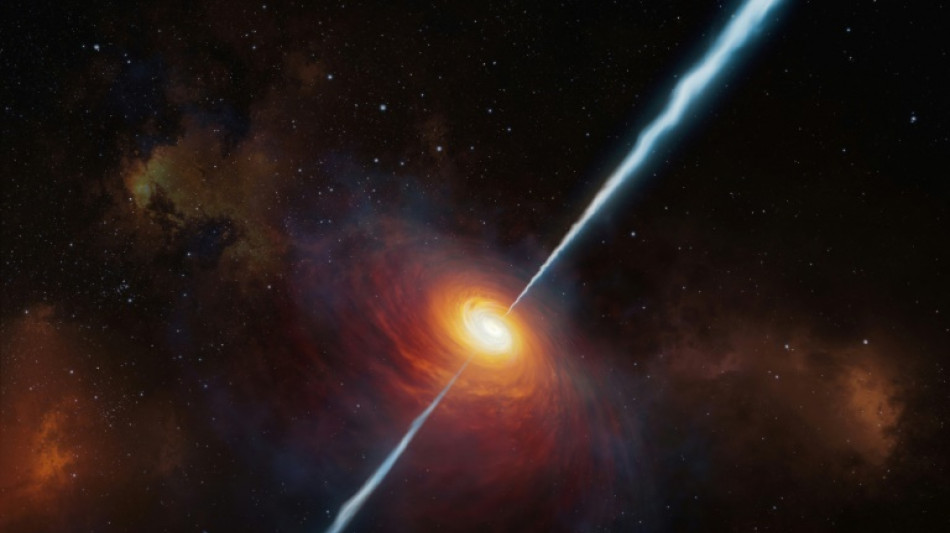
Milky Way's fate? Astronomers reveal what ignites quasars / Photo: M. KORNMESSER - European Southern Observatory/AFP

Milky Way's fate? Astronomers reveal what ignites quasars

Astronomers said Wednesday that for the first time they have confirmed what ignites quasars, the brightest and most powerful objects in the universe, which put galaxies in their "death throes".

Text size:

These celestial behemoths form when two galaxies smash into each other, the astronomers said, warning that this could be the Milky Way's fate in a few billion years.

Quasars are one of the most extreme objects in the universe, some shining with the brightness of a trillion stars despite being packed into the space of our Solar System.

They sit in the heart of galaxies, powered by supermassive black holes, requiring a huge amount of gas to be so staggeringly bright.

But exactly what creates quasars has been a matter of debate since their discovery in the 1950s.

In a new study, an international team of researchers said they have "clear evidence" that quasars are triggered by two galaxies colliding, which releases the vast amounts of energy needed.

Clive Tadhunter, an astrophysicist at the University of Sheffield in the UK and one of the study's authors, told AFP that this could be the fate of the Milky Way one day.

The nearby Andromeda Galaxy is "coming directly towards us at about 200 kilometres (125 miles) a second," he said.

It will collide with the Milky War in roughly five billion years, and "we could get a quasar" as a result, he said.

Quasars push out all the gas from a galaxy, preventing any new stars from forming, he added.

- 'Beacons to the distant universe' -

The researchers compared observations of 48 galaxies with quasars at their centre to 100 without them.

Galaxies hosting quasars were three times as likely to have had collisions with other galaxies, the study said.

While the theory that such collisions ignited quasars has been around for decades, it was difficult to prove.

Tadhunter said this was because observations had often been carried out with telescopes that were optimised to look at objects in the centre of galaxies, but were less effective at spotting the distorted features at their edges that indicate past collisions.

For example, these diffuse structures "get washed out" when observed by the Hubble Space Telescope, he said.

So the team used land-based observatories, such as the Isaac Newton Telescope on the Spanish island of La Palma.

The new study, published in the Monthly Notices of the Royal Astronomical Society, also reviewed previous research to show how it may have missed the tell-tale signs of collisions.

Tadhunter said that quasars "act like beacons to the distant universe" because of their incredible brightness.

The James Webb Space Telescope, which has a much bigger aperture than Hubble, could help reveal more about quasars in this distant universe, when the universe was in its infancy, he said.

(L.Kaufmann--BBZ)