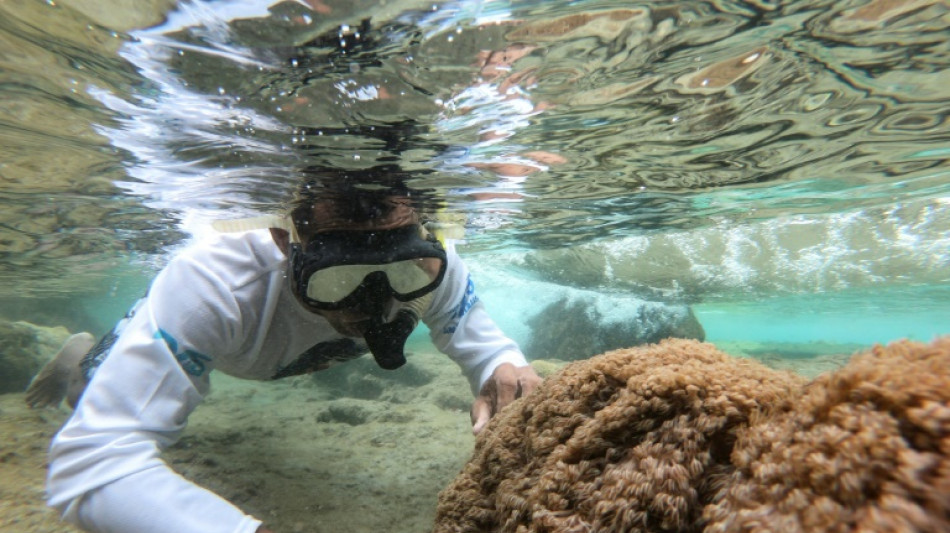
Deadly invader devastating Venezuelan coral reefs / Photo: Yuri CORTEZ - AFP

An ominous shadow in the turquoise Caribbean waters off Venezuela comes from a deadly intruder -- a soft coral that experts say has caused one of the most destructive habitat invasions on record anywhere.
The Unomia stolonifera, native to Indonesia and the Indo-Pacific, is a pinkish type of pulse coral so called for its dance-like movements in the ocean currents.
It is a popular aquarium ornament -- pretty to look at and hardy -- with a single polyp fetching as much as $80 to $120.
But it is also a killer -- settling on native hard corals, rocks and even seagrass which it suffocates and replaces, ultimately destroying entire ecosystems.
Off Venezuela's north coast, Unomia dominates the ocean floor landscape after being introduced through the illegal aquarium trade around 20 years ago.
"This is an ecological catastrophe," said marine biologist Juan Pedro Ruiz-Allais, director of Project Unomia, named after the invader he has spent years investigating.
Fish stocks are drastically decreasing in the waters off Venezuela as native reefs, which serve as nurseries and feeding grounds, die off, he told AFP.
"When the reef dies, when it is covered by the Unomia stolonifera, a disruption of the food chain occurs," said the biologist.
"It is a social, food security, and economic problem because the livelihood of fishermen is compromised."
- 'Nobody knew' -
When Ruiz-Allais first came across the invader in 2007, it was an unknown species in the Caribbean and even the Atlantic, he recalled. "Nobody knew what it was."
It was first spotted in the Mochima National Park, a gorgeous archipelago covering more than 94,000 hectares, and has since been found to have colonized most of those islands.
The first scientific report was published in 2014, and the coral was initially classified as a member of the broad Xeniidae family before it was finally categorized in 2021 as Unomia stolonifera.
From Mochima, it has spread west and east in the Caribbean Sea.
Off the northern state of Anzoategui, it has taken over the equivalent of 300 football stadiums.
The coral is spread by fishing nets, anchors, and ship ballast water.
"It is a great colonizer," Gustavo Carrasquel, director of the Azul Ambientalistas, an environmental NGO, told AFP.
- 'Unprecedented' -
The threat extends beyond Venezuela's borders: officials say Unomia traces have been found near the islands of Aruba and Curacao, and in waters off Colombia and Brazil -- where it became attached to an oil rig but was controlled.
"It is a problem that will affect the rest of the Caribbean," said Ruiz-Allais.
But nowhere has it been more destructive than in Venezuela.
"It is an unprecedented case," said Project Unomia coordinator Mariano Onoro.
Fishermen and tour operators, concerned about the invasive coral's rapid propagation, have resorted to manual extraction.
But experts say this is not advised, because broken-off fragments are transported by the tides, settling to create yet more colonies.
The privately funded Project Unomia has developed an extraction machine with a group of engineers that is awaiting government approval for testing.
Venezuela's Institute for Scientific Research and the ministry of eco-socialism have launched an investigation into the coral's rapid spread but have yet to come up with a solution.
For now, the magnitude of the problem is such that the invader's elimination appears impossible.
"What we can do is recover some areas and control it," said Onoro.
(S.G.Stein--BBZ)