Berliner Boersenzeitung - Mars once had wet-dry climate conducive to supporting life: study

EUR -
AED 4.401854
AFN 77.897256
ALL 96.833701
AMD 453.488183
ANG 2.145273
AOA 1098.954337
ARS 1729.081733
AUD 1.717911
AWG 2.15866
AZN 2.040433
BAM 1.967924
BBD 2.410672
BDT 146.262316
BGN 2.012596
BHD 0.451741
BIF 3559.317113
BMD 1.198423
BND 1.51589
BOB 8.270852
BRL 6.245461
BSD 1.196884
BTN 109.783816
BWP 15.753184
BYN 3.410526
BYR 23489.096101
BZD 2.407251
CAD 1.629915
CDF 2684.467728
CHF 0.918076
CLF 0.026087
CLP 1030.047915
CNY 8.334614
CNH 8.319005
COP 4402.875269
CRC 594.668609
CUC 1.198423
CUP 31.758217
CVE 110.793941
CZK 24.250068
DJF 212.983927
DKK 7.467255
DOP 75.441109
DZD 154.838707
EGP 56.32577
ERN 17.976349
ETB 185.75505
FJD 2.638029
FKP 0.875018
GBP 0.869277
GEL 3.229785
GGP 0.875018
GHS 13.10474
GIP 0.875018
GMD 87.484534
GNF 10486.203264
GTQ 9.183655
GYD 250.410645
HKD 9.3486
HNL 31.710475
HRK 7.538203
HTG 156.968364
HUF 380.014633
IDR 20012.470194
ILS 3.722842
IMP 0.875018
INR 109.714872
IQD 1569.934484
IRR 50483.580457
ISK 145.296991
JEP 0.875018
JMD 188.048533
JOD 0.849674
JPY 182.912353
KES 154.872094
KGS 104.8009
KHR 4830.844578
KMF 493.750766
KPW 1078.604207
KRW 1722.583589
KWD 0.36696
KYD 0.997445
KZT 602.997475
LAK 25817.036779
LBP 102525.11035
LKR 370.616394
LRD 222.24754
LSL 19.126971
LTL 3.538632
LVL 0.724915
LYD 7.579969
MAD 10.851761
MDL 20.180327
MGA 5362.944187
MKD 61.664206
MMK 2516.748037
MNT 4272.540069
MOP 9.617632
MRU 47.793202
MUR 54.551915
MVR 18.515755
MWK 2080.462606
MXN 20.660008
MYR 4.735568
MZN 76.411323
NAD 19.12714
NGN 1687.955172
NIO 43.98542
NOK 11.521264
NPR 175.654642
NZD 1.992241
OMR 0.460804
PAB 1.196864
PEN 4.010525
PGK 5.10172
PHP 70.626078
PKR 335.259502
PLN 4.197765
PYG 8022.492074
QAR 4.363467
RON 5.096534
RSD 117.411955
RUB 91.863782
RWF 1740.110589
SAR 4.4941
SBD 9.680475
SCR 16.921881
SDG 720.847311
SEK 10.55304
SGD 1.512938
SHP 0.899128
SLE 29.124591
SLL 25130.335892
SOS 684.955658
SRD 45.895983
STD 24804.942092
STN 24.687519
SVC 10.472563
SYP 13254.051915
SZL 19.126646
THB 37.171467
TJS 11.179126
TMT 4.194481
TND 3.392135
TOP 2.885515
TRY 52.012492
TTD 8.139212
TWD 37.57956
TZS 3061.041504
UAH 51.378175
UGX 4273.36308
USD 1.198423
UYU 44.84629
UZS 14530.882075
VES 429.60616
VND 31319.59375
VUV 143.507965
WST 3.270848
XAF 660.03991
XAG 0.011307
XAU 0.000236
XCD 3.238799
XCG 2.157108
XDR 0.823023
XOF 662.125411
XPF 119.331742
YER 285.707797
ZAR 19.153443
ZMK 10787.225649
ZMW 23.632299
ZWL 385.891804
  • SCS

    0.0200

    16.14

    +0.12%

  • CMSC

    -0.0496

    23.73

    -0.21%

  • RBGPF

    -0.8300

    82.4

    -1.01%

  • BCC

    -2.0500

    81.35

    -2.52%

  • BCE

    0.2800

    25.43

    +1.1%

  • RYCEF

    0.1500

    17.15

    +0.87%

  • RIO

    1.8600

    92.33

    +2.01%

  • RELX

    -1.4200

    38.09

    -3.73%

  • GSK

    0.6100

    50.93

    +1.2%

  • JRI

    -0.0400

    13.69

    -0.29%

  • NGG

    1.5650

    84.145

    +1.86%

  • CMSD

    -0.0800

    24.08

    -0.33%

  • BTI

    1.1300

    60.12

    +1.88%

  • VOD

    0.2250

    14.455

    +1.56%

  • BP

    0.6250

    37.385

    +1.67%

  • AZN

    1.1350

    95.365

    +1.19%

Mars once had wet-dry climate conducive to supporting life: study
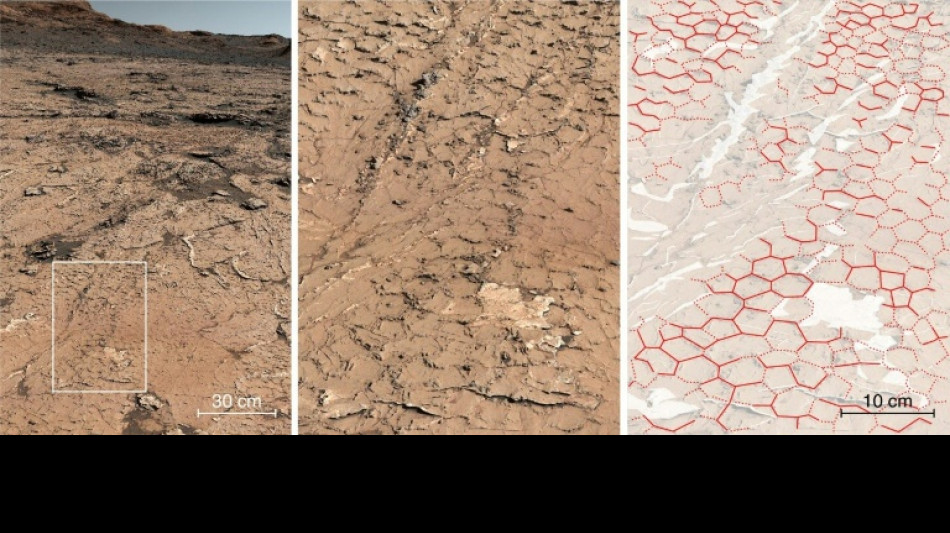
Mars once had wet-dry climate conducive to supporting life: study / Photo: Handout - NASA/JPL-Caltech/MSSS/IRAP/Rapin et al./Nature/AFP

Mars once had wet-dry climate conducive to supporting life: study

NASA's Curiosity rover has discovered the first evidence that Mars once had a climate which alternated between wet and dry seasons similar to Earth, a study said on Wednesday, suggesting the red planet may have once had the right conditions to support life.

Text size:

Though the surface of Mars is now an arid desert, billions of years ago rivers and vast lakes are thought to have stretched across its surface.

Since 2012, the Curiosity rover has been exploring the huge Gale crater, which is believed to be home of a former lake and has a massive mountain of sediment nearly six kilometres (four miles) high in its centre.

"We quickly realised that we were working in lakes and rivers deposits, but did not know what type of climate they were linked to," William Rapin, a researcher at France's CNRS scientific research centre and the study's lead author, told AFP.

While climbing the slope of the sediment mountain in 2021, Curiosity found salt deposits forming a hexagonal pattern in soil dated to nearly four billion years ago.

The rover's instruments identified the patterns as cracks in dried mud, according to the study published in the journal Nature.

"When a lake dries up the mud cracks, and when it fills back up, the cracks heal," Rapin explained.

Repeat this process enough times, and the cracks arrange themselves in hexagons.

Therefore, this is "the first tangible proof that Mars had a cyclical climate," Rapin said.

Regularly occurring wet and dry seasons, as on Earth, could have provided the conditions needed for life to form, the researchers said.

- 'Pretty lucky' -

Curiosity has already detected the presence of organic compounds considered the building blocks of life on Mars, which could be another piece of the puzzle.

But these building blocks need the right conditions to become the precursors of life.

"In a world that's too dry, these molecules never have the opportunity to form -- nor do they in a world that's too wet," Rapin said.

But banish thoughts of big-headed green men -- if Mars did support life, it was likely primitive single-celled microorganisms.

"Over 11 years, we've found ample evidence that ancient Mars could have supported microbial life" due to the Curiosity rover, said Ashwin Vasavada of NASA's Jet Propulsion Laboratory.

"Now, the mission has found evidence of conditions that may have promoted the origin of life, too," he said in a statement.

The discovery of such ancient terrain could never have been possible on Earth, where tectonic plates constantly reshuffle the surface, sifting away such lingering traces of the past.

That means that studying Mars -- which lacks tectonic plates -- could help scientists solve the mystery of how life began on our home planet.

"It's pretty lucky of us to have a planet like Mars nearby that still holds a memory of the natural processes which may have led to life," Rapin said.

(A.Berg--BBZ)