NASA readies for dramatic return of asteroid sample to Earth / Photo: Jason Connolly - AFP/File

The climactic end of a seven-year voyage comes Sunday when a NASA capsule is due to land in the Utah desert, carrying to Earth the largest asteroid samples ever collected.
Scientists have high hopes for the sample, saying it will provide a better understanding of the formation of our solar system and how Earth became habitable.
The Osiris-Rex probe's final, fiery descent through Earth's atmosphere will be perilous, but the US space agency is hoping for a soft landing, around 9:00am local (15H00 GMT), in a military test range in northwestern Utah.
Four years after its 2016 launch, the probe landed on the asteroid Bennu and collected roughly nine ounces (250 grams) of dust from its rocky surface.
Even that small amount, NASA says, should "help us better understand the types of asteroids that could threaten Earth" and cast light "on the earliest history of our solar system," NASA Administrator Bill Nelson said.
"This sample return is really historic," NASA scientist Amy Simon told AFP. "This is going to be the biggest sample we've brought back since the Apollo moon rocks" were returned to Earth.
But the capsule's return will require "a dangerous maneuver," she acknowledged.
Osiris-Rex is set to release the capsule -- from an altitude of more than 67,000 miles (108,000 kilometers) -- some four hours before it lands.
The fiery passage through the atmosphere will come only in the last 13 minutes, as the capsule hurtles downward at a speed of more than 27,000 miles per hour, with temperatures of up to 5,000 Fahrenheit (2,760 Celsius).
Its rapid descent, monitored by army sensors, will be slowed by two successive parachutes. Should they fail to deploy correctly, a "hard landing" would follow.
If it appears that the target zone (37 by 9 miles) might be missed, NASA controllers could decide at the last moment not to release the capsule.
The probe would then keep its cargo and make another orbit of the sun. Scientists would have to wait until 2025 before trying a new landing.
If it succeeds, however, Osiris-Rex would head toward a date with another asteroid.
- Japanese samples -
Once the tire-sized capsule touches down in Utah, a team in protective masks and gloves will place it in a net to be airlifted by helicopter to a temporary "clean room" nearby.
NASA wants this done as quickly and carefully as possible to avoid any contamination of the sample with desert sands, skewing test results.
On Monday, assuming all goes well, the sample will be flown by plane to NASA's Johnson Space Center in Houston, Texas. There, the box will be opened in another "clean room" -- the beginning of a days-long process.
NASA plans to announce its first results at a news conference October 11.
Most of the sample will be conserved for study by future generations. Roughly one-fourth of it will be immediately used in experiments, and a small amount will be sent to Japan and Canada, partners in the mission.
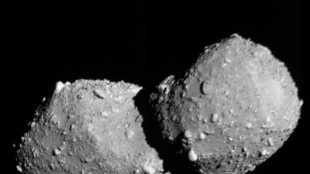
Japan had earlier given NASA a few grains from the asteroid Ryugu, after bringing 0.2 ounce of dust to Earth in 2020 during the Hayabusa-2 mission. Ten years before, it had brought back a microscopic quantity from another asteroid.
But the sample from Bennu is much larger, allowing for significantly more testing, Simon said.
- Earth's origin story -
Asteroids are composed of the original materials of the solar system, dating to some 4.5 billion years ago, and have remained relatively intact.
They "can give us clues about how the solar system formed and evolved," said Osiris-Rex program executive Melissa Morris.
"It's our own origin story."
By striking Earth's surface, "we do believe asteroids and comets delivered organic material, potentially water, that helped life flourish here on Earth," Simon said.
Scientists believe Bennu, which is 1,640 feet in diameter, is rich in carbon -- a building block of life on Earth -- and contains water molecules locked in minerals.
Bennu had surprised scientists in 2020 when the probe, during the few seconds of contact with the asteroid's surface, had sunk into the soil, revealing an unexpectedly low density, sort of like a children's pool filled with plastic balls.
Understanding its composition could come in handy in the -- distant -- future.
For there is a slight, but non-zero, chance (one in 2,700) that Bennu could collide catastrophically with Earth, though not until 2182.
But NASA last year succeeded in deviating the course of an asteroid by crashing a probe into it in a test, and it might at some point need to repeat that exercise -- but with much higher stakes.
(U.Gruber--BBZ)