Berliner Boersenzeitung - Western Hemisphere readies for a 'Ring of Fire' eclipse

EUR -
AED 4.225097
AFN 74.780434
ALL 93.330801
AMD 421.407279
AOA 1054.980993
ARS 1718.813836
AUD 1.638566
AWG 2.073722
AZN 1.931279
BAM 1.955834
BBD 2.32072
BDT 142.282458
BHD 0.434502
BIF 3409.003329
BMD 1.15047
BND 1.477745
BOB 14.028242
BRL 5.85509
BSD 1.15222
BTN 109.797896
BWP 15.671134
BYN 3.368229
BYR 22549.209477
BZD 2.31742
CAD 1.615329
CDF 2602.362517
CHF 0.932312
CLF 0.026952
CLP 1064.196427
CNY 7.768668
CNH 7.770308
COP 3732.296833
CRC 523.402216
CUC 1.15047
CUP 30.487452
CVE 110.266905
CZK 24.201687
DJF 205.183544
DKK 7.475425
DOP 66.840283
DZD 152.991799
EGP 57.937756
ERN 17.257048
ETB 185.975987
FJD 2.54875
FKP 0.856378
GBP 0.856208
GEL 3.002944
GGP 0.856378
GHS 13.464233
GIP 0.856378
GMD 85.134534
GNF 10118.174765
GTQ 8.791152
GYD 241.44417
HKD 9.022848
HNL 30.884131
HRK 7.532242
HTG 150.654566
HUF 363.935611
IDR 20734.91849
ILS 3.498723
IMP 0.856378
INR 109.718701
IQD 1509.412951
IRR 1582183.690469
ISK 142.002458
JEP 0.856378
JMD 182.520773
JOD 0.81571
JPY 181.706937
KES 148.912056
KGS 100.608301
KHR 4656.14113
KMF 492.40131
KRW 1648.634626
KWD 0.356059
KYD 0.960208
KZT 546.57469
LAK 26060.450125
LBP 103186.685366
LKR 386.866682
LRD 207.983592
LSL 19.003028
LTL 3.397038
LVL 0.695907
LYD 7.344127
MAD 10.743586
MDL 20.118347
MGA 4908.020781
MKD 61.526063
MMK 2415.603091
MNT 4123.628378
MOP 9.30728
MRU 46.147195
MUR 54.118279
MVR 17.774842
MWK 1998.00846
MXN 19.907397
MYR 4.712444
MZN 73.518045
NAD 19.002863
NGN 1569.229406
NIO 42.400732
NOK 10.949481
NPR 175.674744
NZD 1.960268
OMR 0.442354
PAB 1.15222
PEN 3.891667
PGK 5.085022
PHP 70.445586
PKR 319.946845
PLN 4.313485
PYG 6873.118715
QAR 4.200473
RON 5.246722
RSD 117.351337
RUB 93.072594
RWF 1689.707155
SAR 4.307508
SBD 9.285622
SCR 15.444045
SDG 690.281641
SEK 11.011774
SGD 1.477163
SLE 28.128442
SOS 658.502788
SRD 43.494652
STD 23812.403546
STN 24.500104
SVC 10.082087
SZL 19.006163
THB 38.482636
TJS 10.640984
TMT 4.026645
TND 3.381158
TRY 54.715507
TTD 7.813067
TWD 37.331651
TZS 3045.866681
UAH 51.685019
UGX 4312.07448
USD 1.15047
UYU 46.3408
UZS 13815.118537
VES 860.380507
VND 30217.666405
VUV 137.071361
WST 3.143332
XAF 655.959777
XAG 0.019614
XAU 0.000284
XCD 3.109202
XCG 2.076618
XDR 0.815807
XOF 655.96833
XPF 119.331742
YER 274.316386
ZAR 19.011457
ZMK 10355.61139
ZMW 21.654186
ZWL 370.450829
  • CMSC

    -0.0800

    21.76

    -0.37%

  • RIO

    -0.9500

    95.9

    -0.99%

  • BTI

    -1.0900

    59.56

    -1.83%

  • BCE

    0.1100

    21.79

    +0.5%

  • CMSD

    -0.0900

    22.02

    -0.41%

  • JRI

    -0.1400

    12.82

    -1.09%

  • NGG

    -0.1100

    79.86

    -0.14%

  • GSK

    -0.1800

    51.51

    -0.35%

  • BCC

    6.6500

    83.03

    +8.01%

  • BP

    -0.9600

    44.26

    -2.17%

  • RBGPF

    1.7800

    70.99

    +2.51%

  • AZN

    -11.6700

    157.97

    -7.39%

  • RYCEF

    0.6500

    20.2

    +3.22%

  • VOD

    -0.1700

    15.61

    -1.09%

  • RELX

    0.7400

    36.16

    +2.05%

Western Hemisphere readies for a 'Ring of Fire' eclipse
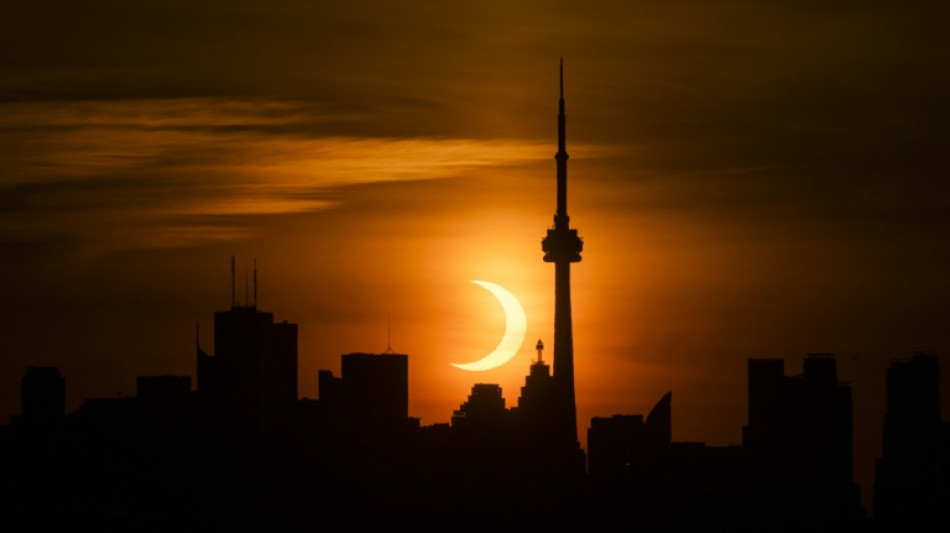
Western Hemisphere readies for a 'Ring of Fire' eclipse / Photo: MARK BLINCH - GETTY IMAGES NORTH AMERICA/AFP/File

Western Hemisphere readies for a 'Ring of Fire' eclipse

Skygazers across the Americas are in for a celestial treat on Saturday: an annular solar eclipse.

Text size:

These occur when the Moon passes between the Sun and Earth at its furthest point from our planet. Since it is so distant, it doesn't cover the Sun completely, creating a "ring of fire" effect.

In the United States, the most striking "path of the annularity" will cross a handful of major cities, including Eugene, Oregon, Alburquerque, New Mexico, and San Antonio, Texas, between 9:15 am to 11:50 am in local time zones, according to NASA, with partial eclipse phases lasting an hour or two before and after.

At any given location, it will be visible from between 30 seconds and five minutes -- but people are urged to take safety precautions and use solar viewing glasses, and never regular sunglasses, to preserve their vision.

"Do NOT look at the Sun through a camera lens, telescope, binoculars, or any other optical device while wearing eclipse glasses or using a handheld solar viewer —- the concentrated solar rays will burn through the filter and cause serious eye injury," NASA says.

Next it will cross Mexico and Central America, then into South America through Colombia and northern Brazil before ending at sunset in the Atlantic Ocean.

For those not lucky enough to be in the path of this special astronomical transit, NASA is also planning a live broadcast on nasa.gov/nasatv/ from 11:30am to 1:15 pm eastern time (1530 to 1715 GMT) from Albuquerque, New Mexico, as well as Carville, Texas and White Sands New Mexico.

- Sounding rockets -

The event also serves as a dress rehearsal before a total eclipse set for April 2024.

Both eclipses are going to be "absolutely breathtaking for science," said Madhulika Guhathakurta, a heliophysics program scientist.

Solar eclipses have a noticeable effect on the upper atmosphere, such as the ionosphere which is full of charged particles and responsible for reflecting and refracting radio waves.

"Although the atmospheric effects of solar eclipses have been studied for over 50 years, many unanswered questions remain," said Guhathakurta.

To study these effects, NASA will launch three rockets from the White Sands Missile Range in New Mexico to gather data on the electric and magnetic fields, electron density, and temperature.

A total eclipse took place in 2017 in the United States. After next April's total eclipse, the next one will take place in 2044, while the next annular eclipse will be in 2046.

(P.Werner--BBZ)