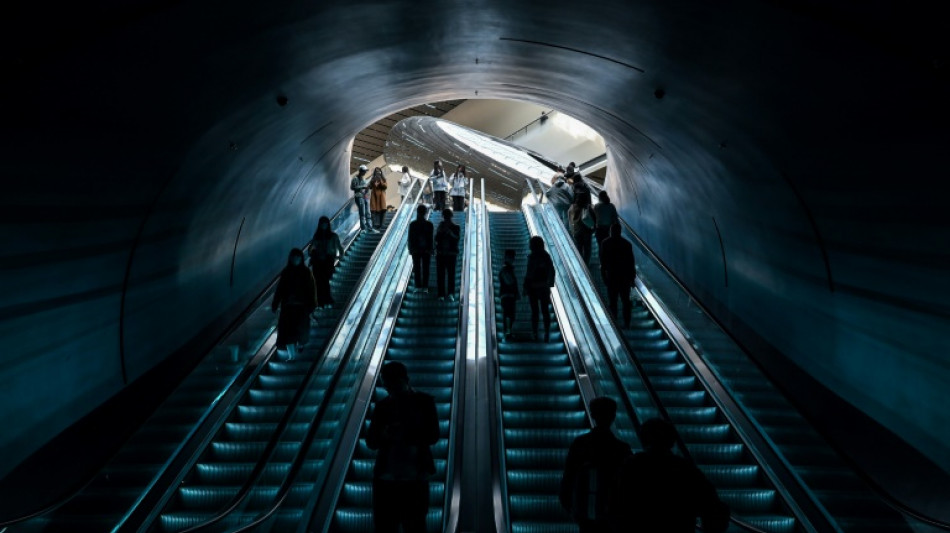
Chinese sci-fi steps into the spotlight / Photo: Hector RETAMAL - AFP

Once effectively banned, Chinese science fiction has exploded into the mainstream, embraced by the government and public alike –- inviting scrutiny of a genre that has become known for its expanding diversity and relative freedom.
Its new status was epitomised by this week's Worldcon, the world's oldest and most influential sci-fi gathering, which closed Sunday after taking place in China for the first time.
Held in the gleaming new Chengdu Science Fiction Museum, the event's star was Liu Cixin, author of the international phenomenon "Three-Body" series and inspiration for the domestic blockbuster "Wandering Earth".
But the wider science fiction fandom has become a rare space where diverse voices have flourished and a vast array of issues -- social, environmental, even sometimes political -- can be explored.
"In its nature, part of sci-fi is talking about the present," award-winning author Chen Qiufan told AFP.
"It takes advantage of talking about outer space, or being set in different times, but reflects the human condition right now."
Chen's own novel "The Waste Tide" is set in a dystopian future China, where migrant e-waste workers toil in hazardous conditions, exploited by corrupt conglomerates.
He grew up near Guiyu, once one of the largest e-waste dumps in the world.
Ecological destruction, urbanisation, social inequality, gender, corruption, to name just a few –- "these issues are intersectional and intertwined with each other", said Xi'an Jiaotong-Liverpool University's Liu Xi.
Together, they "allow everyone to understand Chinese writers' exploration of Chinese society", she said.
That can be rare to find in today's China, where the space for political and artistic expression has shrunk drastically over the last decade under President Xi Jinping.
- 'Spiritual pollution' -
Historically, science fiction has had a turbulent relationship with Chinese authorities -– it effectively disappeared during the Cultural Revolution and then was banned as "spiritual pollution" in the 1980s.
Though it returned, it remained relatively obscure.
Writer Regina Kanyu Wang said it was only at university that she met other fans -- together they formed one of the smaller clubs on campus.
Sci-fi was not taken seriously, and seen as something for children and young adults, Chen said.
That had its advantages.
"There was a lot of freedom... because nobody was reading science fiction, (authors) could just do whatever they wanted," the University of Zurich's Jessica Imbach told AFP.
The global success of the "Three-Body" series changed everything, catapulting its epic themes of technological prowess and the fate of humanity into the public consciousness.
"Whether you like science fiction or not, the social reality we are facing is becoming more and more like science fiction," said Yu Xuying from Hong Kong Metropolitan University.
"We live in a high-tech era. And then your daily life is completely technological," she said.
The pace of digital change in China, already fast, was accelerated by the Covid-19 pandemic.
Cash has all but disappeared, and stringent health regulations further enhanced the state's significant surveillance capacity.
The international interest spike in Chinese sci-fi is also related to real-world concerns, Chen believes.
"I think there are different layers of reasons for the phenomenon," he said.
"But a major one is the rising economic and technological power of China on the world stage."
- 'A good vehicle' -
China's government has been happy to capitalise on all this.
"At a national level, science fiction is a good vehicle for conveying the country's discourse on its science and technology strength," said Yu.
It can also help "highlight the relationship between the Chinese dream (a Xi-era aspirational slogan) and science", she said.
Authorities have put their money where their mouth is.
The nebula-shaped Chengdu Science Fiction Museum, designed by the renowned Zaha Hadid Architects, was built at lightspeed in just a year to coincide with Worldcon.
The event, historically fan-led and funded, this year was a "capitalistic initiative, coming top-down from the Chinese government", said Chen.
"They want sci-fi to be the namecard of the city, showing China's openness and inclusiveness to the world," he said.
Government attention comes with potential risk.
"The Three-Body Problem" has a different structure in English, with the narrative beginning with a violent Cultural Revolution scene.
In the original Chinese, it was buried halfway through the book to make it less conspicuous, the translator Ken Liu was told.
Liu told the New York Times in 2019 that increasingly, "it's gotten much harder for me to talk about the work of Chinese authors without... causing them trouble".
Some works he has translated into English, deemed too sensitive, have never been published in Chinese at all.
"If you're very marginal, if you have low print numbers in China, then it's OK, you have more leeway. If you're doing a mega big-budget movie... it's much more complicated," said Imbach.
"That's what's now also happening with science fiction," she said.
"As it's becoming more mainstream, there is increased scrutiny."
(S.G.Stein--BBZ)