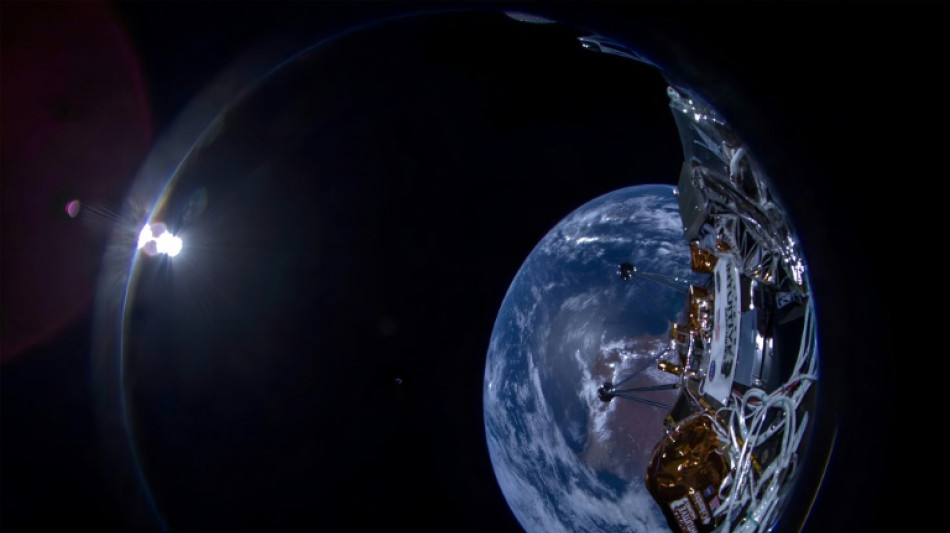
Commercial spaceship set for lunar touchdown, in test for US industry / Photo: Handout - Intuitive Machines/AFP

A company from Texas is poised to attempt a feat that until now has only been accomplished by a handful of national space agencies, but could soon become commonplace for the private sector: landing on the Moon.
If all goes to plan, Houston-based Intuitive Machines will guide its spaceship named Odysseus to a gentle touchdown near the lunar south pole on Thursday at 2249 GMT, then run experiments for NASA that will help pave the way for the return of astronauts later this decade.
A previous effort by another US company last month ended in failure, raising the stakes to demonstrate private industry has what it takes to put an American lander on Earth's cosmic companion for the first time since the Apollo era.
"Accepting risk was a challenge posed by the United States to the commercial business sector," Intuitive Machines CEO Steve Altemus said ahead of launch. "Our collective aim is to return to the Moon for the first time in 52 years."
The company plans to run a live stream on its website, with flight controllers expected to confirm landing around 15 seconds after the milestone is achieved, because of the time it takes for radio signals to return.
As it approaches the surface, Odysseus will shoot out an external "EagleCam" that captures images of the lander in the final seconds of its descent.
- Studying lunar haze -
About the size of a big golf cart, Odysseus is hexagon shaped and stands on six legs.
It launched on February 15 atop a SpaceX Falcon 9 rocket, and boasts a new type of supercooled liquid oxygen, liquid methane propulsion system that allowed it to race through space in quick time, snapping pictures of our planet along the way.
Its destination, Malapert A, is an impact crater 300 kilometers (180 miles) from the lunar south pole.
NASA hopes to eventually build a long-term presence and harvest ice there for both drinking water and rocket fuel under Artemis, its flagship Moon-to-Mars program.
The US space agency paid Intuitive Machines $118 million to ship science hardware to better understand and mitigate environmental risks for astronauts, the first of whom are scheduled to land no sooner than 2026.
Instruments include cameras to investigate how the lunar surface changes as a result of the engine plume from a spaceship, and a device to analyze clouds of charged dust particles that hang over the surface at twilight as a result of solar radiation.
- Mini Moons -
The rest of the cargo was paid for by Intuitive Machines' private clients, and includes 125 stainless steel mini Moons by the artist Jeff Koons.
After touchdown, the experiments are expected to run for roughly seven days before lunar night sets in on the south pole, with the lack of solar power rendering Odysseus inoperable.
Dubbed IM-1, the mission is the second under a NASA initiative called Commercial Lunar Payload Services (CLPS), which it created to delegate cargo services to the private sector to achieve savings and stimulate a wider lunar economy.
Four more CLPS launches are expected this year, which would make 2024 among the busiest ever for Moon landings.
The first, by Pittsburgh-based Astrobotic, launched in January, but its Peregrine spacecraft sprung a fuel leak and it was eventually brought back to burn up in Earth's atmosphere.
Spaceships landing on the Moon have to navigate treacherous boulders and craters and, absent an atmosphere to support parachutes, must rely on thrusters to control their descent. Roughly half of the more than 50 attempts have failed.
The Soviet Union was the first country to achieve a survivable landing on a celestial body when its Luna 9 spaceship touched down and transmitted pictures back from the Moon in February 1966.
Next came the United States, which is still the only country to also put people on the surface.
In America's long absence, China has landed three times since 2013. India reached the Moon in 2023, and Japan was the latest, last month.
(K.Müller--BBZ)