Berliner Boersenzeitung - Space station crew splash down in Gulf of Mexico

EUR -
AED 4.417216
AFN 78.16954
ALL 97.184693
AMD 455.072331
ANG 2.152767
AOA 1102.79295
ARS 1734.892031
AUD 1.716493
AWG 2.166201
AZN 2.044165
BAM 1.974798
BBD 2.419093
BDT 146.773247
BGN 2.019627
BHD 0.453417
BIF 3571.750699
BMD 1.20261
BND 1.521185
BOB 8.299744
BRL 6.242624
BSD 1.201065
BTN 110.167319
BWP 15.808214
BYN 3.42244
BYR 23571.149394
BZD 2.41566
CAD 1.63386
CDF 2693.845366
CHF 0.917303
CLF 0.026185
CLP 1033.931299
CNY 8.363729
CNH 8.336965
COP 4396.139623
CRC 596.745935
CUC 1.20261
CUP 31.869156
CVE 111.181554
CZK 24.227814
DJF 213.727287
DKK 7.467346
DOP 75.704577
DZD 155.380836
EGP 56.53083
ERN 18.039145
ETB 186.404516
FJD 2.64027
FKP 0.878074
GBP 0.869493
GEL 3.241077
GGP 0.878074
GHS 13.15052
GIP 0.878074
GMD 87.79105
GNF 10522.835072
GTQ 9.215736
GYD 251.285393
HKD 9.382171
HNL 31.821034
HRK 7.538556
HTG 157.516693
HUF 379.829849
IDR 20088.512071
ILS 3.735846
IMP 0.878074
INR 110.040583
IQD 1575.418658
IRR 50659.932242
ISK 145.215164
JEP 0.878074
JMD 188.705434
JOD 0.852681
JPY 183.245847
KES 155.413805
KGS 105.166995
KHR 4847.719246
KMF 495.47487
KPW 1082.372041
KRW 1720.675882
KWD 0.367987
KYD 1.000929
KZT 605.103896
LAK 25907.220363
LBP 102883.256592
LKR 371.911049
LRD 223.023597
LSL 19.193309
LTL 3.550993
LVL 0.727446
LYD 7.606478
MAD 10.889666
MDL 20.250822
MGA 5381.678534
MKD 61.877841
MMK 2525.539668
MNT 4287.465121
MOP 9.651229
MRU 47.960233
MUR 54.742595
MVR 18.580395
MWK 2087.730185
MXN 20.64971
MYR 4.752114
MZN 76.678295
NAD 19.19389
NGN 1693.491105
NIO 44.137978
NOK 11.532474
NPR 176.268248
NZD 1.99086
OMR 0.462426
PAB 1.201045
PEN 4.024532
PGK 5.119514
PHP 70.59797
PKR 336.430158
PLN 4.199008
PYG 8050.516648
QAR 4.378696
RON 5.09413
RSD 117.386704
RUB 92.200458
RWF 1746.189231
SAR 4.509597
SBD 9.714291
SCR 16.980843
SDG 723.368311
SEK 10.569778
SGD 1.515944
SHP 0.902269
SLE 29.221206
SLL 25218.122446
SOS 687.292439
SRD 46.056353
STD 24891.591964
STN 24.773759
SVC 10.509147
SYP 13300.351637
SZL 19.193643
THB 37.173272
TJS 11.218177
TMT 4.209134
TND 3.403989
TOP 2.895595
TRY 52.195305
TTD 8.167644
TWD 37.591533
TZS 3071.734468
UAH 51.557652
UGX 4288.291007
USD 1.20261
UYU 45.002949
UZS 14581.64198
VES 431.106882
VND 31429.000932
VUV 144.009275
WST 3.282274
XAF 662.345595
XAG 0.010722
XAU 0.000232
XCD 3.250113
XCG 2.164643
XDR 0.825899
XOF 664.436686
XPF 119.331742
YER 286.706838
ZAR 19.142214
ZMK 10824.938816
ZMW 23.714852
ZWL 387.239821
  • RBGPF

    -0.8300

    82.4

    -1.01%

  • SCS

    0.0200

    16.14

    +0.12%

  • CMSD

    -0.0630

    24.097

    -0.26%

  • CMSC

    0.0200

    23.8

    +0.08%

  • BCC

    -1.6600

    81.74

    -2.03%

  • GSK

    0.4800

    50.8

    +0.94%

  • AZN

    1.3700

    95.6

    +1.43%

  • BTI

    1.3500

    60.34

    +2.24%

  • RYCEF

    0.1500

    17.15

    +0.87%

  • RIO

    2.4400

    92.91

    +2.63%

  • JRI

    -0.0500

    13.68

    -0.37%

  • BCE

    0.3700

    25.52

    +1.45%

  • RELX

    -1.1500

    38.36

    -3%

  • NGG

    1.7300

    84.31

    +2.05%

  • VOD

    0.2700

    14.5

    +1.86%

  • BP

    0.8600

    37.62

    +2.29%

Space station crew splash down in Gulf of Mexico
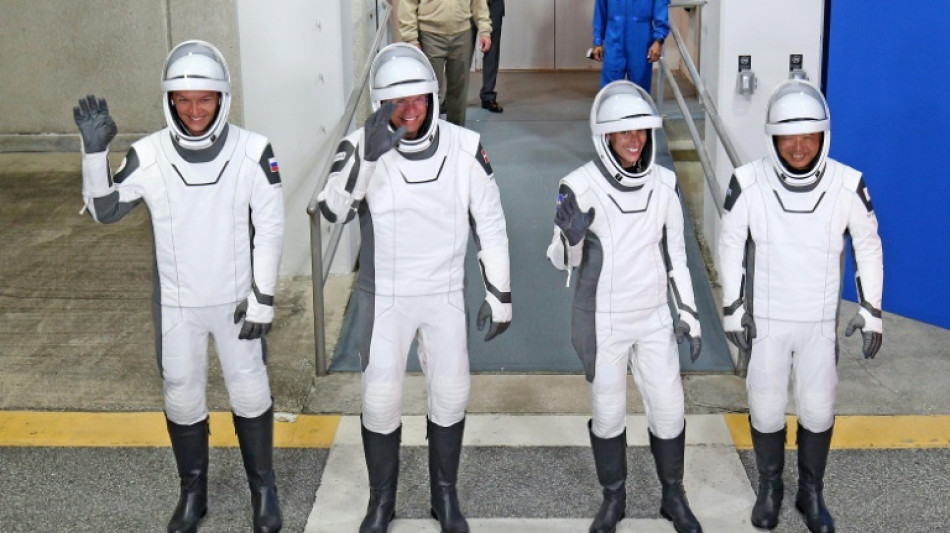
Space station crew splash down in Gulf of Mexico / Photo: Gregg Newton - AFP/File

Space station crew splash down in Gulf of Mexico

Four astronauts splashed down off Florida in the Gulf of Mexico on their return to Earth early Tuesday, following a more than six-month mission on the International Space Station.

Text size:

The SpaceX Crew Dragon spacecraft landed in the waters off Pensacola at 5:47 am (0947 GMT), with a NASA thermal camera showing all four of its drogue parachutes had deployed for the night-time landing after their 18-and-a-half-hour journey from the ISS.

Led by US astronaut Jasmin Moghbeli, who was making her first spaceflight, NASA's Crew-7 arrived at the research platform last August aboard the same SpaceX Crew Dragon that took them back to Earth.

Andreas Mogensen of Denmark, Satoshi Furukawa of Japan, and Russian cosmonaut Konstantin Borisov were also on board.

"It was great to see Crew-7 back home and well. What a way to start a morning," said NASA's Rebecca Turkington, who was on board the recovery vessel.

The capsule was retrieved from the sea less than half an hour after splashdown, with the crew waving to the recovery team as they opened the hatch.

Space remains a rare area of cooperation between the United States and Russia despite the invasion of Ukraine and Russian President Vladimir Putin's ambitions to reshape the global balance of power.

US astronauts also continue to fly aboard Russian Soyuz rockets that launch from Kazakhstan.

During a farewell ceremony on Sunday, Moghbeli paid tribute to the post-Cold War international partnership that paved the way for the construction of the ISS in the 1990s.

"It's an indication of what we can do when we work together," she said.

"To think back to when this was just a dream itself, and the people that had the vision, the grit and the courage to pursue this orbiting laboratory in low Earth orbit, I'm really proud to be a part of this."

The members of Crew-7 carried out science experiments including collecting samples during a spacewalk to determine whether the station releases microorganisms through life support system vents. Another assessed how microgravity, which accelerates aging, affects liver regeneration.

Crew-7 is the seventh routine NASA mission to the orbital platform for Elon Musk's SpaceX, with the first coming in 2020. The latest, Crew-8, launched on March 4.

NASA pays SpaceX for the taxi service as part of a US program put in place to reduce dependency on Russian rockets following the retirement of the space shuttle in 2011.

Boeing is the other contracted private partner, but its program has fallen behind. It now plans to fly its first crew in May.

The first segment of the ISS was launched in 1998, and it has been continuously inhabited by an international crew since 2001.

Its operations are set to continue until at least 2030, after which it will be decommissioned and crash into the ocean. Several private companies are working on commercial space stations to replace it, while China has already established its own orbital lab.

(H.Schneide--BBZ)